Key Takeaway
Mid-market AI gets built by ecosystems, not single vendors, and most ecosystems have strategy, distribution and platforms covered. The scarce layer is engineering that builds and runs the system after launch, and the partners who secure it will decide which AI projects reach production.
No single company builds a production AI system for a mid-sized client on its own. This article is for the partner side of those projects: advisory firm partners, agency leaders and alliance managers at platforms. It explains why production delivery is the layer most ecosystems are missing, and what to demand from a delivery partner.
Picture who’s actually involved when a mid-sized company puts an AI system into production. Not the press release version. The real one.
There’s usually an advisor who understands the business: an accounting or consulting firm that has sat in on board meetings for years and knows where the margin leaks. There’s a firm with the right to propose the project. That might be the same advisor, a digital agency or an IT services provider. There’s a platform the system will run on, often a cloud provider, an ERP (enterprise resource planning) system or a workflow tool the company already pays for. And somewhere there need to be engineers who can build the thing, connect it to messy internal systems, put it into production and keep it working after launch.
AI work in the mid-market gets built by ecosystems, not single vendors, and most ecosystems are missing the same piece. Strategy is well supplied. Distribution exists. Platforms are mature. The scarce layer is production delivery, and whoever fills it reliably will shape how the rest of the ecosystem makes money from AI.
Why can’t one company deliver an AI project alone?
Because every player is strong in one or two areas and structurally weak in the others. That isn’t a criticism. It’s how their businesses are built.
Advisory firms have domain access and trust. Their partners know the client’s finances, controls and regulatory exposure better than anyone. Their economics run on expert hours, and most aren’t set up to staff a software team that writes, tests and supports production code for years.
Agencies and IT services firms have distribution. They hold the relationship, the statement of work and the renewal conversation. Many have strong web, data or integration practices. Fewer have deep experience with model evaluation, retrieval design, agent orchestration and the operational work that keeps an AI system honest after go-live.
Platforms provide the foundation: compute, models, data services, workflow engines, marketplaces. Their partner programs exist because platforms don’t want to do custom delivery for thousands of mid-market accounts. They need others to turn their building blocks into working systems.
Engineering firms can build. On their own, they often lack the client trust and domain context that make a project worth building in the first place.
Put all four together and the client has everything it needs. Leave one out and the project stalls somewhere predictable.
What are the four roles in an AI delivery ecosystem?
Domain access, trusted distribution, a platform, and delivery that builds and runs the system. Each one comes from a different kind of firm, and each one breaks something specific when it’s missing.
| Role | What it contributes | Typically held by | What breaks without it |
|---|---|---|---|
| Domain access | Understanding of the client’s business, risks, regulations and data | Advisory firms, industry associations, vertical specialists | The system solves the wrong problem, or one nobody will pay to solve |
| Trusted distribution | The relationship, the right to propose, procurement access | Advisors, agencies, IT services firms, resellers | Good ideas never get bought |
| Platform | Infrastructure, models, data services, a place for the system to live | Cloud providers, ERP and workflow vendors, marketplaces | Every project reinvents the stack and costs too much to run |
| Delivery (build and run) | Engineering, integration, testing, deployment, monitoring, ongoing support | Specialist engineering teams, or the client’s own team if it has one | The roadmap gets approved and nothing reaches production |
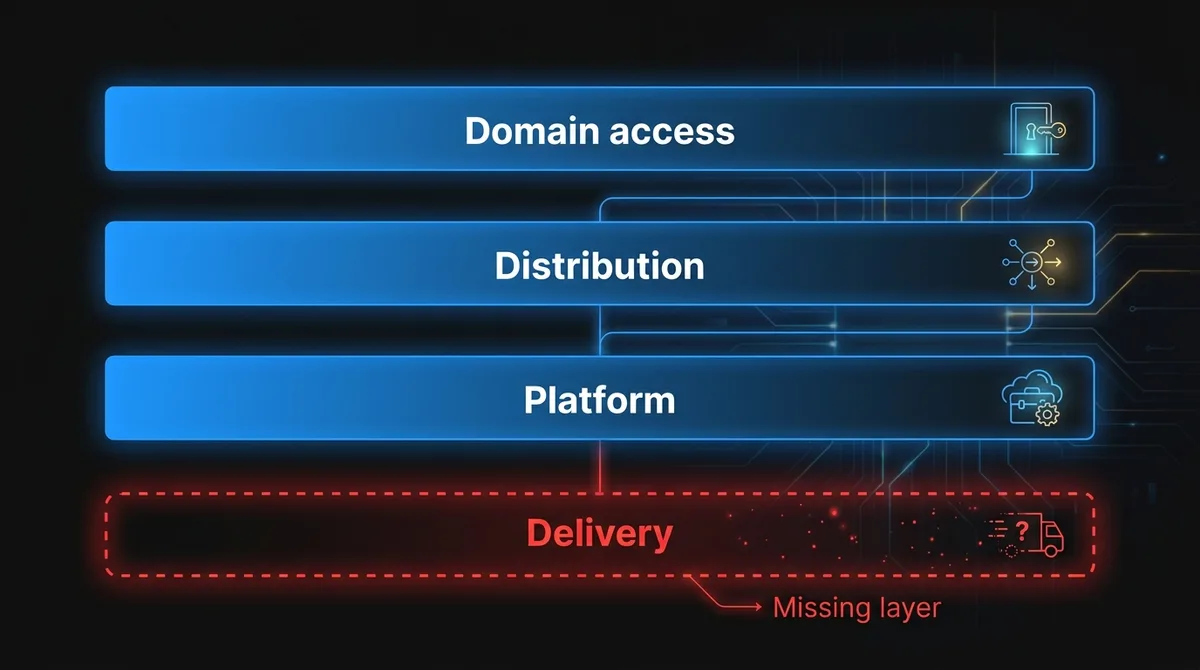
The last row is where most partner conversations get vague. Everyone agrees delivery matters. Few partner models say who does it, on whose contract, with what support commitment after launch.
Why is delivery the bottleneck for AI projects?
Three forces make delivery the scarce layer in AI work, more than in earlier technology waves: running the system costs more than building it, the skills are rare, and pilots don’t prove the production path.
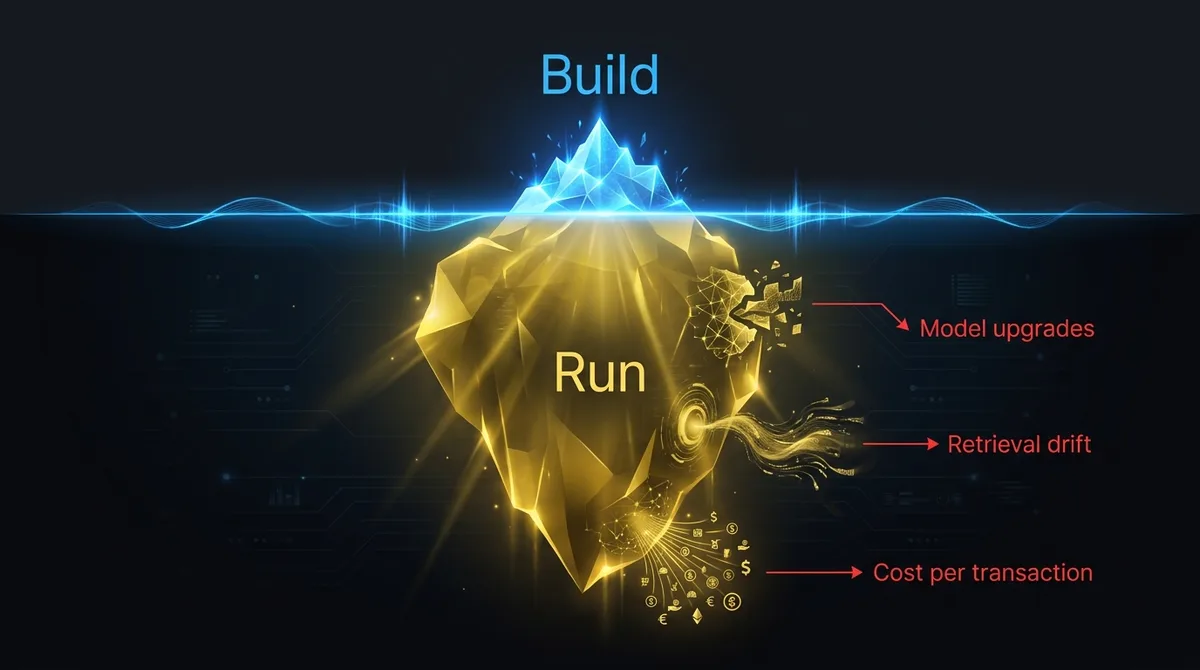
Why is running an AI system harder than building it?
Because an AI system never really reaches “done.” A traditional software project ships, passes acceptance testing, and maintenance shrinks to a small ongoing line item. AI systems don’t behave that way. Model providers ship new versions. Retrieval quality drifts as documents change. Agents that call tools can fail in new ways when an upstream API changes. Someone has to watch evaluation scores, review flagged outputs, manage cost per transaction and respond when behaviour changes.
That run work is continuous, technical and easy to leave out of the original proposal. When it’s missing, the client’s experience is “it worked for a few months, then it got worse.” That lands on whoever owns the relationship, not on whoever wrote the code. We’ve covered what that monitoring looks like in AI agent observability: what monitoring looks like in production.
Why are AI delivery skills so hard to find?
The engineers who can take an agent from a notebook to a production service with evaluation suites, guardrails, audit logs and sensible fallbacks are still a small group. Advisory firms and agencies can hire some, but building a full bench for a practice that’s still finding its demand is a hard bet. Most end up with a few strong people pulled across too many engagements.
Why doesn’t a successful pilot prove the production path?
A pilot proves a model can do the task on curated data. It doesn’t prove the system can handle real volumes, real permissions and real edge cases inside the client’s environment. That gap is where many AI initiatives die, a pattern we describe in AI strategy for scale-ups: from pilot to production. An ecosystem that sells pilots without a credible production path is selling the most fragile part of the project.
What should you look for in an AI delivery partner?
Production engineering, written run commitments, governance your client’s risk team will accept, and commercial behaviour that doesn’t threaten your relationship. If you’re an advisory partner, agency leader or alliance manager, here’s the checklist we’d use ourselves. It’s demanding on purpose, because a delivery partner’s failures become your client problem.
Engineering for production, not demos
- Evaluation suites built before launch, with a baseline the client agrees to
- Integration with the client’s identity, permissions and audit requirements
- Clear fallbacks when the model is uncertain or a dependency is down
- Deployment through a real pipeline, not a manual upload
Run commitments after go-live
- Monitoring for quality drift, latency and cost per transaction
- A defined process for model and dependency upgrades
- An incident owner and response expectations written into the agreement
- Reporting the client can read, framed in business outcomes
Governance the client’s risk team will accept
- Data residency and handling that match the client’s obligations
- Documented decisions about where humans stay in the loop
- An audit trail of what the system did and why
For more on that side, see AI governance for product teams.
Commercial behaviour that respects the ecosystem
- No competition for the client relationship the partner brought
- Willingness to deliver under the partner’s contract, alongside it or directly, depending on what the client needs
- Transparency on margin structure so both sides can price the work
- A clear handback of the account at the end of every engagement
That last group is where many partnerships quietly fail. A delivery partner who starts selling directly to your client after the first project is a competitor with access. Make the incentives explicit from day one.
What does each partner gain from a shared delivery layer?
Each player gets to grow the part of its business it’s built for. Filling the delivery gap isn’t about giving work away.
| Player | What it gives up | What it gains |
|---|---|---|
| Advisory firm | Owning the engineering work directly | AI strategy and governance engagements that lead to systems clients actually use, stickier advisory relationships, follow-on work in controls and assurance |
| Agency or IT services firm | Building a full AI engineering bench up front | The ability to say yes to AI projects now, margin on delivered work, a run relationship that renews |
| Platform | Nothing it wanted to keep | Consumption on its infrastructure, referenceable deployments, partner-sourced accounts |
| Delivery partner | Owning the client relationship | Steady, well-scoped work with partners who already have the trust and context |
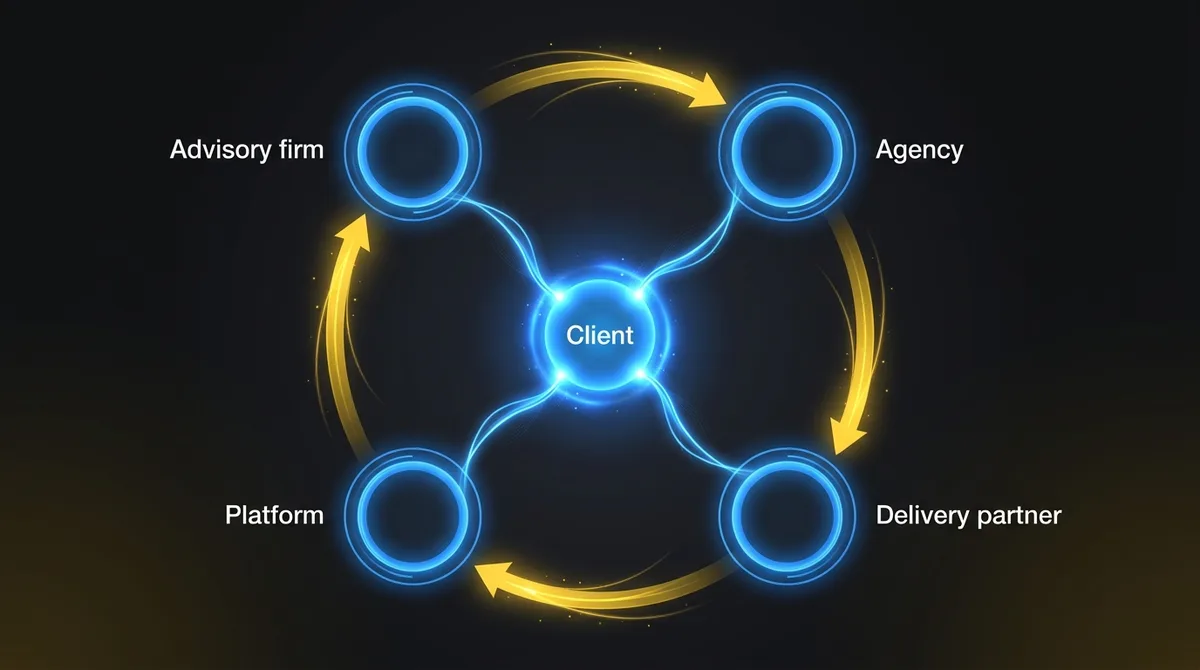
The trade only works if each side is honest about what it’s good at. A firm that wants to own every layer is a solo vendor with a partner slide.
What does co-delivery look like on a real project?
Each firm does the part it’s built for, and the client keeps dealing with the firm it already trusts. This example is illustrative. It shows the structure, not a specific engagement.
A regional manufacturer with a few hundred employees has worked with the same advisory firm for a decade. During a year-end review, the CFO mentions that quoting custom orders takes days because estimators search old jobs, spreadsheets and supplier price lists by hand. Quotes go out late, and margins vary widely between estimators.
Domain access: the advisory partner knows the cost structure and which product lines carry the most margin variance. They frame the opportunity in terms the CFO cares about: quote turnaround and margin consistency.
Distribution: the advisory firm owns the relationship and proposes a scoped engagement. An IT services firm that already supports the ERP comes in for systems access.
Platform: the manufacturer already runs on a mainstream cloud and ERP. The system uses those instead of introducing a new stack.
Delivery: an engineering team builds a quoting assistant that retrieves similar past jobs, pulls current supplier prices from the ERP, drafts a quote and shows the estimator what the draft was based on. Estimators approve every quote. The team sets up evaluation against a sample of historical quotes, monitoring and an upgrade process, then stays on to run the system.
The system reaches production with someone accountable for keeping it working.
Where is the AI partner ecosystem heading?
Toward a sort between ecosystems that consistently get systems into production and keep them running, and those that don’t. Delivery will decide which is which.
Large platforms run partner programs because their own teams aren’t built for custom delivery across thousands of mid-market accounts. Advisory firms are building AI practices because clients keep asking them where to start. Agencies are getting pulled into AI work whether they planned for it or not.
What’s still open is whether the firms involved agree on who does what before the first client meeting, or after the first incident. Our playbook for co-selling AI work shows how to settle it on one account.
Frequently Asked Questions
What is co-delivery in AI projects?
Co-delivery means an advisor, agency or platform partner keeps the client relationship while a specialist engineering team builds and runs the AI system. Ownership, revenue split and handoffs are agreed up front, so nobody competes for the account.
Why do AI projects need ongoing support after launch?
Model versions change, retrieval quality drifts as documents change, and upstream APIs break agent tool calls. Someone has to watch evaluation scores, review flagged outputs and manage cost per transaction, or the system degrades within months.
How do you keep a delivery partner from taking your client?
Write it into the agreement: no direct selling to the client you brought, delivery under your contract if you want it, transparent margins, and a clear handback of the account at the end of every engagement.
Do you have AI demand you can’t fully deliver on?
If you run a practice, an agency or a partner program, start with something concrete. Bring one client challenge or one vertical thesis you’re already working on. We’ll shape a joint offer around it with you: a co-delivery blueprint that sets out who owns what, the revenue path for each side, and what a first account activation could look like. Start the conversation.