Key Takeaway
The first retail AI project should remove one handoff inside a system stores already use, like a BOPIS short pick in the OMS, not add a new assistant on top. Map the friction, define a trigger, decision, action, checkpoint and metric, and ship it in one store cluster.
Most retail AI projects add a new screen for store associates to ignore. The ones that pay off remove one specific friction inside the systems stores already run. This article is for retail operations, e-commerce and IT leaders choosing a first AI project. It shows how to find the friction, size it, and scope it to a production milestone you can ship around peak season.
Walk into the back room of almost any multi-store retailer and count the screens. There’s the POS (point of sale). A handheld for receiving and picking. A workforce app for shifts. A store portal from head office with this week’s price changes and planogram updates. Maybe a tablet for online order pickup. Often a binder, too.
Now picture the typical retail AI pitch: an assistant that sits on top of all of it. Ask it anything. It’ll summarize your store’s performance, answer policy questions and suggest actions.
Store associates don’t have a question-asking problem. They have a handoff problem. A web order lands at a store that can’t fill it. A return comes back for an item the POS can’t find. A markdown file arrives from head office, and the shelf labels, the POS price and the e-commerce price drift apart for three days. Each of those moments involves somebody re-keying data, phoning another team or waiting.
Our position is simple. The first AI project in a retail business should remove one of those frictions inside a system people already use. No new interface. No new login. A workflow that used to take four touches now takes one, and you can measure the difference.
Why do AI layers rarely survive the store floor?
Because retail has constraints that kill generic AI tools. Associates are there to serve customers, staff turn over fast, the useful data sits in transactional systems, and peak season punishes experiments. An assistant that can’t write back to the POS or OMS can describe a problem but can’t fix it.
Associates are paid to serve customers, not to operate software. Any task that pulls someone off the floor to type into a new app competes with the customer in front of them. The customer wins, and the app goes unused.
Turnover is high and training time is short. Every new interface needs training for staff who may be gone in a few months. A change inside the POS flow they learned on day one costs almost nothing to roll out.
The data that matters lives in transactional systems. Inventory positions sit in the OMS (order management system) and WMS (warehouse management system). Sales and returns are in the POS. Item attributes are in the PIM (product information management system). Orders and customer history live in commerce and CRM platforms. An AI layer that can’t write back to those systems can only describe the problem.
Peak periods punish experiments. Most retailers lock down system changes from early November through the holidays. Anything that isn’t stable by the freeze waits until the new year, and anything that breaks during peak gets switched off for good.
None of this means AI doesn’t belong in retail. It means AI has to show up as a better step inside an existing workflow, not as a separate destination.
Where does friction actually live in retail operations?
At the seams between systems and teams. The pattern is always the same: a trigger in one system, a human relay between teams, and a resolution in another system. Here’s where we see it most, split by who feels it.
Customer-facing
- Buy online, pick up in store (BOPIS) short picks. The OMS routes an order to a store showing three units on hand. The associate finds zero. A manual chain follows: tell the store manager, message customer service, cancel or re-route in the OMS, email the customer, process the refund.
- Cross-channel returns. A customer returns an online purchase in store. The POS can’t see the web order, so the associate searches by email, keys the item manually or calls head office for an override.
- “Where is my order” (WISMO) contacts. Service agents check the OMS, then the carrier portal, then the store, then write a reply by hand. The answer usually exists in a system the agent doesn’t have open.
Employee-facing
- Price change execution. Head office publishes markdowns. Stores print labels, swap them and confirm. The POS, the website and the shelf disagree until someone catches it, often a customer at checkout.
- Receiving discrepancies. The advance ship notice (ASN) says 48 units. The carton holds 36. Someone counts, writes it down, enters it in the WMS or store system and emails the buyer or vendor team. The chargeback conversation starts weeks later with incomplete evidence.
- Shift handovers on open issues. A customer special order, a damaged display, a pending transfer. The details live in a notebook or a group chat, and the next shift starts from scratch.
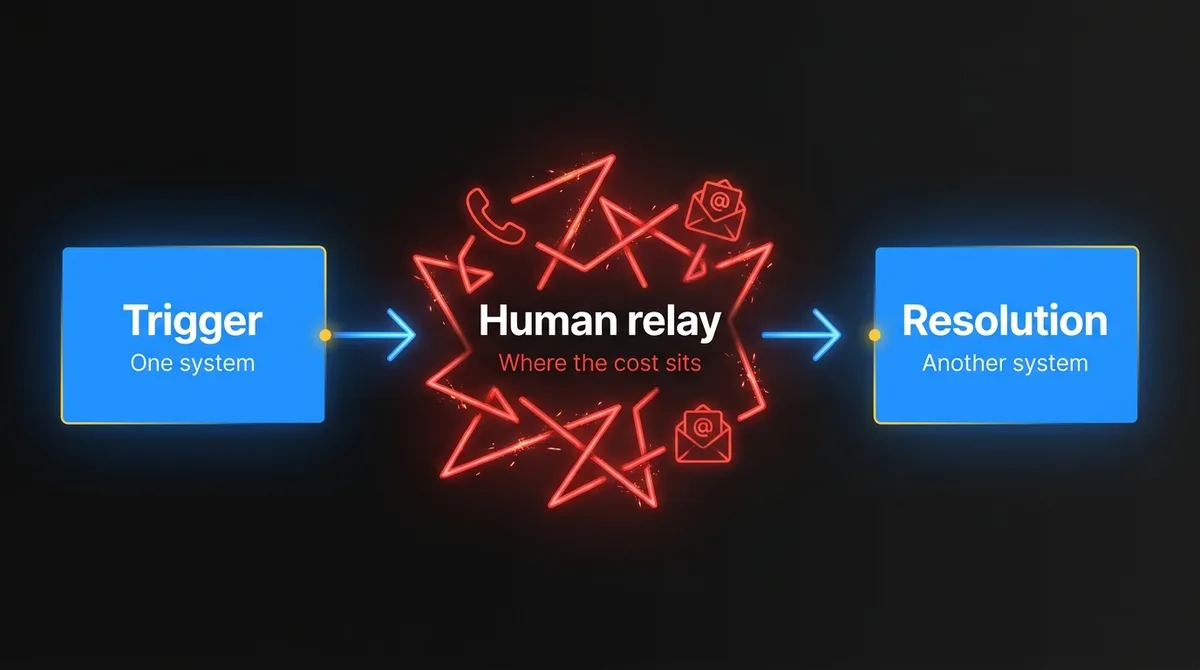
That relay is where the cost sits. It’s also where a well-scoped AI workflow does its best work.
How do you choose which retail friction to fix first?
Map the frictions on a retail opportunity map, then pick the one with high weekly volume, four or more handoffs, and data that already sits in a system you control. Rows are moments in the customer or employee journey. Columns are the questions that decide whether a friction is worth fixing first.
| Journey moment | Systems touched | Handoffs per instance | Weekly volume | Peak sensitivity | Data available to act on |
|---|---|---|---|---|---|
| BOPIS short pick | OMS, handheld, CS desk, payments | 4 to 5 | High | Very high | Store inventory, nearby stock, order history |
| Cross-channel return | POS, OMS, commerce platform | 2 to 3 | Medium | High (January) | Order record, item master |
| WISMO contact | OMS, carrier tracking, help desk | 3 | High | Very high | Shipment events, order status |
| Markdown execution | Pricing system, POS, label printer, web | 3 | Weekly batch | Medium | Price file, POS price, web price |
| Receiving discrepancy | ASN/EDI, WMS or store system, email | 3 to 4 | Medium | High | ASN, receipt count, PO |
Fill it in with your own numbers. Peak sensitivity tells you when the fix pays back fastest, which affects timing more than priority.
Two rules keep the map honest. First, count handoffs by watching the work, not by reading the process document. The documented process for a short pick is usually two steps. The real one is often five. Second, name the systems. “Inventory system” isn’t specific enough. “The OMS store-availability feed that refreshes every 15 minutes” is, because now you know why the store showed three units.
What does a scoped production milestone look like?
It ships into production in one region or store cluster and changes a number you can measure. A useful milestone has five parts.
- Trigger. The system event that starts the workflow. “Associate marks an item short on the handheld.”
- Decision. What the AI step does with the context it has. “Check same-day availability at stores within 20 km and at the distribution centre (DC). Rank options by pickup time and margin.”
- Action. What gets written back, and where. “Propose the re-route in the OMS. Draft the customer message. Queue it for one-click approval in the service desk.”
- Human checkpoint. Who approves, and for how long. Start with every action approved. Relax it once the approval rate holds.
- Measure. One operational metric and one commercial one, both baselined before launch. For short picks: minutes of staff time per incident, and the share of short-picked orders saved instead of cancelled.
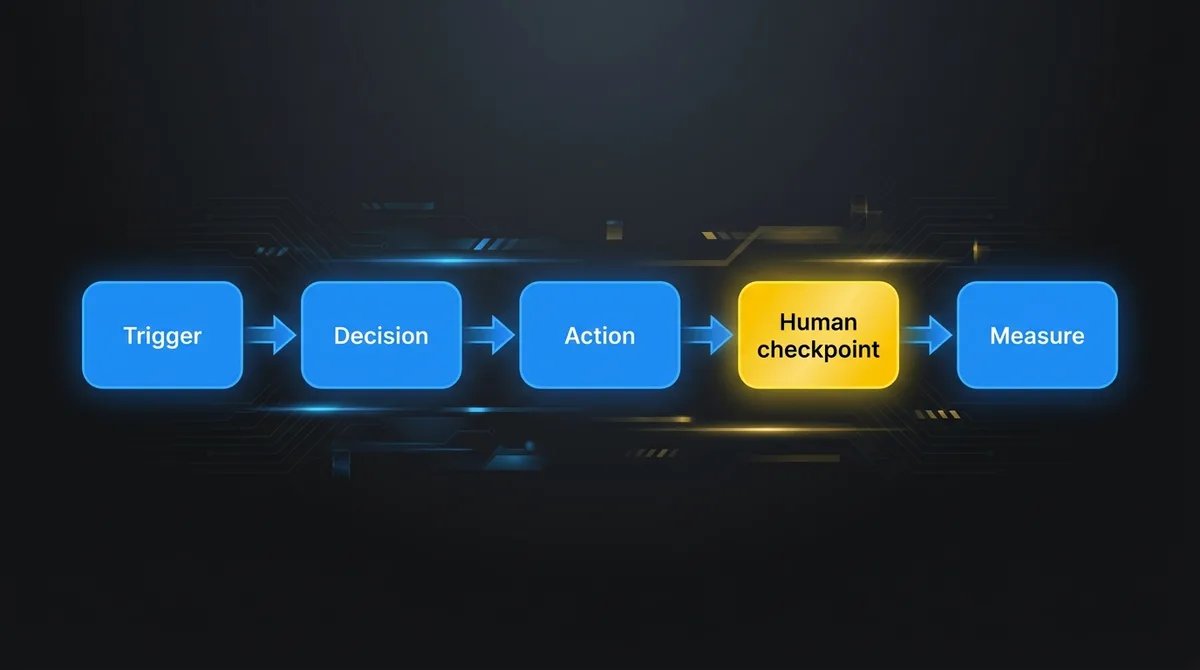
Notice what’s missing: a chatbot, a new dashboard, a new app for associates. The associate presses the same “short” button they already press. Everything after that gets faster.
This is also where most retail AI pilots go wrong. They build a capable model and leave the write-back for “phase two.” Without the write-back, nothing changes in the store, and the pilot never earns phase two. We cover that pattern in generative AI development: what companies get wrong, under building a chatbot when you need a workflow.
What’s a BOPIS short pick worth fixing?
At a 60-store retailer, roughly 80 staff hours and $13,200 in lost sales every week. The numbers below are illustrative. The structure holds for most retailers running ship-from-store or BOPIS.
The business. A specialty apparel retailer with 60 stores and an e-commerce site. Store inventory feeds the OMS every 15 minutes. About 4,000 BOPIS orders a week.
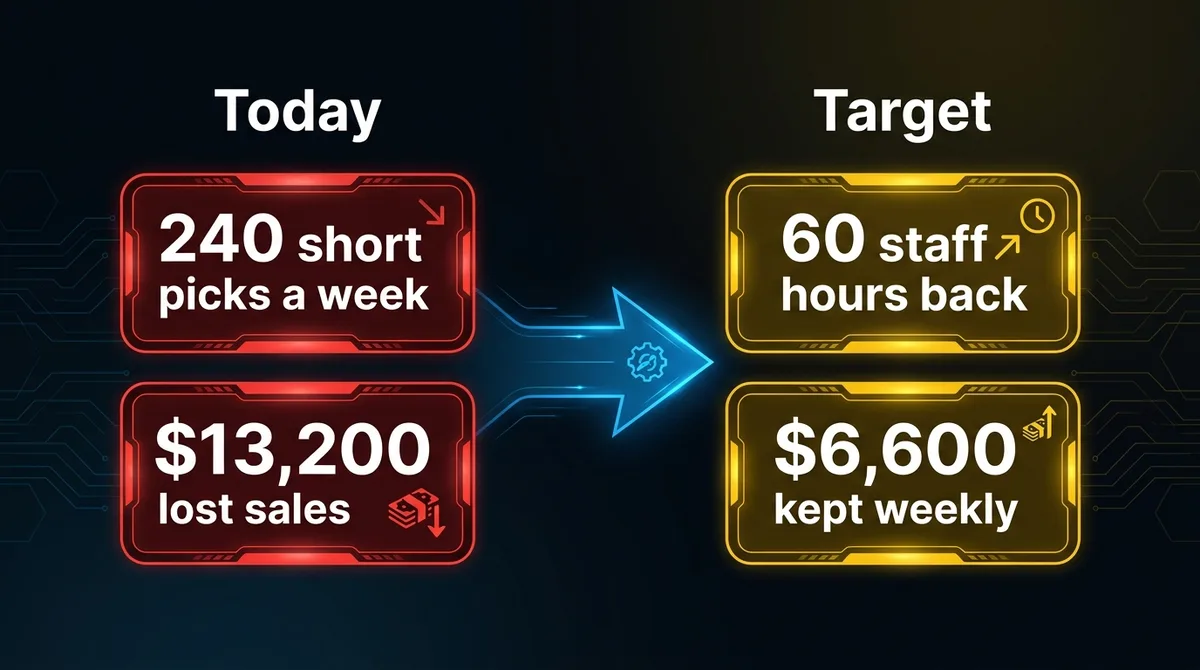
The friction. Roughly 6% of those orders hit a short pick: the system said the item was there and it wasn’t. That’s about 240 incidents a week. Each takes around 20 minutes of combined time across the store associate, store manager and customer service agent, and roughly half end in a cancellation.
The cost today. 240 incidents at 20 minutes each is 80 staff hours a week. At an average order value of $110, 120 cancellations a week is about $13,200 in weekly sales that walked away, many to a competitor. Those were customers who’d planned a trip to the store.
The milestone. When an associate marks a short, the workflow checks nearby stores and the DC, proposes the fastest alternative, drafts the customer message with the new pickup time, and puts both in front of a service agent for approval. If the customer declines, it processes the cancellation and refund in the same flow.
The target. Cut handling time from 20 minutes to under 5, and save half the orders that currently cancel. If that holds, the retailer gets back about 60 staff hours a week and keeps around $6,600 in weekly sales, before counting the effect on repeat purchase.
What’s hard. Not the model. The hard parts are the OMS integration, the rules for which substitutions are acceptable, and getting the store-availability feed accurate enough that re-routes don’t create a second short pick. That’s where the build time goes.
There’s a second-order benefit, too. Every logged short pick is a data point on inventory accuracy by store and category. After a quarter, you know which stores need cycle counts, which is a merchandising conversation the retailer couldn’t have before.
When should retailers ship AI around peak season?
Measure during peak, scope in January, and ship before your next peak that matters. Most retailers freeze POS, OMS and e-commerce changes from early November. Black Friday falls on November 27 this year, and the returns wave runs well into January, so a production change to a customer-facing flow before then is unrealistic for most teams.
That doesn’t make the next ten weeks wasted. Use them differently:
- Measure during peak. Holiday volume gives you the clearest baseline you’ll get all year. Log every short pick, every cross-channel return override, every WISMO contact. Count the handoffs.
- Scope in January. Once the returns wave settles, fill in the opportunity map with real peak numbers and pick one friction.
- Ship before the next peak that matters to you. For many retailers that’s spring, back-to-school or a major promotional event. A narrow milestone in one store cluster is realistic within that window.
The exception is a back-office workflow that doesn’t touch the POS or customer-facing flows, such as receiving discrepancies or markdown reconciliation. Some of those can ship before the freeze if the scope is narrow and the systems involved aren’t frozen. Ask your IT team before assuming either way.
Who should build a retail AI workflow?
Someone with spare engineering capacity during your busiest months, which is rarely your in-house team. Retailers usually know exactly which friction hurts. Their engineers are typically committed to platform work: the OMS upgrade, the loyalty relaunch, the POS migration.
That’s the gap we fill. We build the workflow for you: expert-supervised AI agents doing the build, senior engineers accountable for production quality, and a fixed milestone with outcome-based pricing, so you pay for what gets delivered rather than hours spent. Your team’s part is the decision owner’s time and API access to the systems on the map. More on how that works in outcome-based pricing for software development.
If you’re a larger retailer and want your own engineers to own the capability long term, the same approach works with our engineers embedded in your team. See how we work with retail and commerce teams, and for the broader pattern, read AI strategy for scale-ups: moving from pilot to production.
Frequently Asked Questions
What’s the best first AI use case for a retailer?
The one that removes a high-volume handoff inside a system you already run. BOPIS short picks, cross-channel returns and WISMO contacts are common picks because they happen weekly, involve four or more handoffs and have the data to act on already sitting in the OMS or POS.
Can we ship a retail AI project before the holiday freeze?
Usually not for customer-facing flows. Most retailers freeze POS, OMS and e-commerce changes from early November. A narrow back-office workflow, like receiving discrepancies, can sometimes ship before the freeze if those systems aren’t locked.
Do store associates need a new app for AI to help them?
No, and they shouldn’t get one. The best retail AI starts from a button associates already press, like marking an item short on the handheld, and handles the steps after it in the background.
What retail friction would you remove before your next peak?
Bring that question to your next planning meeting. If you want help answering it, we’ll work through a retail opportunity map with you. You bring the journey you suspect is costing the most. We map the systems and handoffs, size the friction and define one scoped production milestone with a trigger, an action and a metric. You keep the map either way. Book a retail opportunity map session.