Key Takeaway
Waiting on a roadmap feature isn't free. Put a monthly cost of delay on your top candidates, pick the one with a high cost and low coupling to your core team, and ship it now as a fixed milestone with a committed date and price.
This article is for product and engineering leaders building a 2027 roadmap with more good ideas than capacity. It shows how to put a monthly price on a feature that’s waiting, how to pick the one worth pulling forward, and how to ship it as a fixed first milestone without taking your core team off the roadmap.
It’s planning season. The 2027 roadmap is taking shape, and it looks a lot like the 2026 roadmap did a year ago. There are more good ideas than the team can build, and the most interesting ones got pushed to the second half of the year.
Nobody chose to delay those features. Engineering is fully booked on commitments, platform work and whatever customers are escalating this quarter. The backlog grows because demand is real and capacity is fixed.
The trouble with a long backlog is that it makes waiting feel free. A feature parked in H2 2027 doesn’t show up as a cost anywhere. It doesn’t hit the P&L and nobody gets a bill for it. But every month it waits, deals close slower, customers work around the gap, and a competitor gets a little closer to shipping it first.
So here’s the case for pulling one feature forward, now, as a fixed first milestone. Not the whole roadmap. One feature, chosen because its cost of delay is high and its dependency on your core team is low.
What is cost of delay, and why does it matter for your roadmap?
Cost of delay is what it costs you, per unit of time, for a feature not to exist yet. Don Reinertsen popularized the idea in product development economics, and it’s the basis of WSJF (weighted shortest job first) prioritization. Product teams talk about it often and apply it with rigor almost never.
The point isn’t precision. It’s turning “we’ll get to it” into a monthly number that can sit next to an engineering cost. Once a waiting feature has a price, leaving it in the backlog becomes a decision someone has to defend.
Cost of delay usually comes from one or more of these sources:
| Source | What to ask | Where the answer lives |
|---|---|---|
| Revenue gained | Which deals are waiting on this, or would close faster with it? | Sales: lost-deal notes, open opportunities with the feature as a blocker |
| Revenue protected | Which customers are at risk without it, or working around its absence? | Customer success: renewal risk notes, escalations, feature requests tied to accounts |
| Cost reduced | How many hours a month does the gap cost us internally? | Support, onboarding and operations: manual workarounds |
| Competitive position | If a competitor ships this first, how many deals change? | Sales and product marketing: win/loss data |
| Option value | Does this feature open a segment, a partnership or a pricing tier we can’t reach today? | Leadership and product |
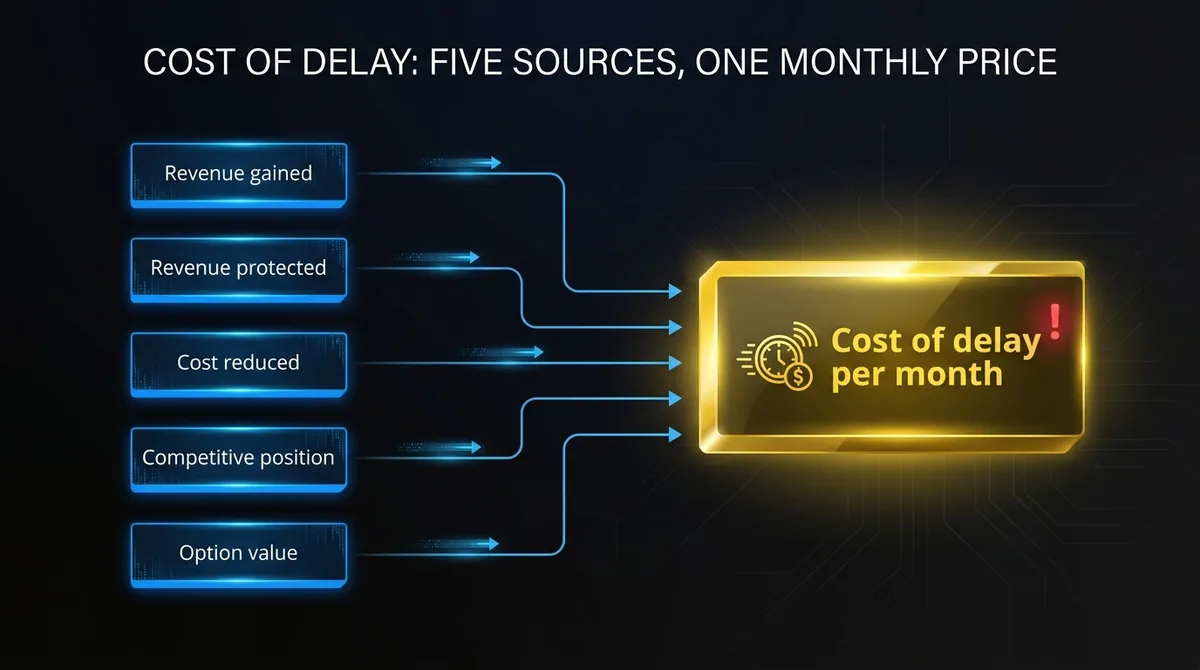
You don’t need all five. A credible monthly estimate from one or two sources is enough to change the conversation. Write the assumptions next to the number so anyone can challenge them.
If you need to frame this kind of estimate for a CFO or a board, see how to build the business case for AI investment.
Why doesn’t hiring fix an over-booked roadmap this year?
Because hiring is slow and the ramp eats your senior engineers’ time. It’s often the right long-term answer. It won’t help a feature you want in production next quarter.
It takes months to get an offer signed and more months before a new engineer is productive in an unfamiliar codebase. During that ramp, your senior people interview and onboard instead of shipping. For AI features, the engineers you’d need are the hardest to recruit.
The other usual answer is to squeeze the feature in by reprioritizing. That just moves the cost of delay from one feature to another. Sometimes it’s the right call, but it doesn’t add capacity.
The third option is to take one feature off your team’s plate entirely. Scope it tightly, build it outside your core team’s sprint load, and integrate it through a clean interface. That only works for the right kind of feature, which is why the choice matters.
Which roadmap feature should you pull forward first?
The one where a high cost of delay meets low coupling to your core team’s work. That’s often not the most valuable feature on the roadmap. Score your top candidates on these five factors:
| Factor | Strong candidate | Weak candidate |
|---|---|---|
| Cost of delay | A credible monthly number with named deals, accounts or hours behind it | “Customers have been asking for it” |
| Coupling | Lives at the edge of the product: a new service, workflow, integration or AI capability behind an API | Needs deep changes to the core data model or a shared component everyone touches |
| Spec clarity | You can describe what done looks like in a page, with acceptance criteria | Needs months of discovery to define |
| Internal dependency | Needs a few hours a week of review from your team, not their sprint capacity | Needs your senior engineers to co-build it |
| Validation path | Specific users or customers are ready to use it the day it ships | Nobody is lined up to try it |
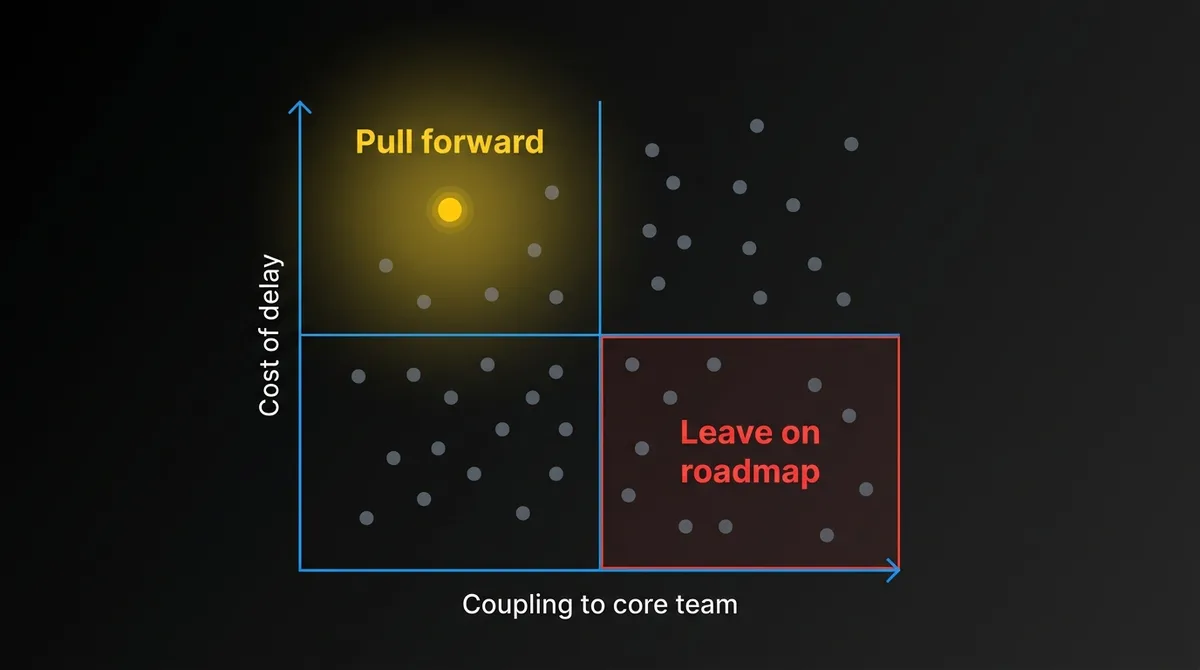
Features that score well tend to look alike. They add something new next to the product instead of reworking its center. AI capabilities often fit: document extraction, intelligent routing, summarization, an assistant inside one workflow. They can sit behind an API, read from your systems through defined interfaces, and get built and tested without blocking anyone’s sprint. Our post on AI features for SaaS products covers which ones tend to deliver real value.
If none of your high-value features is loosely coupled, that tells you something too. Your architecture probably needs a seam before extra capacity can help.
What does a fixed first milestone look like?
One feature, in production, by a committed date, at a committed price. That’s the whole commitment. It’s the opposite of an open-ended engagement that bills by the hour while the scope moves.
The milestone spec should fit on two pages. Here’s the structure we use:
- Outcome statement. One sentence on what changes for which users. “Onboarding specialists import a new customer’s legacy data in under an hour, without manual field mapping.”
- Cost of delay. The monthly number and its assumptions.
- Users. Who uses it first, by team or by customer.
- In scope. The specific capabilities that ship.
- Out of scope. Just as specific. This list is what makes a fixed price possible.
- Interfaces. The APIs, events and data the feature reads and writes, and who owns each one.
- Acceptance criteria. Testable conditions, including quality thresholds for any AI component and the evaluation set they’re measured against.
- Your team’s involvement. Named reviewers and the hours per week they’re committing. Usually architecture review, code review on integration points and acceptance testing.
- Date and price. Committed, not estimated.
- Handoff. What your team gets at the end: code in your repositories, documentation, runbooks and a walkthrough.
Writing this spec is most of the scoping work. If you can’t fill in sections 5, 6 and 7, the feature isn’t ready to be a fixed milestone. It needs a short discovery step first.
What does this look like for a B2B SaaS company?
Here’s an illustrative example. The numbers aren’t from a specific client, but the structure carries over.
The company: A 120-person B2B SaaS company selling to the mid-market. Most new customers migrate from a competitor or from spreadsheets.
The feature: AI-assisted data import. New customers upload exports from their old system, and the feature maps fields, flags anomalies and proposes transformations for an onboarding specialist to approve. It’s slotted for Q3 2027.
Estimated cost of delay:
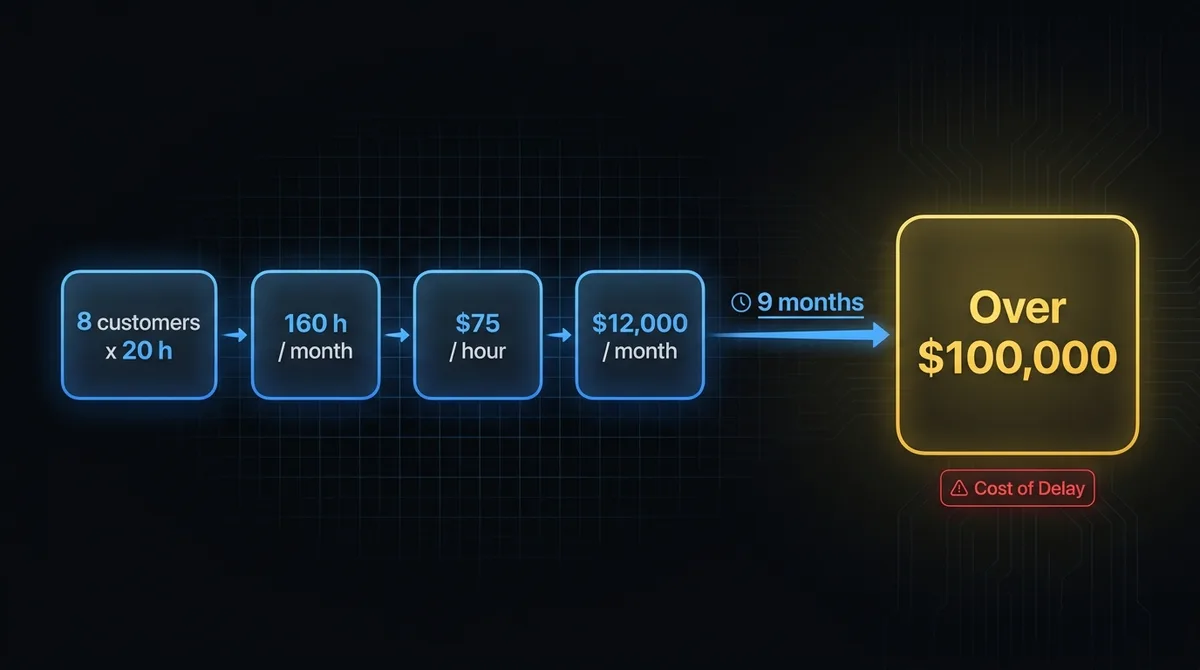
- The company signs about 8 new customers a month. Onboarding specialists spend roughly 20 hours per customer on manual mapping and cleanup. That’s 160 hours a month.
- Time to go live averages five weeks, and the import step takes about two of them. Customers pay from signature, but the team has noticed that slow go-lives line up with weaker first renewals.
- Sales reports that two to three deals a quarter raise migration effort as a concern late in the cycle.
Only put a price on what you can defend. At a loaded cost of $75 an hour, the internal hours alone come to $12,000 a month. Leaving the feature in Q3 2027 means roughly nine more months of waiting. That’s over $100,000 in onboarding time before you count renewal risk or the deals that stall on migration worries.
Why it’s a good candidate: It sits at the edge of the product. It reads uploaded files, writes through the existing import API and has a clear human approval step. The core team needs to review the integration and own the import API contract. They don’t need to build it.
The milestone: AI-assisted import live for new customers on the two most common source formats, with the onboarding team approving every mapping, by a committed date, at a committed price. More source formats and self-serve import are explicitly out of scope.
If it ships this quarter instead of next Q3, the onboarding hours come back first. The less obvious gain is data. Within two quarters, the company can see whether faster go-lives actually improve first renewals, a question it’s been arguing about without evidence.
How does one shipped feature change the next planning cycle?
It gives you evidence your roadmap debates rarely have: what a defined piece of work actually cost, how long it actually took and what it actually changed. That makes the next call easier.
If the first feature moved its number, you’ve got a case for pulling the next one forward. If it didn’t, you learned that from one bounded commitment instead of a year of roadmap.
It also changes how the roadmap gets discussed. Once one item carries a cost of delay and a fixed milestone, people start asking the same questions about the others. That’s the habit worth building. For a wider view of sequencing AI work into a roadmap, read AI product strategy: where to start when your roadmap has no AI.
When shouldn’t you pull a feature forward this way?
When the feature is the core of the product, when the spec is still a guess, or when nobody on your team has time to review. Better to know that before scoping.
- The feature is the core of the product. If it touches every part of the codebase, it needs your team. Outside capacity should support them, not build it separately.
- The spec is still a hypothesis. If you’re not sure customers want it, run a cheap validation first. A fixed milestone commits to building, not to finding out.
- Nobody can review. Even a well-separated feature needs a few hours a week from someone who knows your architecture. If nobody has that time, integration becomes the bottleneck.
Frequently Asked Questions
How do you calculate cost of delay for a software feature?
Estimate what the feature’s absence costs per month from one or two sources: deals waiting on it, customers at risk, internal hours spent on workarounds, or competitive losses. Write the assumptions next to the number. A defensible rough estimate beats a precise one nobody believes.
What kind of feature can an outside team build without slowing the core team?
One that sits at the edge of the product: a new service, integration or AI capability behind an API, with a spec that fits on a page. It should need a few hours a week of review from your engineers, not their sprint capacity.
What’s the difference between a fixed milestone and a time-and-materials engagement?
A fixed milestone commits to one feature in production by a set date at a set price, with an explicit out-of-scope list. Time and materials bills by the hour while the scope can keep moving, so the risk of overruns stays with you.
Which feature on your 2027 roadmap should already be live?
Look at the roadmap and ask one question. Which feature, if it were in production today, would move a number you care about this quarter?
We build features like that as fixed milestones: scoped with your team, built by senior engineers supervising AI agents, and delivered into your codebase with a committed date and price. Scoping is free. Name one feature or bottleneck and we’ll come back with a proposed milestone. Propose a feature.