Key Takeaway
Data sovereignty for AI is an architecture decision, not a compliance roadblock. Sort workloads by exposure, compare two or three hosting patterns on residency, jurisdiction and portability, design for exit before you sign, and get one accountable executive to sign the position.
This article is for CIOs, CISOs and CTOs at regulated Canadian companies whose AI projects keep getting parked in risk review. It covers how to sort workloads by exposure, compare hosting patterns fairly, design for exit from day one, and run a five-question architecture review per workload. It describes public laws and vendor commitments for general information. It isn’t legal advice, and your counsel should own the final position.
In regulated Canadian companies, AI projects rarely die in the pilot. They die in the gap right after it.
The proof of concept works. Then the CISO (chief information security officer) asks where customer data goes during inference. Counsel asks which governments could compel access to it. Procurement asks what the company owns if it leaves the vendor in two years. Nobody has a documented answer, so the project goes into a risk review with no owner and no deadline.
We think this is an architecture problem dressed up as a compliance problem. Residency, legal exposure and portability are design decisions. Made early, one workload at a time, they can be written down, compared and signed off. Made late, they become a reason to stop.
Why doesn’t Canadian hosting settle the AI data sovereignty question?
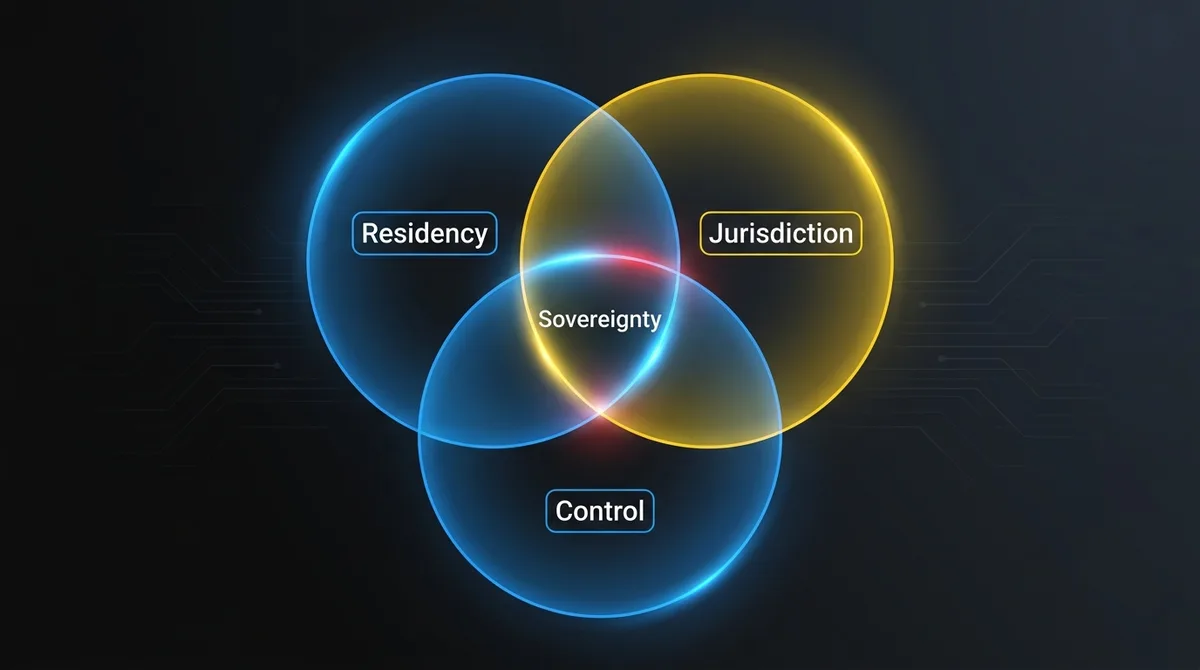
Because sovereignty has three parts, and residency is only one of them. Jurisdiction and control matter just as much, and a workload can score well on residency and poorly on the other two.
Canadian hosting options have improved a lot. AWS runs regions in Montreal and Calgary. Microsoft runs Azure regions in Toronto and Quebec City, and in December 2025 it committed to “keep Canadian data on Canadian soil,” with in-country data processing for Copilot interactions, an expanded Azure Local offering for customer-owned environments, and a Sovereign AI Landing Zone for Canada planned for 2026. In October 2025, ThinkOn, Hypertec, Aptum and eStruxture announced what they describe as Canada’s first end-to-end sovereign, AI-ready government cloud.
For many workloads, that settles it. For regulated ones, look at all three parts.
Residency. Where the data physically sits and where it’s processed. That includes prompts, retrieved context, model outputs, logs and telemetry. Teams often check the database region and forget that the inference call, the vector index or the observability tool runs somewhere else.
Jurisdiction. Which governments can legally compel access. The U.S. CLOUD Act lets U.S. authorities require U.S.-based providers to produce data in their possession, custody or control, no matter where it’s stored. Microsoft’s Canadian commitment is honest about this: it promises to challenge government demands for customer data “where we have a legal basis for doing so.” That’s a meaningful commitment. It’s still a conditional one.
Control. What you can take with you. Your data, yes, but also the prompts, evaluation sets, retrieval logic, fine-tuned weights and integration code that make the system work. That’s your IP. If it only exists inside a vendor’s managed service, you don’t fully control it.
Which Canadian privacy rules apply to AI workloads?
Two frameworks come up in almost every review: PIPEDA (the Personal Information Protection and Electronic Documents Act) federally, and Quebec’s Law 25. They get misread in opposite directions. PIPEDA is looser on transfers than people assume, and Law 25 is stricter.
PIPEDA doesn’t require data to stay in Canada. It does keep you accountable for personal information you transfer to a processor, including one outside the country. The Office of the Privacy Commissioner (OPC) guidance on cross-border processing asks organizations to use contractual or other means to provide a comparable level of protection, and to be transparent with individuals. The OPC has been revisiting that guidance since 2019, so check the current position with counsel.
Quebec’s Law 25 is stricter on transfers. Since September 2023, an organization must complete a privacy impact assessment (PIA) before personal information collected in Quebec is communicated outside the province. That includes other Canadian provinces, and it applies when you entrust a third party outside Quebec with storing or processing the data. A model API hosted outside Quebec is that kind of third party. The assessment doesn’t prohibit the transfer. It requires you to show the information will be adequately protected.
Federal policy is moving too. The Canadian Sovereign AI Compute Strategy launched in December 2024. Applications for the AI Sovereign Compute Infrastructure Program, to build a Canadian-owned AI supercomputer, opened in April 2026. The national AI strategy announced in June 2026, “AI for All,” names “building a foundation for Canadian sovereign AI” as one of its six pillars and commits to modernizing privacy law. Most of that capacity targets research and industry, not your next deployment. It does tell boards where expectations are heading.
How do you decide which AI workloads need a sovereignty review?
Sort them by exposure into three tiers. Most workloads don’t need a sovereignty review, and the fastest way to unblock a program is to separate the few that do from the many that don’t.
| Tier | What’s in it | Typical examples | Default posture |
|---|---|---|---|
| 1. Low exposure | Public or non-personal data, no regulated content, no core IP | Marketing copy drafts, public document search, internal code assistants on non-sensitive repos | Any reputable provider and region. Standard vendor review. |
| 2. Personal or contractual | Personal information, customer data under contract, Quebec-collected data | Customer service summarization, claims triage, HR document processing | Canadian residency for data and inference. Law 25 PIA where Quebec data is involved. Documented processor contracts. |
| 3. High consequence | Regulated records, government or defence-adjacent data, data covered by explicit contractual residency or jurisdiction clauses, crown-jewel IP | Health records, trading strategies, public sector supplier data, proprietary models | Explicit jurisdiction position signed by an accountable executive. Consider customer-controlled or Canadian-owned infrastructure. |
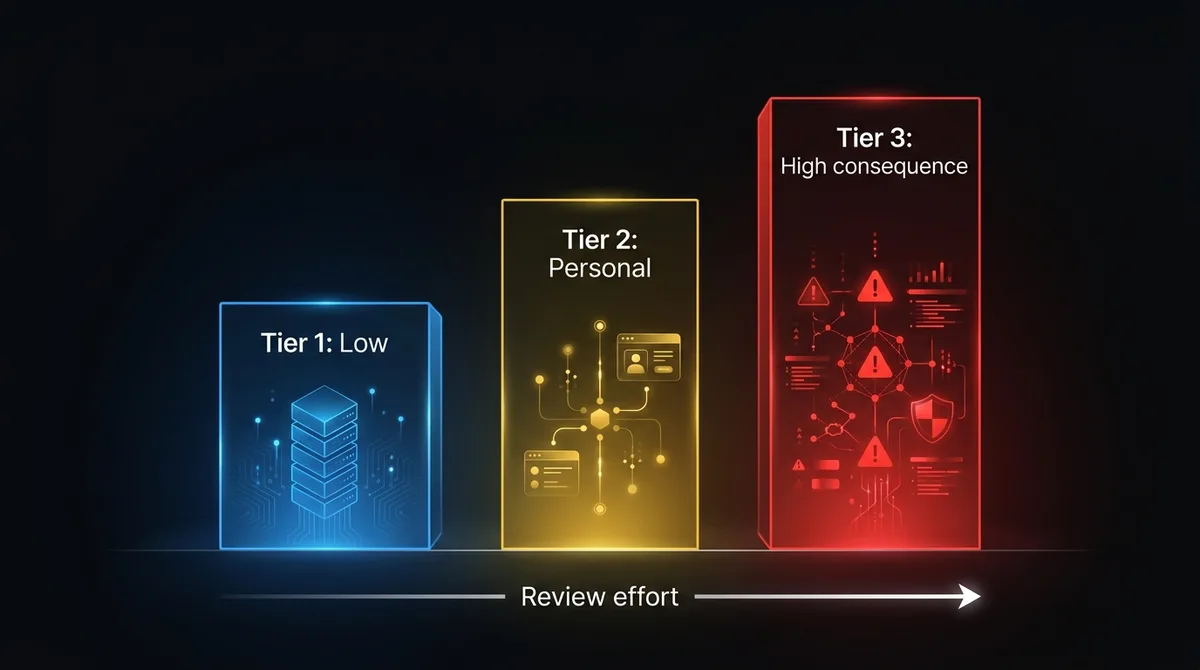
Tier 1 should move this week. Tier 2 usually moves once someone documents the data flow. Tier 3 is where the architecture review earns its keep.
Which hosting pattern should a regulated Canadian AI workload use?
For a Tier 2 or Tier 3 workload, compare two or three realistic patterns side by side. Each one has real strengths. The goal is a choice you can defend, not a winner.
| Pattern | Residency | Jurisdiction exposure | Portability | Capability and speed | Watch for |
|---|---|---|---|---|---|
| A. Hyperscaler Canadian region, managed AI services | Strong if every component is pinned in-region | U.S. parent subject to CLOUD Act; provider commitments to challenge demands | Depends on how much you build on proprietary services | Highest. Broadest model and tooling choice. | Logs, telemetry and model endpoints that default to other regions |
| B. Hyperscaler stack in a customer-owned environment | Strong | Reduced operational access, but software and support still come from a U.S. vendor | Moderate | High, with some service gaps | Feature parity and operational overhead |
| C. Canadian-owned cloud provider | Strong | Canadian jurisdiction for the provider; check sub-processors | Moderate to high | Narrower managed AI catalogue; often paired with open-weight models | GPU capacity, support depth, service maturity |
| D. On-premises or colocation with open-weight models | Full | Lowest external exposure | Highest | Lower; you run everything | Operating cost, staffing, model quality gap for some tasks |
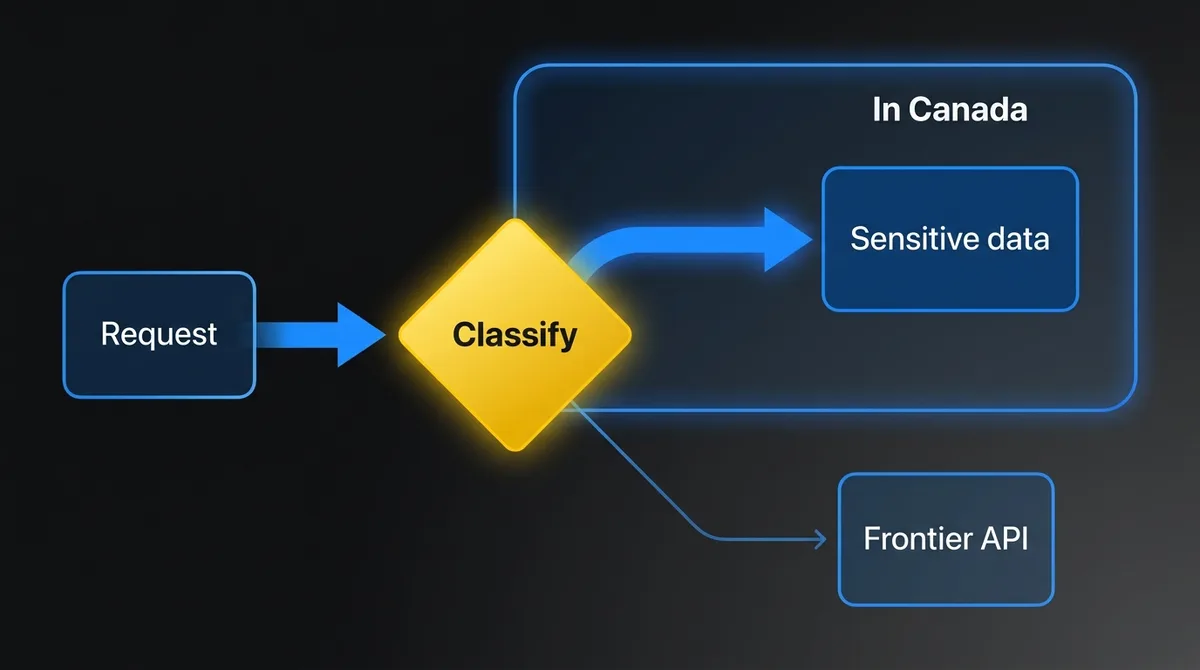
| E. Hybrid split | Sensitive data and inference in A to D; non-sensitive tasks on frontier APIs | Concentrated where it matters | High if the split is clean | High overall | Routing logic must be enforced in code, not policy |
Pattern E is the one we recommend most often, because it stops the most sensitive workload from setting the hosting rules for everything else. A redaction or classification step decides which requests can leave the boundary, and that decision is logged.
Customer-managed encryption keys come up in every one of these conversations. They raise the bar in a real way. Whether they change your legal position under a specific compelled-disclosure scenario is a question for counsel, not for an architecture diagram.
How do you avoid AI vendor lock-in?
Design for exit before you sign. Lock-in does more long-term damage than residency, and it gets priced less often.
Here’s how it usually goes. A team builds on one provider’s agent framework, a proprietary vector store and prompts tuned to one model family. Eighteen months later a better model ships elsewhere, pricing changes, or a regulator asks for an on-premises option. Moving becomes a rebuild.
None of the following slows a build down. Skipping them makes leaving expensive.
- Source data stays in formats you control. Keep the canonical copy in your own storage, in open formats such as Parquet or Iceberg tables. A vendor’s managed index can be a derived copy, never the only one.
- A thin model gateway. Route model calls through one internal interface. It lets you swap models, run two side by side on the same evaluation set, and enforce the hybrid routing rule above.
- Your IP lives in your repository. Prompts, retrieval configuration, evaluation datasets, guardrail rules and fine-tuning data are versioned in your Git and reviewed like code.
- Integration through documented contracts. The AI system talks to your core systems through APIs you own and can document, not through point-to-point connectors only one vendor understands.
- A one-page exit plan. What moves, what gets rebuilt, which contracts have notice periods, and a rough effort estimate. Write it before signing and review it yearly.
If you’re building agents, the same discipline applies to tool definitions and permissions. We cover that side in AI agent architecture: what production systems actually look like.
What should an AI architecture review cover?
Five questions per workload: data, location, jurisdiction, ownership and integration. It fits on one page and takes a working session, not a quarter. This is the review we run with clients.
- Data. What data does the workload touch at every step: input, retrieval, prompt, output, logs? Which tier is it?
- Location. For each hosting pattern under consideration, where is each of those steps processed and stored?
- Jurisdiction. Which legal regimes could reach each component, sub-processors included? What’s the documented position, and who signs it?
- Ownership. If you leave the vendor, what do you keep and what do you rebuild? Is the exit plan written?
- Integration. Which internal systems does it read from and write to, through what interfaces, and with which permissions?
The output is a short comparison of two or three patterns against those five questions, a recommended pattern, and the name of the person accountable for the risk decision. That last line is what turns a parked project into a moving one.
For governance controls inside the product itself (audit trails, bias testing, explainability), see AI governance for product teams.
What does a sovereignty review look like for a Quebec insurer?
Here’s an illustrative example. It shows the structure of a review, not a real client engagement.
The workload. A property and casualty insurer headquartered in Quebec wants an assistant that summarizes claim files for adjusters: adjuster notes, policy documents, captioned photos and correspondence.
Where it was stuck. The pilot ran on a frontier model API with default settings. Security found that prompts and outputs were processed outside Canada and kept for a period for abuse monitoring. Counsel flagged a Law 25 assessment that hadn’t been done. The project sat for two months.
The review.
- Data: Tier 2, close to Tier 3. Personal information collected in Quebec, some of it health-related from injury claims.
- Patterns compared: A (hyperscaler Canadian region with a model served in-region), C (Canadian-owned cloud with an open-weight model) and E (hybrid).
- Choice: E. Claim files and summarization stay in a Canadian region with an in-region model. A separate, non-personal workload (drafting generic policy explainer text) uses a frontier API.
- Exit design: claim data stays in the insurer’s own storage, prompts and evaluation sets live in its repository, and a model gateway sits in front of both paths.
- Paperwork: Law 25 PIA completed for the in-region processor, jurisdiction position signed by the CISO, exit plan reviewed by procurement.
The result. The architecture decision took two working sessions. The project went from parked to in build, with a named owner and a documented position.
Who needs to be in an AI sovereignty review?
Four people: the executive accountable for the risk (usually the CISO or CIO), someone who knows the data flows, someone who can speak to procurement and contracts, and an engineer who has deployed AI systems under each of the hosting patterns you’re comparing.
The last role is usually the gap. Most infrastructure teams know their cloud. Fewer have shipped model gateways, in-region inference and hybrid routing to production, then run them afterward.
That’s where we come in. Chrono builds and runs AI systems with a Canadian delivery team, and we start with the architecture review, so the decisions about ownership, hosting and integration are made before anything gets built.
Frequently Asked Questions
Does PIPEDA require AI data to stay in Canada?
No. PIPEDA lets you transfer personal information to processors outside Canada, but you stay accountable for it and must provide comparable protection through contracts or other means. Quebec’s Law 25 is stricter: it requires a privacy impact assessment before personal information collected in Quebec leaves the province.
Does hosting AI in a Canadian cloud region protect data from the U.S. CLOUD Act?
Not entirely. The CLOUD Act can require U.S.-based providers to produce data they control wherever it’s stored, so a Canadian region solves residency but not jurisdiction. Have counsel document your position for high-consequence workloads.
What’s the simplest way to reduce AI vendor lock-in?
Route every model call through a thin internal gateway and keep prompts, evaluation sets and source data in your own repository and storage. That lets you swap models or providers without rebuilding the system.
Which AI workload have you held back?
You don’t need a national sovereignty strategy to unblock your AI program. You need one workload, reviewed honestly, with a named owner and a documented choice.
Tell us which workload you’ve held back because of residency, lock-in or integration risk, and we’ll run an architecture review comparing ownership, hosting and integration options side by side. You keep the comparison whether or not we work together. Request an architecture review.
This post is general information about public laws and vendor commitments as of October 2026. It isn’t legal advice. Have counsel review your specific situation.