Key Takeaway
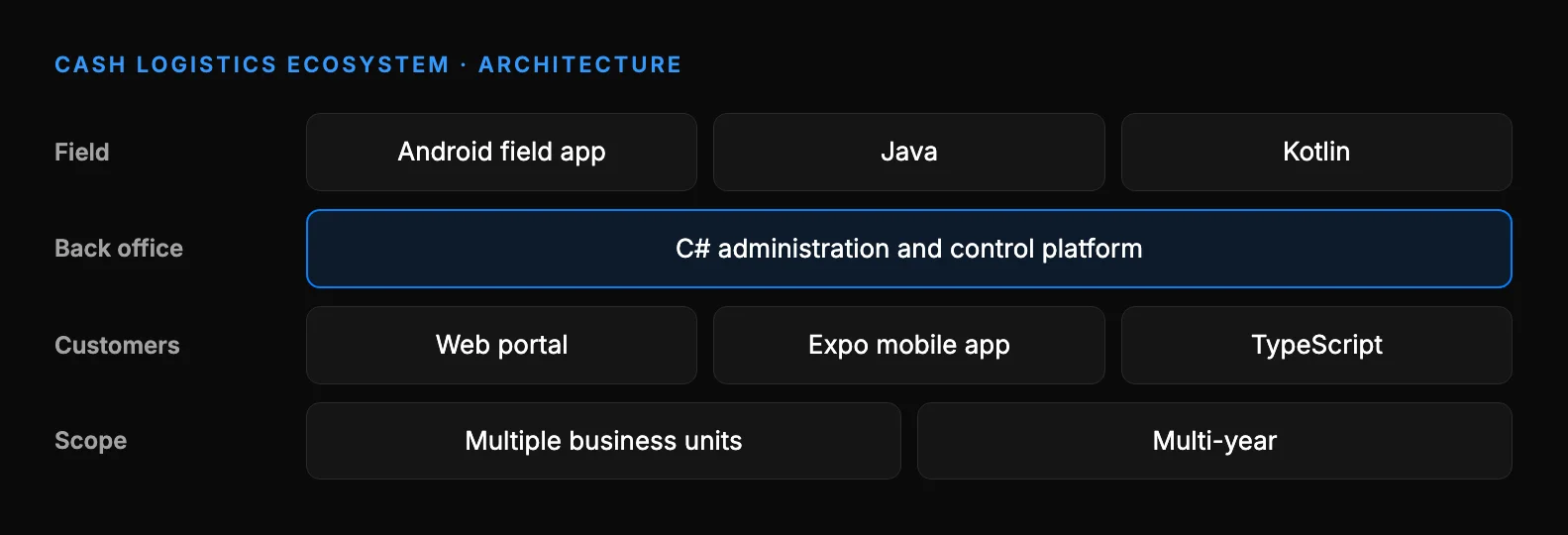
Over several years, Chrono built the connected products behind a national cash logistics operation, an Android field app, a C# administration and control platform, a customer web portal and a customer mobile app, which now serve more than 80,000 daily active users and support the company's critical operations.
In cash logistics, every pickup, delivery and deposit has to match across three groups: the agent in the field, the team in the back office, and the customer waiting on their cash. A national cash logistics company needed all three working from the same picture. Chrono built the products that connect them and has kept building on them for years. Today they serve more than 80,000 daily active users and carry the operations the business can’t afford to stop.
What problem was the company solving?
Keeping a national operation in sync. Field agents, back-office control and customer self-service each had their own job to do, and in a business that moves cash, a gap between them is more than an inconvenience. If the field and the back office disagree, someone has to stop and reconcile by hand.
The company needed tools for each group that shared the same data and the same rules.
What did Chrono build?
Four products that work together:
- A field app for agents on Android, used on every route
- An administration and control platform where the back office manages and checks operations
- A customer web portal for self-service
- A customer mobile app for customers on the go
Each product serves a different group. All of them run on the same operational data, so what a field agent records is what the back office checks and what the customer sees.
What does it take to support 80,000 daily users on critical operations?
Treating every release as if the business depends on it, because it does. More than 80,000 people use these products every day, and the work they do with them is the company’s core operation. If the field app is down, routes stop. If the back office can’t confirm a deposit, customers wait on their money.
So nothing ships as a big-bang launch. Changes go out in small steps, and new work is built around what the operation already relies on instead of replacing it.
How do you deliver across legacy and modern stacks?
By working in both instead of rewriting everything. The field app runs on Android in Java and Kotlin, mixing the established and the newer language. The back office is a C# platform. The customer products are built in TypeScript, with the mobile app on Expo.
Rewriting a system a national operation depends on every day is a risk few companies should take. Extending it carefully, product by product, keeps the business running while it improves.
Why does a multi-year engagement matter here?
Because the knowledge compounds. Cash logistics is a regulated, high-security industry, and the rules that matter rarely live in documentation. A team that has worked across the company’s business units for years knows them, and doesn’t have to relearn them every time a new feature starts.
What does this mean for your operation?
If your field, back office and customers each use different tools, the cost shows up as reconciliation, errors and support calls. Connecting them doesn’t require starting over, even at tens of thousands of daily users. It takes a team willing to work in the systems you already have and stay long enough to know them.
See how we work with logistics companies, or add a team that ships with yours through embedded pods. To scope your own, start here.
Frequently Asked Questions
How do you run apps that 80,000+ people use every day for critical operations?
Change it in small steps and build around what the operation already relies on. On this platform, that’s how more than 80,000 daily active users keep working while the products evolve.
How do you keep field, back-office and customer apps in sync?
Run them on the same operational data and rules. Here, what a field agent records in the Android app is what the back office checks in the control platform and what customers see in the portal and mobile app.
Should you rewrite a legacy system or extend it?
Usually extend it. On this engagement, Chrono works across Java, Kotlin, C# and TypeScript in the same ecosystem, so daily operations keep running while the products evolve.
Can an outside team work on a regulated, high-security platform for years?
Yes. Chrono has delivered across this company’s business units for several years, which lets the team carry the domain rules from one project to the next.