SaaS MVP development is harder than it looks. Not because the concept is complicated (“build a software product, sell subscriptions, iterate”) but because the technical requirements of a SaaS product run significantly deeper than most founders expect.
A blog with authentication is not a SaaS product. A prototype built in Bolt.new is not a SaaS product. A landing page with a waitlist is definitely not a SaaS product. A real SaaS MVP needs user management, billing infrastructure, data isolation, API architecture, and a deployment pipeline that lets you ship updates without breaking what’s live.
That’s the bad news. The good news: in 2026, SaaS MVP development that used to take 4-6 months and $100K+ can be completed in days to weeks. AI-supervised building has compressed timelines without compressing quality. The tech stack is mature. The patterns are well-established. The infrastructure is available as a service.
This guide covers what makes SaaS different, what your tech stack needs, how much it costs, and the fastest path to a production-grade SaaS product.
What Makes SaaS MVP Development Different
A SaaS product has structural requirements that a mobile app, e-commerce site, or content platform doesn’t. These requirements exist from day one. They’re not features you add later.
Multi-tenancy
Every SaaS product serves multiple customers (tenants) from the same codebase. Each customer’s data must be isolated. Customer A can’t see Customer B’s data. This sounds simple until you’re designing a database schema that handles it reliably across every query, every API endpoint, and every background job.
There are three approaches to multi-tenancy:
| Approach | How It Works | Best For |
|---|---|---|
| Shared database, shared schema | All tenants share tables; a tenant_id column isolates data | Simple SaaS products, low-data-sensitivity use cases |
| Shared database, separate schemas | Each tenant gets their own schema within a shared database | Medium complexity, moderate data isolation needs |
| Separate databases | Each tenant gets their own database | Enterprise SaaS, high-security requirements, regulated industries |
Most SaaS MVPs start with shared database + shared schema. It’s the simplest to implement and sufficient for the first 100+ customers.
Authentication and authorization
SaaS auth is more complex than single-user auth. You need:
- User registration and login (email/password, social login, SSO for enterprise)
- Organization/workspace management (users belong to teams, teams belong to organizations)
- Role-based access control (admin, member, viewer with different permissions per role)
- Invitation flows (invite teammates by email, manage pending invitations)
- Session management (secure tokens, refresh logic, device tracking)
This is table stakes. Users expect it to work flawlessly from day one. A broken invitation flow or a permissions bug isn’t a minor issue. It’s a reason to churn.
Subscription billing
SaaS revenue requires subscription infrastructure:
- Payment processing (Stripe is the standard in 2026)
- Plan management (free, starter, pro, enterprise with feature gating per plan)
- Billing cycles (monthly, annual, with proration for mid-cycle upgrades)
- Invoice generation (automated invoices for each billing cycle)
- Failed payment handling (dunning emails, grace periods, automatic retries)
- Self-service plan changes (upgrades, downgrades, cancellations)
Stripe handles the payment processing. But the integration (connecting Stripe events to your feature gating, user permissions, and UI) is custom engineering work.
API design
If your SaaS product will ever have integrations, a mobile app, or third-party access, you need a well-designed API from day one. Retrofitting an API onto a product that was built without one is painful and expensive.
A production SaaS API includes:
- RESTful or GraphQL endpoints
- Authentication (API keys, OAuth)
- Rate limiting
- Versioning
- Documentation
- Error handling with meaningful messages
Data and analytics
SaaS products generate data that drives product decisions and customer retention:
- Usage tracking (which features customers use, how often, engagement patterns)
- Customer health metrics (last login, feature adoption, support ticket frequency)
- Product analytics (funnel conversion, onboarding completion, feature discovery)
You don’t need a full analytics stack for an MVP. But you need event tracking in place from day one so you can make data-informed decisions from your first customers.
The SaaS MVP Tech Stack Checklist
Here’s what a production-grade SaaS MVP needs in 2026, and the standard choices for each layer.
| Layer | What It Does | Standard Choices (2026) |
|---|---|---|
| Frontend | User interface | Next.js, React, SvelteKit |
| Backend | Business logic, API | Node.js (Express/Fastify), Python (FastAPI), Go |
| Database | Data storage | PostgreSQL (standard for SaaS), with Redis for caching |
| Authentication | User management | Clerk, Auth0, Supabase Auth, or custom |
| Payments | Billing + subscriptions | Stripe (Billing + Checkout + Customer Portal) |
| Transactional + marketing | Resend, Postmark, or SendGrid | |
| File storage | User uploads, assets | AWS S3, Cloudflare R2 |
| Hosting | Application deployment | Vercel, Railway, AWS, or Fly.io |
| Monitoring | Error tracking, uptime | Sentry (errors), Better Uptime (monitoring) |
| Analytics | Usage + product analytics | PostHog, Mixpanel, or Amplitude |
| CI/CD | Deployment pipeline | GitHub Actions, Vercel auto-deploy |
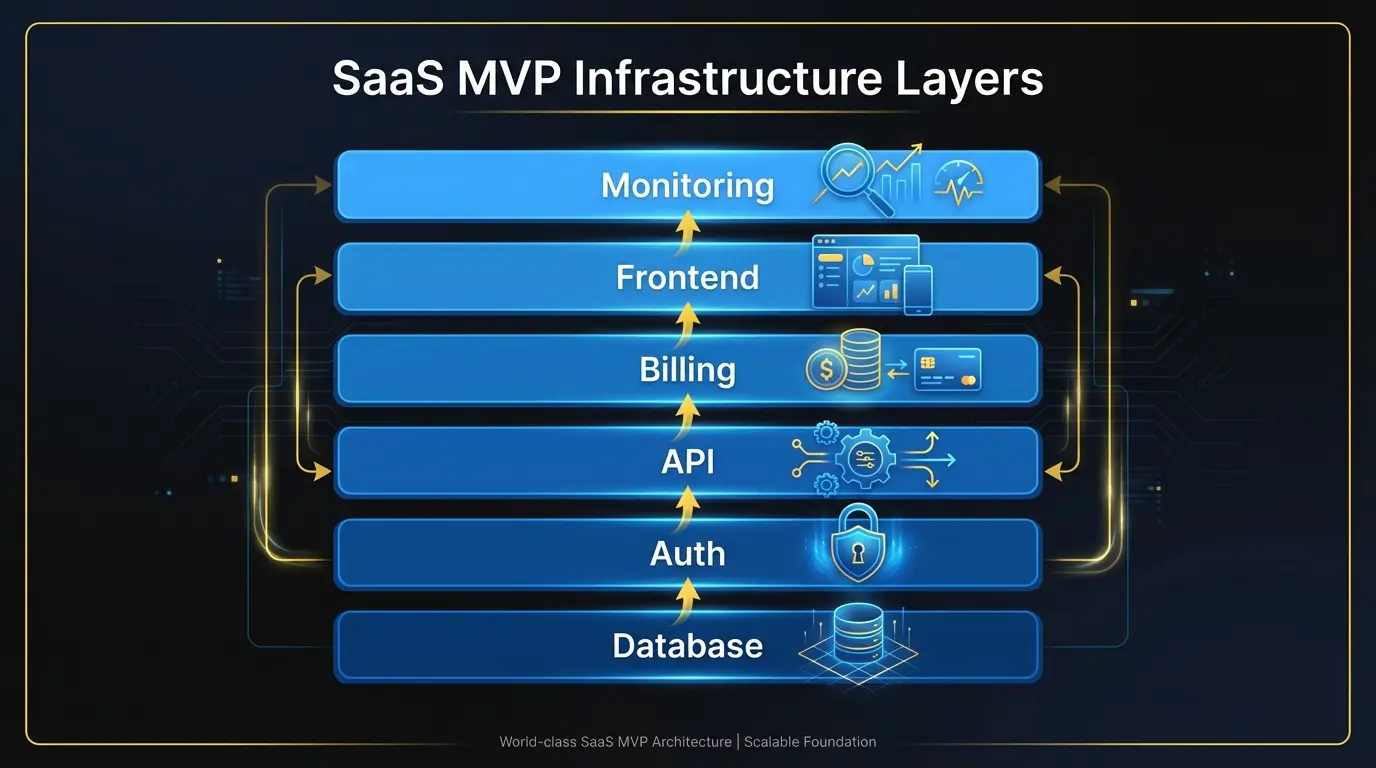
This is not a recommendations list. It’s a requirements list. A production SaaS product needs all of these layers, whether you build them yourself, use managed services, or have them built for you.
Cost and Timeline Reality
What SaaS MVP development costs in 2026
| Approach | Simple SaaS | Moderate SaaS | Complex SaaS |
|---|---|---|---|
| Build yourself | $0 + 2-4 months of your time | $0 + 4-6 months | Not realistic solo |
| Freelancer | $15K-$40K, 6-10 weeks | $30K-$70K, 10-16 weeks | $50K-$120K, 4-6 months |
| Agency | $40K-$80K, 8-12 weeks | $80K-$150K, 12-20 weeks | $150K-$300K+, 5-9 months |
| Supervised AI build | $8K-$20K, 1-2 weeks | $20K-$40K, 2-4 weeks | $40K-$75K, 3-6 weeks |
“Simple SaaS” = single user role, basic CRUD, Stripe billing, 5-10 screens. “Moderate SaaS” = multiple roles, dashboard with analytics, 3-5 integrations, 15-25 screens. “Complex SaaS” = marketplace/platform, real-time features, custom workflows, enterprise auth (SSO).
Why SaaS costs more than you’d think
The infrastructure requirements listed above aren’t optional features. They’re baseline requirements. A SaaS product without proper auth, billing, and data isolation isn’t an MVP. It’s a demo. Every one of those layers needs to be implemented correctly, tested, and maintained.
The billing integration alone (Stripe webhooks, subscription management, feature gating, dunning flows) typically represents 15-20% of the total development effort for a SaaS MVP.
Build vs. Buy vs. Have It Built
For SaaS MVP development specifically, the “build vs. buy” framework has a third option.
Build: Do it yourself
Who this is for: Technical founders with backend experience and 2-4 months to dedicate.
The advantage is total control and zero cash cost. The disadvantage is time. Most technical founders should be spending their time on customers, not code, in the earliest stages.
If you build it yourself, use managed services for everything possible. Don’t build your own auth (use Clerk or Supabase Auth). Don’t build your own billing (use Stripe). Don’t build your own email (use Resend). Focus your custom engineering on the one thing that makes your product unique.
Buy: Use a SaaS boilerplate
Who this is for: Technical founders who want a head start.
SaaS boilerplates like ShipFast, Gravity, or SaaSfly give you a pre-built codebase with auth, billing, and basic architecture already configured. You customize from there.
The advantage: you skip 2-4 weeks of boilerplate setup. The disadvantage: you inherit someone else’s architecture decisions, and those decisions may not fit your product. Customizing a boilerplate past its intended patterns often takes longer than building from scratch.
Have it built: Expert-supervised AI building
Who this is for: Founders (technical or not) who want production-grade SaaS shipped in weeks.
Senior engineers use AI agents to build your SaaS product from your description. Architecture decisions are made by experienced engineers. Code is generated by AI and reviewed by humans. The SaaS infrastructure (auth, billing, multi-tenancy, deployment) is implemented to production standards.
For a complete overview of this approach and how it compares to agencies and freelancers, see MVP Development in 2026: The Complete Guide for Startups.
How AI-Supervised SaaS Builds Work
The supervised AI building model is particularly well-suited for SaaS because SaaS architecture follows well-established patterns. Authentication, billing, multi-tenancy, CRUD operations, dashboard layouts. These are solved problems. AI agents can generate the implementation quickly because the patterns are well-documented and consistent.
What makes supervised building different from using AI tools yourself:
Architecture decisions are made by engineers. Database schema design, API structure, multi-tenancy approach, caching strategy. These decisions determine whether your SaaS can scale. AI generates the code. Engineers make the decisions the code implements.
The full stack is covered. Not just the frontend (like most AI builder tools). Backend, database, authentication, billing integration, deployment pipeline, monitoring. The complete SaaS infrastructure.
Integrations are production-grade. Stripe webhooks that handle every edge case (failed payments, subscription updates, refunds, disputes). Email flows that actually deliver. API connections with proper error handling and retry logic.
The output is a real SaaS product. Not a prototype that needs to be rebuilt. A product with a deployment pipeline, staging environment, monitoring, and the ability to ship updates safely.
The Case for Speed: Why Days Matter for SaaS
SaaS founders often underestimate the cost of being slow. Timeline compression matters more for SaaS than almost any other product category.
Monthly revenue starts at $0
Unlike a one-time sale, SaaS revenue only begins when customers start paying monthly. Every month you spend building instead of selling is a month of $0 MRR. If your SaaS charges $99/month and you get 20 customers in month 1, that’s $1,980/month in recurring revenue you didn’t collect during a 6-month development cycle.
Churn compounds in reverse
The earlier you launch, the earlier you start learning what causes churn. A SaaS product that launches 4 months sooner gets 4 months of customer feedback, usage data, and churn analysis. That data compounds into better retention, which compounds into higher LTV, which compounds into a more fundable business.
Competitors are building with AI too
The founders using AI builder tools to launch SaaS products may not build production-grade products, but they’re getting to market fast. If a competitor launches a mediocre version of your product 3 months before you ship a good version, they have 3 months of customer relationships, feedback loops, and brand recognition that you’re starting from zero.
Fundraising windows have timelines
If you’re raising capital, investors want to see traction. Traction requires a live product. A 6-month development timeline that pushes your launch past the fundraising window can delay your raise by a full quarter.
Getting Started
If you’re ready to build a SaaS MVP, here’s the path:
- Define the core value. What does your SaaS do that’s worth $X/month? Write it in one sentence.
- Identify the 3-5 core features. Not the full roadmap. Just the features that deliver the core value to your first 10 customers.
- Choose your build approach. Based on your budget, timeline, and technical skills (use the comparison table above).
- Invest in the PRD. Whether you build it yourself or hire someone, a detailed product requirements document prevents the number one cause of delays: unclear requirements.
- Ship, measure, iterate. Launch to 10 customers. Watch what they do. Fix what breaks. Add what they ask for. Repeat.
The biggest mistake in SaaS MVP development isn’t choosing the wrong tech stack or the wrong agency. It’s spending 6 months building a product that 10 conversations with customers would have reshaped in week 2. Ship fast. Learn fast. Iterate fast.
The Bottom Line
SaaS MVP development is more complex than building a simple web application. Multi-tenancy, subscription billing, role-based auth, API design, and data isolation are baseline requirements, not nice-to-haves.
That complexity is exactly why the supervised AI building model fits SaaS so well. The patterns are established. The integrations are standard. AI agents can generate the implementation fast. Experienced engineers ensure the architecture decisions are sound.
Building a SaaS product in 2026 doesn’t require 6 months and $100K. It requires clear requirements, the right approach, and a team that can ship production-grade software in days. The SaaS founders who win are the ones who get to market first with a product that actually works.
Want to ship your SaaS MVP in weeks, not months? Get in touch with our team to discuss your project.