Key Takeaway
SR&ED consultants charge 15-30% of your claim value and handle everything. Software platforms like Chrono cost a flat fee ($2K-$9.5K per claim) and automate documentation from your dev tools. DIY is free but risky if you lack CRA experience. Companies with $100K+ in annual claims usually benefit most from automation.
Filing an SR&ED claim is not a trivial exercise. The average Canadian technology company spends 40 or more hours per claim cycle gathering documentation, writing project descriptions, allocating expenditures, and preparing Form T661 for submission to the CRA. How you approach that process — doing it yourself, hiring a consultant, or using a software platform — affects how much you recover, how much you spend to recover it, and how exposed you are to an audit.
This guide breaks down all three approaches so you can make an informed decision based on your company’s size, claim complexity, and internal capacity.
The Three Approaches to SR&ED Claims
1. DIY (In-House Filing)
Filing your SR&ED claim internally means your technical and finance teams handle everything: identifying eligible projects, writing technical narratives, calculating expenditures, completing Form T661, and submitting to the CRA.
Who it works for:
- Companies with a dedicated finance team that has SR&ED experience
- Firms with straightforward claims (fewer than 3 projects, single jurisdiction)
- Businesses with strong existing documentation practices
What it actually costs:
| Cost Component | Estimate |
|---|---|
| Internal labour (40-80 hours at $75-150/hr loaded cost) | $3,000 - $12,000 |
| Opportunity cost of technical staff writing narratives | $2,000 - $5,000 |
| Risk of under-claiming due to inexperience | 15-30% of potential credit |
| Potential audit remediation if documentation is weak | $5,000 - $15,000+ |
| Total effective cost | $5,000 - $32,000+ |
Pros:
- No external fees. Every dollar recovered is retained.
- Full control over timeline and process.
- Institutional knowledge stays in-house.
Cons:
- Steep learning curve. CRA’s eligibility criteria, the three-part test for technological uncertainty, and expenditure allocation rules are nuanced.
- Under-claiming is the most common outcome. Companies that file without expertise routinely leave 15-30% of eligible credits on the table because they miss qualifying activities, under-allocate salary expenditures, or fail to include eligible materials and subcontractor costs.
- Audit risk increases. Claims without proper documentation and technical narratives that satisfy CRA reviewers are more likely to be selected for review and more likely to face reductions.
- Time drain on your best people. Your CTO writing SR&ED narratives is not building product.
The bottom line: DIY works if you have done it before successfully and your claims are simple. For first-time claimants or companies with complex, multi-project claims, the savings on fees are typically wiped out by under-claiming and audit exposure.
2. SR&ED Consultants
SR&ED consulting firms handle the claim preparation process for you. They typically assign a technical writer and a financial analyst to your account. They interview your engineering team, write the project descriptions, calculate expenditures, prepare Form T661, and represent you if the CRA initiates a review.
Consultants range from boutique SR&ED-only firms to Big 4 accounting practices (KPMG, Deloitte, PwC, EY) that offer SR&ED as part of broader tax advisory services. If you’re evaluating consultants, see our guide to 13 SR&ED tax credit consultants in Canada.
Who it works for:
- Companies filing SR&ED for the first time and needing expert guidance
- Firms with complex claims spanning multiple projects, provinces, or fiscal years
- Businesses that want audit defense included
- Organizations without internal SR&ED or tax credit expertise
What it actually costs:
Most SR&ED consultants use one of two fee structures:
| Fee Model | Typical Rate | On a $200K Claim |
|---|---|---|
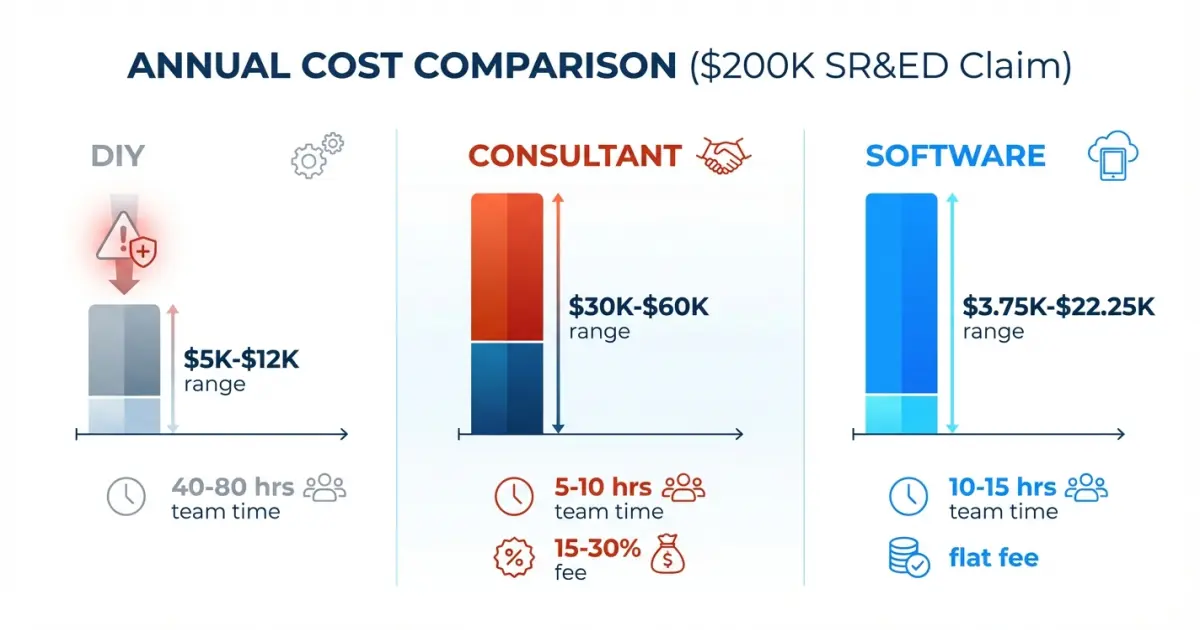
| Contingency (% of credit recovered) | 15-30% of the refund | $30,000 - $60,000 |
| Fixed fee | $5,000 - $25,000 per claim | $5,000 - $25,000 |
| Hourly (less common) | $150 - $400/hr | $10,000 - $40,000 |
Contingency-based pricing is the most common model. It eliminates upfront risk for the claimant, but the cumulative cost over multiple filing years is significant. On a $200,000 annual claim at 25% contingency, you pay $50,000 per year — or $250,000 over five years — for what is largely the same work repeated.
Boutique firms vs. Big 4:
| Factor | Boutique SR&ED Firm | Big 4 (KPMG, Deloitte, PwC, EY) |
|---|---|---|
| Typical fee | 15-25% contingency or $5-15K fixed | 20-30% contingency or $15-25K fixed |
| Specialization | SR&ED is their entire business | SR&ED is one service among many |
| Attention | Dedicated team, often the principals | May be delegated to junior staff |
| Audit defense | Usually included | Often an additional engagement |
| Industry expertise | Varies by firm | Broader but shallower |
| Minimum claim size | Often $50K+ credit | Often $100K+ credit |
Pros:
- Expertise maximizes claim value. Good consultants consistently recover 20-40% more than first-time DIY filers.
- Audit defense is typically included or available. Experienced consultants know CRA reviewers and processes.
- Minimal time required from your team. Typically 5-10 hours of interviews per claim cycle.
- Industry-specific knowledge. The best firms know exactly what CRA expects in your sector.
Cons:
- Expensive, especially on contingency. The 15-30% fee compounds annually and does not decrease as the consultant’s familiarity with your business grows.
- You are dependent on their schedule. Consultants manage multiple clients, and claim cycles can slip.
- Knowledge stays with the consultant, not your company. If you switch providers or bring the process in-house later, you start over.
- Quality varies enormously. The market includes excellent specialists and underperforming generalists. Due diligence on success rates and references is essential.
- Documentation gaps persist. Most consultants rely on your team’s recollection months after the work was done. If your engineering team cannot reconstruct what they worked on six months ago, even the best consultant cannot fully capture eligible activities.
The bottom line: Consultants are the right choice when you lack internal expertise, your claim is complex, and the fee is justified by the recovery uplift. They are the wrong choice when you are paying 25% of a predictable, repeating claim year after year for the same work, or when your primary bottleneck is documentation, not claim preparation.
3. SR&ED Software Platforms
Software platforms like Chrono automate the documentation, time tracking, and claim preparation workflow. Instead of relying on a consultant to reconstruct your eligible activities after the fact, a platform captures evidence in real time — integrating with your existing project management tools (Jira, Asana, Linear), communication platforms (Slack, Teams), and time tracking systems to build a continuous, audit-ready record of your R&D work.
Who it works for:
- Technology companies (software, SaaS, engineering) where R&D activity is tracked in digital tools
- Companies with repeating annual claims that want to reduce the cost of filing over time
- Firms that want to maintain control of the process without starting from scratch each year
- Businesses that have been through the consultant model and want a more cost-effective, scalable approach
What it actually costs:
| Cost Component | Estimate |
|---|---|
| Platform subscription (annual) | $3,000 - $15,000 |
| Internal time (reduced to 10-15 hours with automation) | $750 - $2,250 |
| Optional consultant review (flat fee, not contingency) | $2,000 - $5,000 |
| Total effective cost | $3,750 - $22,250 |
Compare this to the consultant model on a $200K annual claim: a platform saves $28,000 - $38,000 per year versus a 25% contingency arrangement.
Pros:
- Dramatically lower cost per claim cycle, especially after the first year.
- Real-time documentation eliminates the retrospective scramble. Evidence is captured as work happens, not reconstructed months later from memory.
- Audit readiness is built in. Automated time categorization, project-to-expenditure mapping, and continuous technical evidence collection mean your claim is defensible from day one.
- Institutional knowledge stays in your company. Your SR&ED history, documentation, and claim data are yours, not locked in a consultant’s files.
- Scales with your business. Adding projects, team members, or provincial claims does not trigger proportional cost increases.
- Integrates with your existing workflow. No new tools to learn — the platform pulls from the systems your team already uses.
Cons:
- Requires some internal ownership. Someone on your team needs to manage the platform and review outputs, even if the time commitment is low.
- Not ideal for companies with zero digital project tracking. If your R&D work is not tracked in any system, a platform has less data to work with.
- First-year setup requires configuration and data integration.
- For extremely complex, multi-entity, multi-jurisdiction claims, you may still want a consultant involved for strategic advisory (but the platform handles the heavy lifting).
The bottom line: Software platforms are the right choice when your company files annually, your R&D work is tracked digitally, and you want to reduce costs while maintaining or improving claim quality. They are especially compelling for technology companies that have outgrown the value proposition of paying 15-30% contingency fees on repeating claims.
Head-to-Head Comparison
| Factor | DIY | Consultant | Software Platform |
|---|---|---|---|
| Annual cost (on $200K claim) | $5,000 - $12,000 + risk | $30,000 - $60,000 | $3,750 - $22,250 |
| Time from your team | 40-80 hours | 5-10 hours | 10-15 hours |
| Claim quality | Variable (depends on expertise) | High (if firm is reputable) | High (with real-time evidence) |
| Audit readiness | Low without proper documentation | High (with experienced firm) | High (built-in) |
| Year-over-year cost trend | Flat | Flat (same % every year) | Decreasing (setup is year 1 only) |
| Knowledge retention | In-house | With the consultant | In-house |
| Scalability | Poor (linear with headcount) | Moderate (fees scale with claim) | High (marginal cost near zero) |
| Best for | Simple, small claims with experienced staff | Complex first-time claims, multi-jurisdiction | Recurring technology company claims |
Decision Framework: Which Approach Should You Choose?
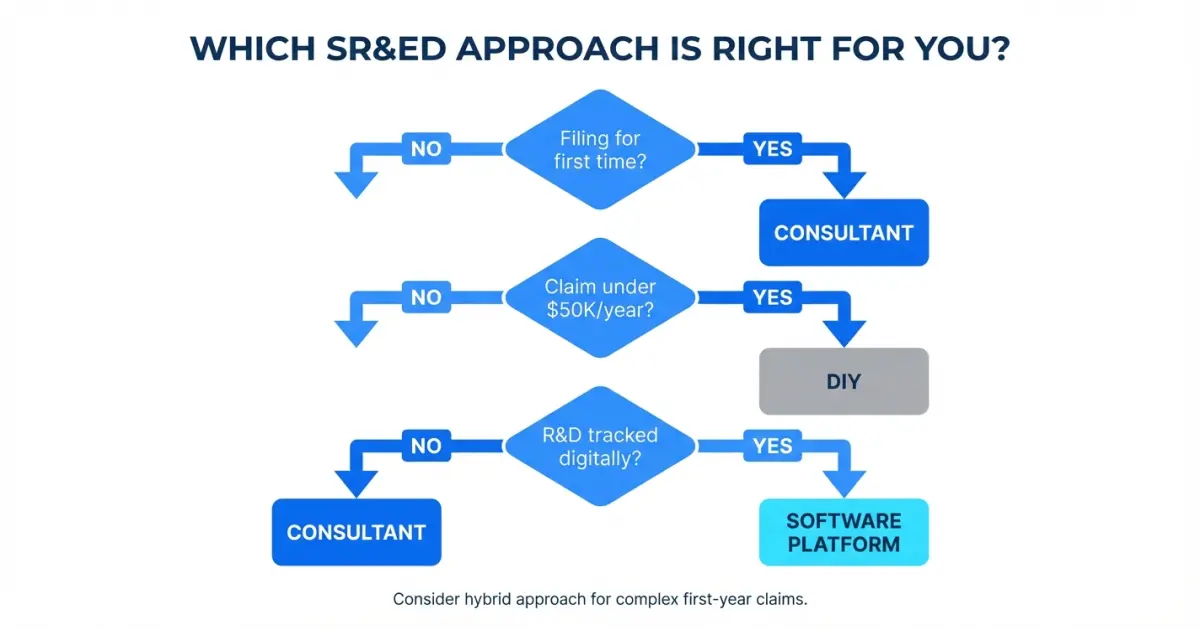
Use this framework to narrow your decision:
Choose DIY if:
- Your claim involves fewer than 3 projects
- You have someone on your team with direct SR&ED filing experience
- Your annual credit is under $50,000
- You have strong existing documentation habits
Choose a Consultant if:
- You are filing SR&ED for the first time and need hands-on guidance
- Your claim spans multiple provinces, entities, or fiscal years
- You need someone to represent you in an active CRA review
- Your claim is large enough that even a 15-30% fee leaves meaningful recovery
- You do not have internal capacity to manage any part of the process
Choose a Software Platform if:
- You file SR&ED annually and want to reduce your cost-per-claim over time
- Your R&D team uses digital project management and communication tools
- You want real-time documentation instead of retrospective reconstruction
- You have had a consultant but find the annual fee hard to justify for repeating work
- You want audit-ready evidence without the ongoing expense of an external firm
Consider a Hybrid Approach if:
- You want a platform for documentation and expenditure tracking but a consultant for strategic advisory and audit defense on your first filing
- You are transitioning from a consultant to in-house management and want a platform to bridge the gap
What About the Big 4?
Companies sometimes default to KPMG, Deloitte, PwC, or EY for SR&ED because they already have an accounting relationship. This can work, but it comes with trade-offs worth understanding.
Big 4 firms typically charge 20-30% contingency or premium fixed fees ($15,000-$25,000+). Their SR&ED practice may be staffed by specialists, but claim work can also be delegated to junior team members with less direct experience. Audit defense is often billed as a separate engagement.
The Big 4 make sense when your SR&ED claim is part of a broader tax optimization strategy involving transfer pricing, international R&D credits, or multi-entity structures. For a standalone Canadian SR&ED claim at a mid-market technology company, they are often more expensive without a proportional increase in claim quality.
Comparing SR&ED Software Platforms
If you are evaluating SR&ED software, you may have come across platforms like Boast.ai. When comparing platforms, evaluate:
- Integration depth: Does the platform connect to your actual project management tools (Jira, Asana, Linear), or does it require manual data entry?
- Evidence quality: Does it capture contemporaneous documentation, or does it still rely on retrospective interviews?
- Cost structure: Is it a flat subscription, or does pricing scale with your claim size (effectively a digital contingency fee)?
- Audit defensibility: Can it produce a complete audit trail that satisfies CRA reviewers?
- Time categorization: Does it automatically classify R&D activities against SR&ED eligibility criteria?
Chrono Platform was built specifically for technology companies that want to automate the hardest part of SR&ED: capturing real-time evidence of eligible work from the tools engineering teams already use. It integrates with Jira, Asana, Slack, Microsoft 365, and other workplace systems to build a continuous, audit-ready record — eliminating the documentation gap that both DIY filers and consultants struggle with.
The Real Cost of the Wrong Choice
The stakes are higher than most companies realize:
- Under-claiming is the silent cost. Companies that file without expertise or proper documentation routinely recover 15-30% less than they are entitled to. On a $300,000 eligible claim, that is $45,000 - $90,000 left on the table — every year.
- Overpaying for consultants is the visible cost. A 25% contingency fee on a $200,000 annual claim is $50,000 per year. Over five years, that is $250,000 paid for what is largely repetitive work.
- Audit failure is the catastrophic cost. A poorly documented claim that triggers a CRA review can result in the entire credit being denied or substantially reduced. The ripple effects include repayment obligations, penalties, and future claims receiving heightened scrutiny.
The right approach is the one that maximizes your net recovery (credit received minus cost to file) while keeping your audit risk low. For most recurring technology company claimants, that points toward a platform-based approach — either standalone or combined with targeted consultant advisory.
Next Steps
- Calculate your current cost-per-claim. Include internal hours, consultant fees, and any credit you suspect you are leaving on the table.
- Assess your documentation baseline. Do you have contemporaneous records of R&D activities, or are you reconstructing from memory each year?
- Try the SR&ED Calculator. Get a quick estimate of your potential credit to understand the dollar value at stake.
- Book a demo of Chrono Platform. See how automated time tracking and real-time documentation can reduce your filing cost while improving claim quality.
If your SR&ED claim is worth protecting — and if you are paying more than you should to prepare it — it is worth 15 minutes to see a better approach.
Frequently Asked Questions
How much do SR&ED consultants charge?
Most SR&ED consultants charge 15-30% of your approved claim value as a contingency fee. On a $200,000 annual claim, that’s $30,000 to $60,000 per year. Some offer fixed-fee arrangements, but contingency pricing dominates the market.
Can I file an SR&ED claim without a consultant?
Yes. Companies with internal technical and accounting expertise can file claims themselves using Form T661. The risk is under-claiming or making documentation mistakes that trigger CRA audits. Software platforms reduce this risk by automating evidence collection and generating CRA-ready documentation.
What’s the cheapest way to file SR&ED claims?
Software platforms like Chrono cost a flat fee ($2K-$9.5K per claim) and automate documentation from your development tools. For companies with $100K+ in annual claims and recurring filing needs, automation has the lowest total cost over time compared to consultants or DIY approaches.