You hired three senior engineers. Gave them an AI product to build. Everything broke.
Not technically. Organizationally.
By week three, nobody knew who owned evaluation quality. By week five, model selection decisions bottlenecked the product roadmap. By week six, someone shipped a feature without checking whether the cost was sustainable. By week eight, the whole thing derailed.
This isn’t a management failure. It’s a structural one. Building AI products demands different role clarity than traditional software — and most teams figure this out after it explodes.
The Structural Differences
Traditional software products have clear responsibility lines. The frontend engineer owns rendering. The backend engineer owns the API. The database engineer owns the schema. When something breaks, you know whose problem it is.
AI products blur those lines.
A single decision — how you orchestrate tool calls, how aggressive your guardrails are, how much context you retrieve — affects:
- Model accuracy (ML space)
- System performance (infrastructure)
- User cost (product economics)
- Team velocity (operational)
It’s not one person’s problem. It’s everyone’s. And without explicit ownership, you get analysis paralysis or random decisions that pile up as technical debt.
The Roles That Actually Work
The AI Architect (sometimes the lead engineer, sometimes a separate role) owns end-to-end orchestration. What model goes where? How does data flow from input to output? Where do humans intervene? What are the failure modes? This person makes the structural decisions the rest of the team builds on.
The AI Reliability Engineer (the SRE equivalent for AI systems) owns observability, cost measurement, and failure recovery. What do we measure to know the system works? What breaks, and how do we recover? Traditional engineering leads don’t usually own these dimensions well, and it’s too important to be someone’s side project.
The Evaluation Lead (often overlaps with the AI Architect) owns test coverage — not unit tests for code, but evaluation coverage. How do we know the system is good enough to ship? What’s the eval strategy? Most teams under-evaluate, and that’s the difference between shipping a working product and an embarrassing failure.
The Product Engineer (a senior engineer in traditional terms) owns feature velocity and integration. How does this fit the product roadmap? What’s the user experience? This person makes sure the AI is a feature, not a solution looking for a problem.
The Platform Engineer (optional early, required at scale) owns infrastructure, model hosting, and inference serving. Cost-efficiency, latency, and reliability at the infrastructure layer.
The key difference from traditional product teams: the AI Reliability Engineer and Evaluation Lead roles are explicit and carry real authority. They’re not secondary hats worn by someone else.
The Decision-Making Structure
Ownership clarity is only half of it. You also need clear decision rights.
Model selection: The AI Architect and Evaluation Lead own this. Not the entire team debating. Not product pulling in a direction that ignores cost. The Architect and Eval Lead say “here’s the model, here’s why,” and the team moves.
Orchestration: The AI Architect owns this. Single agent? Multi-agent? Tool use? Cascading fallbacks? This decision cascades into everything else. It needs a single owner.
Cost: The AI Reliability Engineer owns this. If an experiment would triple the token spend, they flag it — not to say no, but to say “here’s what this costs, here’s what we’re giving up.”
Evaluation thresholds: The Evaluation Lead owns this. When can we ship? What metrics matter? What’s passing? This needs to be clear before you’re emotionally attached to shipping.
Feature prioritization: Product owns this, in conversation with the Architect. The Architect says what’s technically feasible, and Product decides what matters most.
The single mistake most teams make: they involve too many people in every decision, hoping consensus will catch problems. Instead, they get slow, uncertain decision-making where nobody feels accountable when things go wrong.
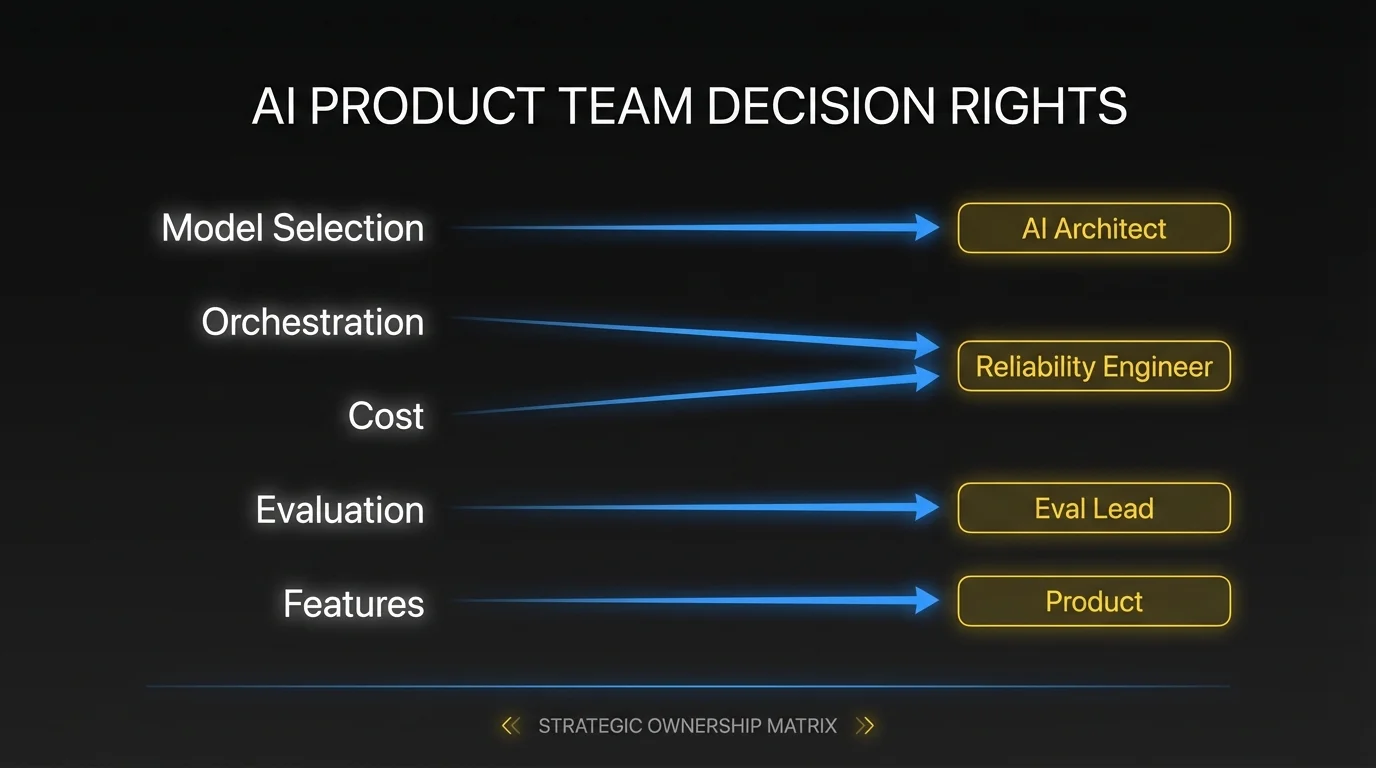
Clear ownership + clear decision rights = speed.
The Org Chart That Works
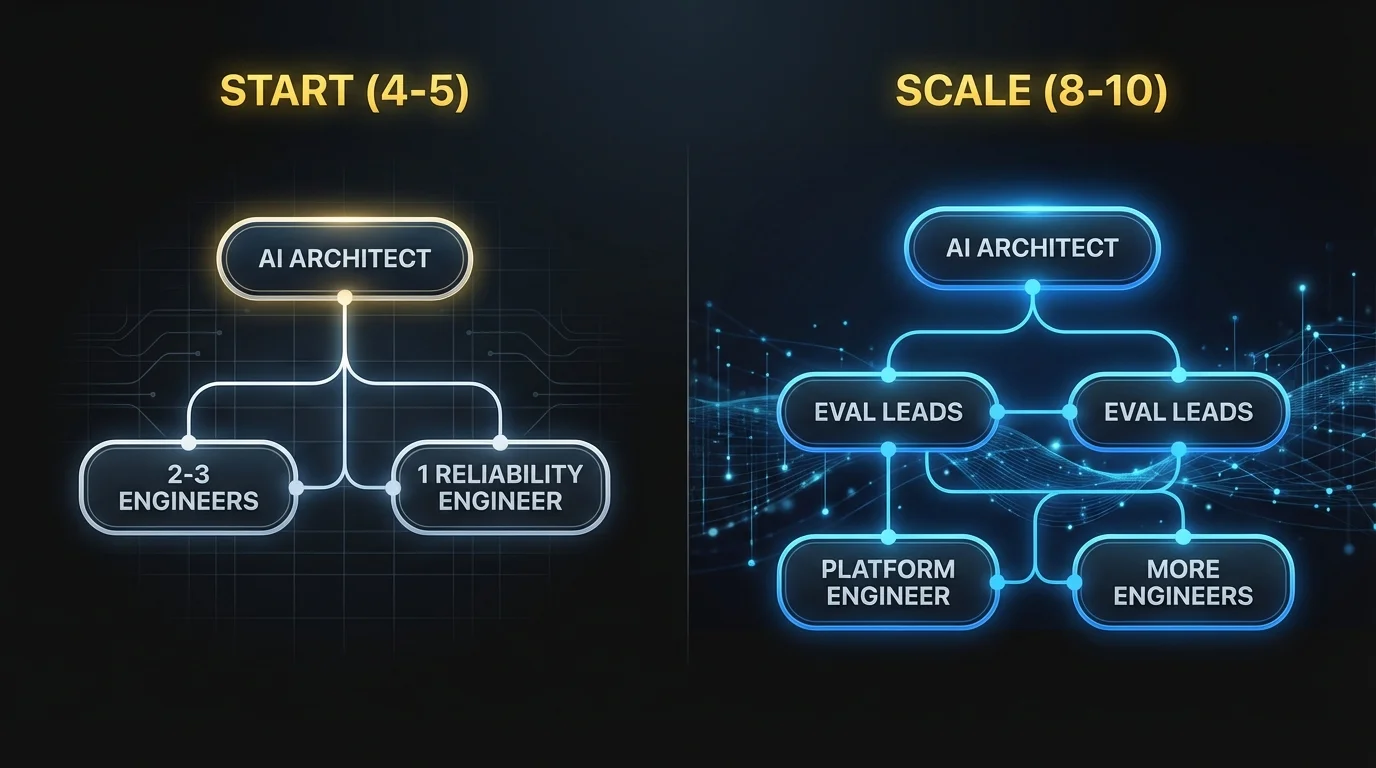
At the start (team of 4-5):
- AI Architect (leads)
- 2-3 Product Engineers
- 1 AI Reliability Engineer (might split duties with the Architect early on)
- Product Manager (sometimes part-time)
As you scale (team of 8-10):
- AI Architect
- 3-4 Product Engineers (some specializing in different surfaces)
- 1-2 AI Reliability Engineers
- 1-2 Evaluation Leads
- Product Manager
- 1 Platform Engineer (for inference infrastructure)
The key: these roles exist with authority, not as hats stacked on top of other jobs.
What This Means
Think about this structure before day one of your next AI product. You won’t have all these roles immediately, but you should know who owns what. Evaluation. Reliability. Orchestration. Cost. Feature velocity.
The teams that ship have clarity on who makes which decisions. The teams that derail let decisions emerge organically.
Building an AI product and want to get the team structure right from the start? Talk to our AI development team about how we help organizations ship AI agents without the organizational chaos.