Key Takeaway
BDC's $500M LIFT program can pay for an AI project, but it can't define one. Before the financing conversation, turn one specific bottleneck into a ten-field project canvas with a measured baseline, a named owner and a plan for after the pilot, then run a 6 to 12 week pilot that ends in a decision.
Financing for AI adoption is easier to get in Canada than it was a year ago, but a loan pays for a project without defining one. This article is for owners and operators of small and mid-sized enterprises (SMEs) looking at BDC’s LIFT program or any AI budget. It shows how to turn one operational bottleneck into a project that’s specific enough to finance and small enough to deliver, before you talk to a lender.
In April 2026, BDC (the Business Development Bank of Canada) launched LIFT, a $500 million program for SMEs adopting AI and productivity technology. In June, the federal AI strategy pointed to LIFT as one of the ways it plans to get more small and mid-sized businesses using AI.
That helps. It also exposes a gap financing can’t close. Most SMEs we talk to sense that AI could help somewhere in operations. They have a much fuzzier picture of the specific problem, the measurable result, who owns it, and what happens after the first few months.
Disclaimer. Chrono Innovation is not affiliated with BDC. LIFT eligibility, terms and approval are determined by BDC. This is general information, not financial advice. Check bdc.ca or talk to BDC directly for current program details.
What is BDC LIFT?
LIFT (Lead with Innovation and Focus on Technology) is a BDC financing program for SMEs adopting AI and productivity technology. BDC announced it on April 24, 2026, with $500 million earmarked and a goal of helping more than 1,000 SMEs adopt AI. The announcement describes loans from $25,000 to $5 million, flexible terms including postponed principal payments, and pairing owners with expert AI advisors.
BDC’s program page describes two tracks:
| Digital transformation and AI | Productivity and digitally enabled equipment | |
|---|---|---|
| Who | Canadian businesses with at least $1M in revenue, most industries (some exceptions) | Canadian businesses with at least $5M in revenue in listed sectors, including manufacturing, transport and warehousing, wholesale and construction |
| What it finances | Data infrastructure, enterprise systems such as ERP and CRM, AI technology, cybersecurity | Equipment, robotics, automation and related implementation costs |
| Advisory | A BDC Advisory Services plan is mandatory | Consulting is optional |
Two more details from BDC’s page matter for planning. You need a productivity plan to apply for financing. And preferential terms apply, with conditions, when Canadian suppliers provide or integrate the technology.
That plan requirement is BDC’s process, and their advisors run it. Nothing here replaces it. This is the prep work that makes that conversation, or any internal budget conversation, more productive.
Why do SME AI projects stall even with financing?
Because the money was rarely the problem. When AI projects at SMEs stall, it’s almost always one of five things, and each can be fixed before a dollar is spent.
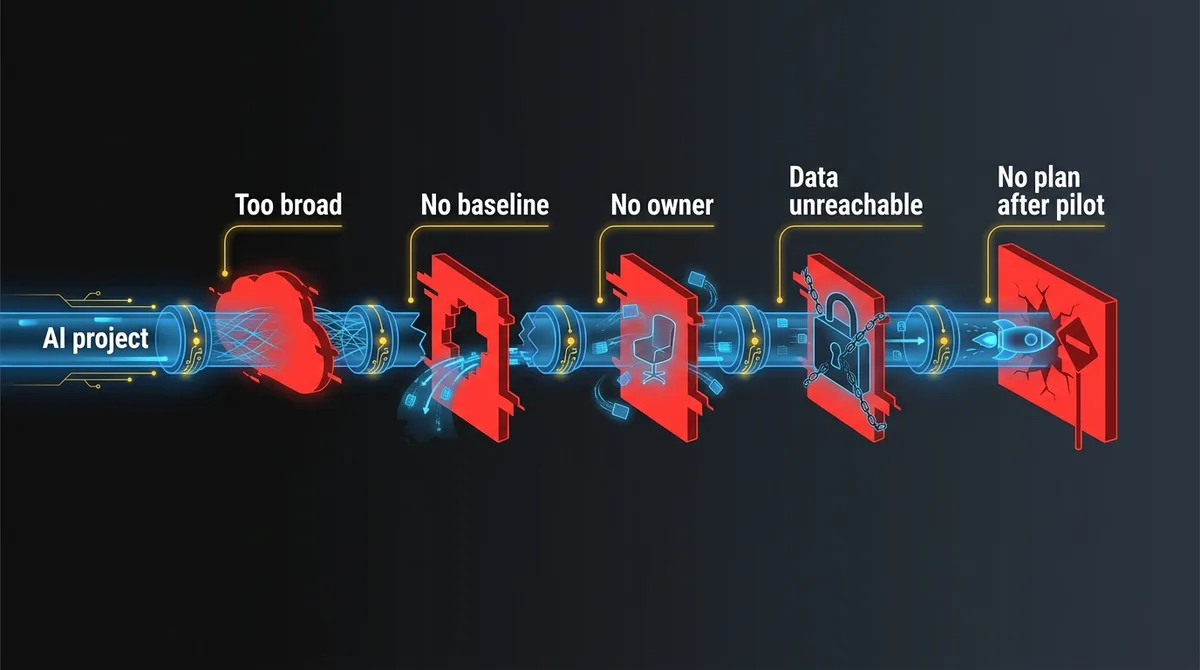
The problem is too broad. “Use AI in customer service” or “automate the back office” can’t be scoped, priced or measured. Nothing in it tells an engineer what to build first.
There’s no baseline. Nobody has measured how long the process takes or what it costs today. So nobody can say whether the project worked, and the lender or the board has no way to judge the value.
Nobody owns it. The idea came from the CEO or an outside advisor, but no one in operations has agreed to change how their team works.
The data isn’t reachable. What the system needs sits in inboxes, PDFs, a legacy ERP with no API, or someone’s spreadsheet.
There’s no plan after the pilot. The pilot ships, works, and then nobody runs it. No one budgeted for hosting, monitoring or the hour a week of maintenance it needs.
Most of these take a few conversations and a week of measurement to fix.
How do you pick the right first AI project?
Start with one bottleneck that’s specific, frequent and measurable, where the data is reachable and someone will own the change. The best first AI project at an SME is almost never the biggest opportunity.
A good bottleneck statement fits in one or two sentences and names a process, a volume and a cost. Compare these two:
- “We want to use AI to improve sales operations.”
- “Quotes for custom parts take four days on average because an estimator re-keys dimensions from customer drawings into our costing spreadsheet. We send about 60 quotes a week and lose a lot of the late ones.”
You can scope, build and measure the second one. The first needs another month of meetings.
If you have several candidates, pick the one with the shortest path to a measurable result. From Data to Value takes the same approach to ranking, applied to decisions instead of processes.
What should an AI project canvas include?
Ten fields on one page: bottleneck, baseline, target, value, owner, scope, data and systems, risks, the plan after the pilot, and the decision point. Fill it in before the project goes to a lender, an advisor or your own leadership team.
| # | Field | What to write | Warning sign |
|---|---|---|---|
| 1 | Bottleneck | One or two sentences: process, volume, cost | Needs a paragraph to explain |
| 2 | Baseline | The metric today, measured: hours per week, days per cycle, error rate, cost per unit | “We think it’s about…” with no measurement |
| 3 | Target | Where the metric should be after the pilot, and after rollout | Target set by the vendor, not the owner |
| 4 | Value | What the improvement is worth per year, in dollars, with the arithmetic shown | Value is “efficiency” with no number |
| 5 | Owner | One person who runs the process and will make decisions weekly during the pilot | Owner is the CEO “in principle” |
| 6 | Scope | What the pilot includes, and what it explicitly leaves out | No “out of scope” list |
| 7 | Data and systems | Where inputs come from, how the system reaches them, where outputs go | “The data is somewhere in the ERP” |
| 8 | Risks | Data quality, adoption, security and privacy, vendor dependency, with a mitigation for each | Empty, or only technical risks |
| 9 | After the pilot | Who runs it, what it costs per month to operate, how it expands | Not discussed |
| 10 | Decision point | The result at the end of the pilot that means continue, adjust or stop | No pre-agreed criteria |
Fields 2, 5 and 9 get left blank most often. They’re also the ones that most often decide whether a project survives its first year. If you only fill in three fields this week, make it those.
For a deeper look at baselines, adoption targets and first-milestone criteria, see Before You Scale an AI Pilot, Write Down Five Numbers.
What does a 6 to 12 week AI pilot look like?
A baseline, two weeks of access and specification, a build against real inputs, a run with one team, and a decision against pre-agreed criteria. A pilot built for a measurable result runs on real work with the real team, and it ends with a decision instead of a demo. How long it takes depends mostly on data access and integration.
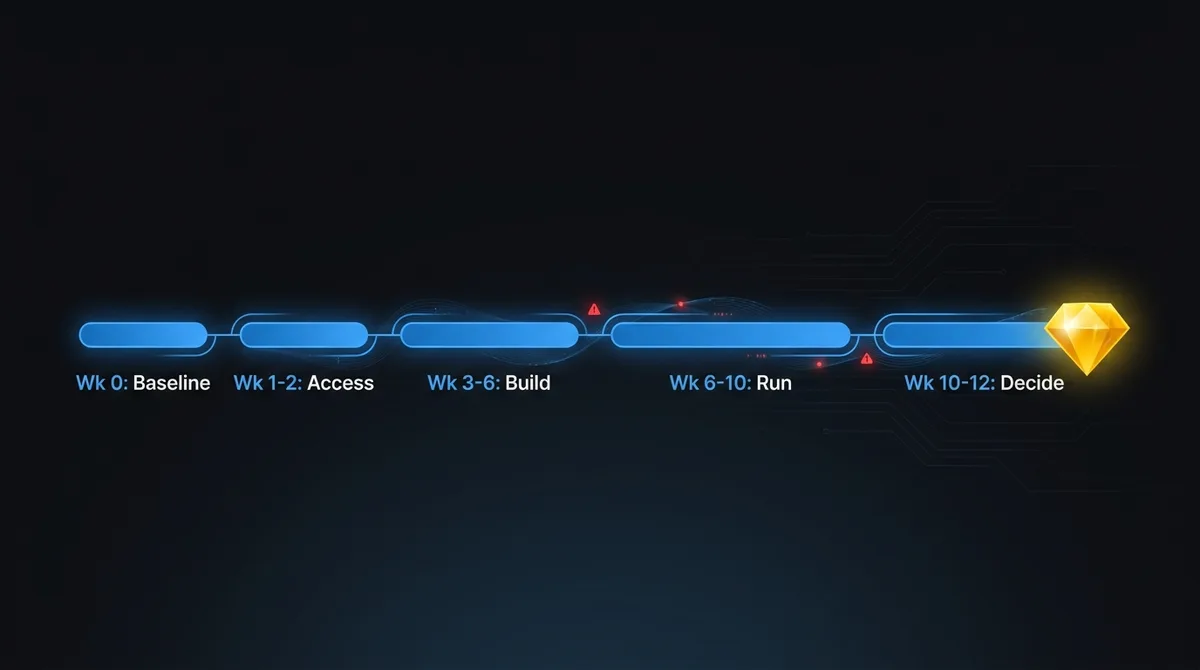
Week 0: Baseline. Measure the current process for one to two weeks if nobody has yet. Confirm the owner and the decision criteria.
Weeks 1 to 2: Access and specification. Get access to the data and systems. Collect a representative sample of real inputs, awkward ones included. Agree exactly what the system does and what a person still does.
Weeks 3 to 6: Build. Build against the real sample. Put it where the team already works (the ERP screen, the inbox, the CRM), not in a separate tool. Log every output and every human correction.
Weeks 6 to 10: Run with one team. Put it into production use for a defined slice of the work. Review adoption, accuracy, correction rate and the operating metric weekly with the owner.
Weeks 10 to 12: Measure and decide. Compare against the baseline. Continue, adjust or stop, using the criteria in field 10. If you continue, lock in the rollout plan and the monthly run cost.
Small projects with clean data finish closer to six weeks. Ones that need a new integration with an older system take longer. Either way, you end with a number and a decision. Our post on moving AI from pilot to production covers what changes once a pilot becomes a production system.
What do AI project canvases look like by sector?
Here are three, built from common patterns we see rather than specific clients. None needs a new platform. Each needs one owner, reachable data and a team willing to change one step of how it works.
Manufacturing: how do you speed up quote turnaround?
- Bottleneck: Custom-part quotes take four days; an estimator re-keys dimensions and materials from customer drawings and RFQ emails.
- Baseline: 60 quotes a week, an average of 3.5 estimator hours per quote, four-day turnaround.
- Pilot: The system pulls dimensions, materials and quantities from drawings and emails, pre-fills the costing sheet, and flags anything it’s unsure of. The estimator reviews and approves.
- Target: Estimator time under 1.5 hours per quote; turnaround under two days.
- Main risk: Drawing formats vary widely. Mitigation: start with the three most common customer formats.
- After the pilot: Expand to all formats; connect to the ERP quoting module.
Distribution: how do you automate order entry?
- Bottleneck: Customer purchase orders arrive as PDFs and emails in different formats; two people key them into the ERP.
- Baseline: About 400 orders a week at 6 minutes each, plus rework on keying errors.
- Pilot: The system reads incoming orders, matches customers and SKUs, creates draft orders in the ERP, and routes low-confidence lines for review.
- Target: 70% of orders created as drafts that only need approval; keying errors cut in half.
- Main risk: SKU matching for customers who use their own part numbers. Mitigation: build the cross-reference table in weeks 1 to 2.
Professional services: how do you cut proposal assembly time?
- Bottleneck: An engineering firm assembles proposals by searching past projects for similar scope, CVs and reference text. It takes senior staff a day or more per proposal.
- Baseline: About 15 proposals a month, roughly 10 senior hours each.
- Pilot: The system searches the past-project archive, drafts the relevant sections with sources linked, and assembles a first draft for a senior reviewer.
- Target: Senior time under 4 hours per proposal.
- Main risk: Confidential client information showing up in the wrong proposal. Mitigation: access controls by client and a review checklist.
How does Chrono help build the pilot?
We build the system for you. Supervised AI agents do the build work, senior engineers own the architecture and quality, and you get a production-grade system running on your real work, not a prototype. Pricing is tied to the outcome and a fixed milestone instead of hours, so the pilot’s cost is a known number you can put in field 9 and bring to a financing conversation. Here’s how outcome-based pricing works.
Whoever builds it, and however you pay for it, the canvas comes first. A lender, an advisor or your own board will ask the same questions it answers.
Frequently Asked Questions
Who is eligible for BDC LIFT?
According to BDC’s program page, the digital transformation and AI track is for Canadian businesses with at least $1M in revenue in most industries, and the equipment track is for businesses with at least $5M in revenue in listed sectors like manufacturing and construction. BDC sets eligibility and approval, so confirm the current terms with them directly.
Do I need a project plan before applying for AI financing?
BDC requires a productivity plan to apply for LIFT financing, and its advisors run that process. Arriving with a clear bottleneck, a measured baseline and a named owner makes that conversation faster and more useful.
How long should a first AI pilot take?
Six to 12 weeks for most SME workflows. Projects with clean, reachable data finish closer to six weeks, while ones that need a new integration with an older system take longer.
Which bottleneck will you bring?
Bring us one operational bottleneck and we’ll help you turn it into a project canvas and a 6 to 12 week pilot outline you can take into a financing or budget conversation. We’ll fill in the fields with you, flag what’s missing, and sketch what a measurable first milestone looks like. If it makes sense for us to build it, we’ll talk about that separately. Book a working session.
Chrono Innovation is not affiliated with BDC. LIFT eligibility, terms and approval are determined by BDC. This is general information, not financial advice.