Key Takeaway
The fastest path to AI funding is a single use case with clear costs, a 3-year ROI model showing year-1 investment and year-3 compounding, and all four alternatives (hire, embedded team, agency, do nothing) side by side.
Every SaaS company between $10M and $25M in revenue is having the same conversation right now. The CTO wants to build AI features. The CFO wants to see the math. The CEO wants both, yesterday.
Most of these conversations stall. Not because the opportunity isn’t real, but because the business case tries to justify “AI” as a category instead of a specific implementation with measurable outcomes. That’s like building a business case for “software.” Too broad to evaluate, too vague to fund.
The companies that move fastest start smaller. They pick one use case, model costs against alternatives, project revenue impact across multiple dimensions, and present a case their CFO can actually approve.
Why should you start with one use case instead of an AI strategy?
The instinct is to build a comprehensive AI strategy before asking for budget. Resist it. A 40-slide deck about “your AI vision” creates more questions than it answers. Most executive teams will defer the decision rather than approve something that broad.
Pick the use case with the clearest path to measurement. Good candidates share three traits: the current process has a known cost, the volume is high enough to matter, and the outcome is observable within 90 days.
For a $15M SaaS company, that might look like automating a chunk of customer onboarding that currently requires 3 hours of manual configuration per account. Or building an AI feature that moves a key product metric like activation rate or time-to-value. Or replacing a manual QA process that’s bottlenecking your release cycle.
Specificity matters. “We want to add AI to our platform” is a strategy discussion. “We want to automate the document classification step in our intake workflow, which currently takes 45 minutes per submission and processes 200 submissions per month” is a business case.
Build the case for a single use case. Win funding. Ship it. Use the results to fund the next one. This is how AI investment compounds inside an organization.
What are the four cost options every AI business case needs?
The cost side of an AI business case has four realistic options. Most teams only compare two, which distorts the analysis.
Full-time AI hire. A senior AI/ML engineer in the US costs $206K in base salary. Total first-year cost (benefits, equity, recruiting fees, onboarding) runs $250K-$320K. The hiring process takes 4-6 months on average. Add 2-3 months of ramp time before they’re productive in your codebase. Your first AI feature ships 6-9 months from the decision to hire.
Embedded fractional team. A senior embedded AI engineer or small squad runs $15K-$25K/month, working inside your codebase and your sprint cycle. First productive output within 1-2 weeks. No recruiting risk, no ramp period, and the engagement scales up or down based on what the roadmap requires.
Traditional agency or consultancy. Project-based engagement, typically $150K-$400K for a defined scope, delivered over 3-6 months. The output is a deliverable, not integrated capability. Your team inherits code they didn’t write, built on architectural decisions they didn’t make. Integration and maintenance costs are often underestimated.
Do nothing. This is the option most business cases leave out. It’s often the most expensive. More on this below.
Put all four in the spreadsheet. Include not just direct cost but time-to-first-value for each path. A $250K hire that takes 9 months to produce results has a very different NPV than a $20K/month embedded engagement that ships in 6 weeks.
How should you map revenue impact?
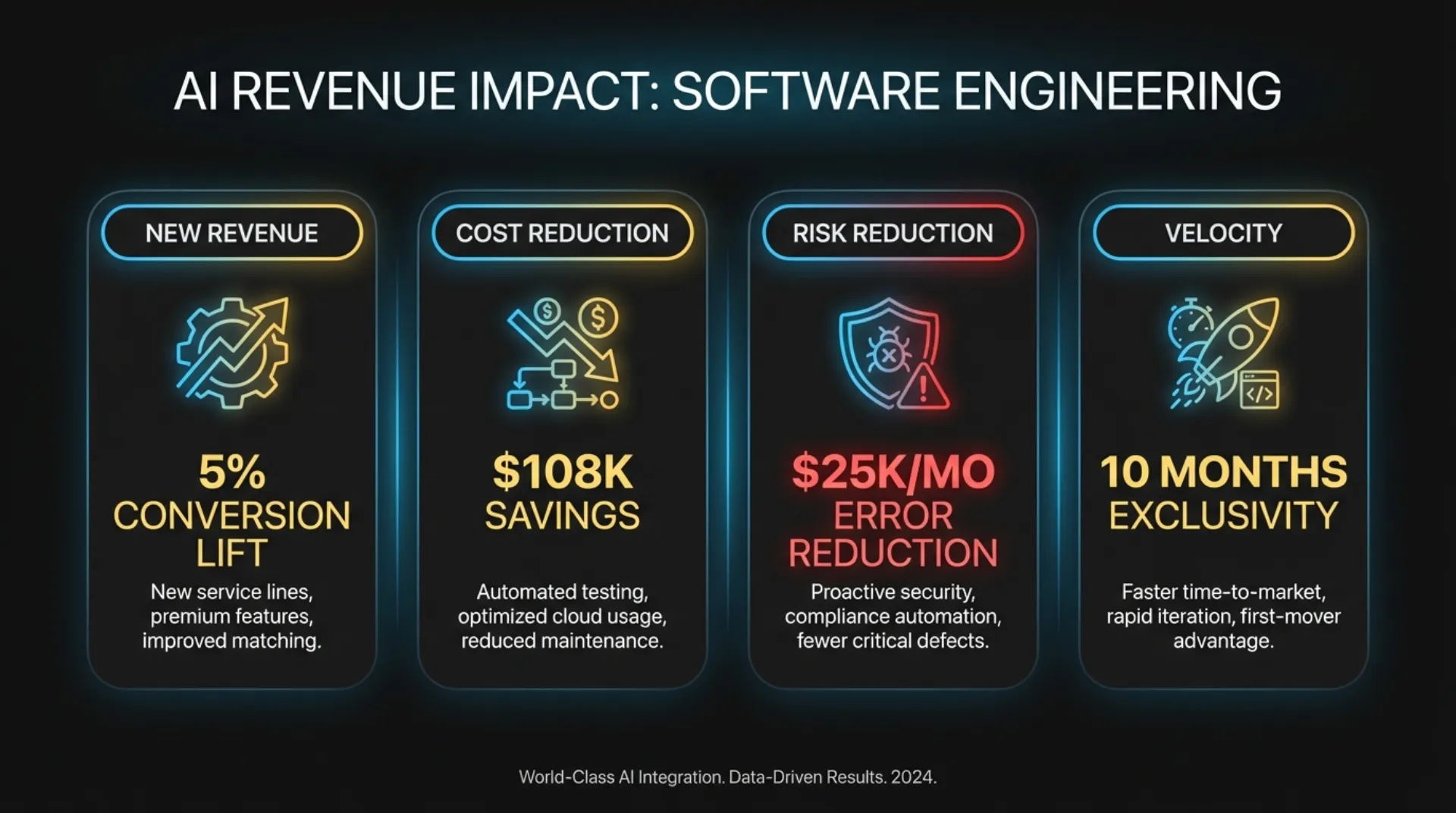
Cost modeling tells you what you’ll spend. Revenue impact tells you why you should spend it. Most business cases focus on cost reduction alone and miss the other three categories.
New revenue. AI features that drive upgrades, expansion, or new customer acquisition. If an AI capability moves 5% of your free users to paid, or increases average contract value by 10% for enterprise accounts, that’s direct top-line impact. Building AI into your product architecture creates features your competitors can’t replicate quickly.
Cost reduction. Automation of manual processes your team currently handles. Calculate the fully loaded cost of the humans doing the work today, multiply by the percentage the AI implementation will handle, and discount by a realistic adoption curve. Don’t assume 100% automation on day one. A 60% reduction in manual effort on a process that costs $180K/year in labor is $108K in annual savings. That’s a concrete number a CFO can evaluate.
Risk reduction. Compliance automation, error rate reduction, fraud detection. These are harder to quantify but often carry the highest stakes. If your current manual process has a 3% error rate and each error costs $5K in rework, the math is straightforward: 200 monthly transactions x 3% error rate x $5K per error = $30K/month in error costs. Cut the error rate to 0.5% and the delta is $25K/month.
Velocity. Shipping faster means capturing market position earlier. This is the hardest category to put a dollar figure on, but often the most important. If an AI feature takes your competitor 12 months to build and you ship it in 8 weeks with an embedded team, you have 10 months of market exclusivity. What’s that worth to your pipeline?
Build a line item for each category. Not every use case hits all four, but most will hit at least two.
Why does the year-1 vs. year-3 timeline matter so much?
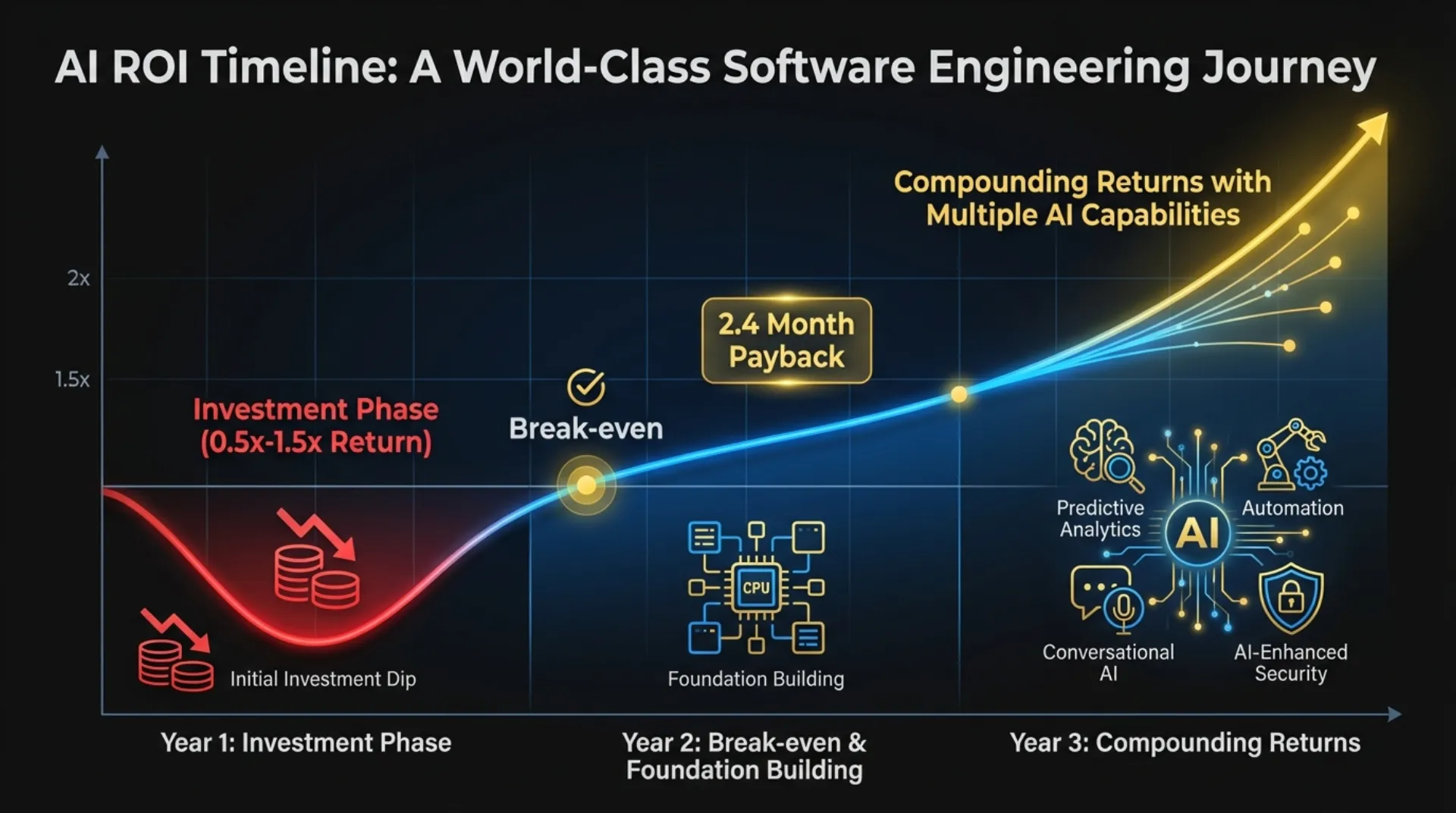
Teams consistently overestimate year-1 ROI and underestimate year-3 compounding. This pattern kills AI business cases. The year-1 projection misses, leadership loses confidence, and the compounding never kicks in.
Year 1 involves implementation costs, integration work, adoption friction, and iteration. Your AI feature won’t be perfect at launch. It’ll require tuning, user feedback loops, and probably a second major iteration before it hits stride. Budget for this. A realistic year-1 model shows a return of 0.5x to 1.5x on implementation cost, not 5x.
Year 2 is where the model improves with accumulated data, adoption reaches steady state, and the team builds on the foundation. The cost of the second AI feature drops dramatically because the infrastructure, patterns, and organizational muscle are already in place.
Year 3 is where compounding becomes visible. Multiple AI capabilities, each building on shared infrastructure and data. The product has differentiation that competitors need years to replicate. Companies that integrate AI into their existing product at this stage have a defensible advantage, not just a feature.
Present the business case with a 3-year model. Show the CFO that year 1 is the investment year, year 2 is break-even, and year 3 is where returns accelerate. If the numbers only work on a 12-month horizon, either the use case is wrong or the cost model needs adjustment.
What are the five mistakes that kill AI business cases?
Vanity metrics. API call volume, model accuracy percentages in isolation, number of AI features shipped. None of these connect to business outcomes. A model with 94% accuracy sounds impressive until you realize the baseline manual process was 91% accurate. Report metrics that map to revenue, cost, or risk.
Comparing to perfection. The question isn’t whether your AI implementation will be perfect. It’s whether it’ll be better than what you’re doing today. A document classification model that handles 80% of cases automatically and routes 20% to a human is a massive improvement over routing 100% to a human. Don’t let the 20% kill the business case.
Ignoring integration and maintenance costs. The model is 20% of the cost. Data pipelines, API integration, monitoring, retraining, edge case handling, and ongoing infrastructure represent the other 80%. Include a maintenance line item of 15-25% of initial implementation cost per year.
Sandbagging the timeline. If you pad every estimate to protect yourself, the business case won’t clear the hurdle rate. Be honest about optimistic, expected, and pessimistic scenarios. Present all three. Your CFO will respect the transparency more than a single number they suspect is inflated.
Skipping the baseline. You can’t measure improvement without a clear picture of current performance. Before building the case, document the current cost, speed, error rate, and throughput of the process you’re proposing to improve. This takes a week of measurement, not a month. Do it before you present.
What does a real AI ROI calculation look like?
Here’s a worked example for a mid-market SaaS company automating customer onboarding.
Current state:
- 150 new accounts per month
- 3 hours of manual configuration per account
- Fully loaded cost of the ops team member: $85/hour
- Monthly cost: 150 accounts x 3 hours x $85 = $38,250
- Error rate: 4% of accounts require re-configuration (adds 2 hours each)
- Monthly error cost: 6 accounts x 2 hours x $85 = $1,020
- Total monthly cost: $39,270
Projected state with AI automation:
- AI handles 75% of configurations automatically (conservative estimate)
- Remaining 25% still require human review: 37.5 accounts x 3 hours x $85 = $9,563
- AI processing cost (infrastructure): $800/month
- Error rate drops to 1%: 1.5 accounts x 2 hours x $85 = $255
- Total monthly cost: $10,618
Monthly savings: $28,652. Annual savings: $343,824.
Implementation cost:
- Embedded AI engineering (3-month engagement at $20K/month): $60,000
- Infrastructure setup and integration: $8,000
- Total: $68,000
Time to positive ROI: 2.4 months after launch.
That’s the format. Current cost x volume x error rate. Projected cost with AI. The delta is the value. Adjust the numbers for your use case, but the structure works across most process automation and feature development scenarios.
What happens if you wait?
Option 4 from the cost model. Doing nothing.
Every quarter you spend evaluating, your competitors ship. The AI talent gap is widening, not shrinking. Implementation costs aren’t going down. And the compounding effect means a company that starts building AI capability today will be 2-3 years ahead of one that starts next year. The gap accelerates.
The business case for AI investment isn’t about whether the technology works. That question was settled two years ago. It’s about which specific implementation delivers measurable value on a timeline your organization can execute, at a cost structure that makes the math work.
Pick the use case. Run the numbers. Present the four options. Show the 3-year model. Let the spreadsheet make the argument.
Frequently asked questions
How long does it take to see ROI on an AI investment?
For a well-scoped use case with an embedded team, expect 2-4 months to positive ROI after launch. Year 1 typically returns 0.5x to 1.5x on implementation cost. The real returns compound in years 2 and 3 as you build on shared infrastructure and accumulated data.
Should we hire an AI engineer or use a fractional team?
It depends on urgency and scope. A full-time hire costs $250K-$320K in year one and takes 6-9 months to produce results. An embedded fractional team runs $15K-$25K/month and delivers productive output within 1-2 weeks. For a first AI use case, the fractional model gets you to results faster and with less risk.
What’s the biggest mistake companies make in AI business cases?
Trying to justify “AI” as a category instead of a specific implementation. The winning approach: pick one use case with measurable current costs, model all four alternatives (hire, embedded team, agency, do nothing), and present a 3-year ROI model that accounts for compounding.
Ready to build your first AI business case? Talk to our team about scoping a use case and getting to production in weeks, not quarters.