Key Takeaway
AI can build a prototype in hours or a production app in weeks — the difference is whether you're using self-service tools yourself or having an expert-supervised team build it for you.
Yes, AI can build an app for you. But what “build it” actually means depends on which type of AI you’re talking about, and the difference is significant enough to affect every decision you make next.
There are two real options. The first: use an AI builder tool to build it yourself, with AI doing the heavy lifting while you drive. The second: have a team use AI agents to build it for you, with expert oversight, while you describe what you want and wait for the result. These are very different experiences with very different outputs.
The confusion between these two things is causing founders to waste time on prototypes they can never ship, or to rule out AI entirely because they think “AI app builder” means Lovable when it actually doesn’t have to.
Option 1: AI Builder Tools — You Still Do the Building
Tools like Lovable, Bolt.new, Replit, and Cursor let you describe what you want in plain language and watch code appear. For non-technical founders, this feels like magic. For the first few hours, it often is.
What they actually do
These tools translate your description into working code. Lovable and Bolt.new generate a full-stack app from a prompt. Replit runs it in a browser-based environment. Cursor is a code editor where an AI assistant helps you write and edit code directly.
The AI is doing real work. It writes HTML, CSS, JavaScript, and back-end logic based on what you ask for. You can iterate by describing changes: “add a login screen,” “make the button blue,” “add a table that shows user signups.” It responds and updates the code.
What you still have to do
You’re the product manager, the QA team, and the architect. Every decision about what the app should do and how it should behave is yours. The AI executes; you direct.
When something breaks (and things break), debugging falls to you. AI builders will help you fix errors, but you need to describe the problem clearly, evaluate whether the fix makes sense, and catch issues the AI doesn’t catch on its own.
Connecting to real services — sending emails, processing payments, securing user data — these integrations require configuration that goes beyond “describe what you want.” The AI can scaffold them, but getting them production-ready requires either technical knowledge or significant iteration.
What the output looks like
For a simple prototype, the output can look remarkably finished. A functional UI, data persistence, basic authentication. If your goal is a demo for investors or a test to validate a concept, this is often good enough.
For a product you intend to ship to paying customers, the gaps appear quickly. Performance under real user load, security vulnerabilities, database design decisions that create problems at scale, error handling that silently fails. These tools are built for speed of prototyping, not for the durability of production software.
Who this is right for
AI builder tools work well for three situations:
You want to test an idea before committing to a proper build. Spend a weekend on Bolt.new to see if the core concept works before investing $30,000 in production development.
You’re a developer who wants AI to accelerate your own workflow. Cursor and GitHub Copilot are genuinely powerful for engineers who can evaluate and correct the output.
You’re building an internal tool where “production-grade” matters less — a dashboard that three people on your team will use, where downtime is inconvenient rather than catastrophic.
For non-technical founders who want to ship a product to paying customers, these tools have a ceiling. Most prototypes built on them never become real products. The gap between a working demo and something production-ready is wider than the tools suggest.
Option 2: AI Builds It for You — With Expert Oversight
The second option is structurally different. You’re not using an AI tool yourself. A team of senior engineers uses AI agents to build your product, with the humans responsible for the architectural decisions, quality, and output.
What this looks like in practice
You arrive with a product idea — the problem you’re solving, the users who will use it, the core flows that matter. The team translates that into a structured product requirements document and a fixed price. You review and approve. Then they build it.
You’re not in standups. You’re not reviewing designs. You’re not managing a development process. You describe what you need; they deliver it.
The AI agents handle large portions of the code generation. Senior engineers make the architectural decisions, supervise the build, and ensure the output meets production standards. The AI compresses what would traditionally take months into days or weeks.
What the output is
A production-grade product. Proper authentication, data integrity, error handling, security practices, automated tests, and a deployment pipeline. Not a prototype you need to rebuild. Something you can put in front of paying customers from day one.
The distinction from Option 1 is that a senior engineer has made every significant architectural decision. The AI generated the code, but a human decided how the database should be structured, how authentication should be handled, how the app should behave under failure conditions. Those decisions compound over time. Getting them right at the start saves months of technical debt later.
Timeline and pricing
For a well-scoped product, expect days to a few weeks. The speed comes from AI compressing code-generation volume, not from cutting corners on quality.
Pricing at this end of the market runs from $15,000 to $75,000 depending on scope and complexity. That’s a fixed price for a delivered product, not an hourly rate. You know what you’re paying before any work begins.
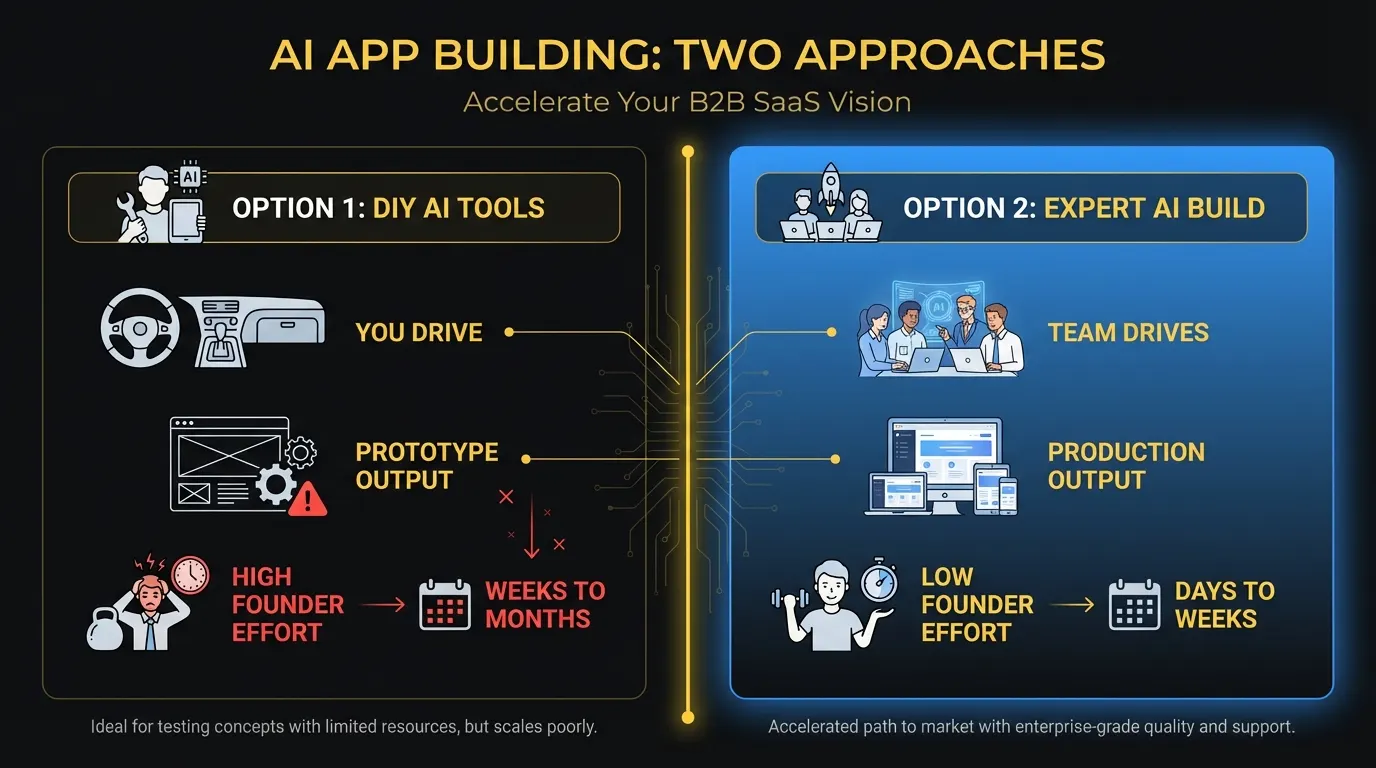
The Key Question: Do You Want to Build It, or Do You Want It Built?
This is the actual decision point, and it’s worth being honest about.
If you want to build it yourself — if the act of building is something you find interesting, if you have the time to learn the tools, if a prototype is genuinely what you need right now — AI builder tools are legitimate and capable. The barrier to getting something working has dropped dramatically.
If you want a product, not a project, the distinction matters. Managing the build of a software product is a full-time job. Debugging AI-generated code, making product decisions, iterating on an architecture you didn’t design, integrating services, testing edge cases. For most founders, that’s not where your time creates the most value.
The question isn’t whether AI can build it. It’s whether you want to be the one doing it.
What Production-Grade Actually Requires
“Production-grade” gets used a lot. Here’s what it means in practice, because the gap between a working prototype and a production product is where most self-built apps stall.
Authentication that’s actually secure. Not just a login form, but proper session management, password hashing, token expiry, and protection against common attacks. Getting this wrong creates serious liability.
Data integrity under real conditions. When multiple users hit the app simultaneously, when a network request fails halfway through, when a user does something unexpected. Prototypes fail silently. Production software handles these cases deliberately.
Performance that holds under load. An app that works for five test users can fall apart with fifty paying customers. Database queries that are fast for a small dataset become bottlenecks at scale. These require explicit attention during the build, not after.
Error handling and logging. When something breaks in production (and it will), you need to know what happened. Production apps have monitoring, error tracking, and logging built in.
A deployment pipeline. The ability to push updates without downtime, roll back a bad release, and manage multiple environments. Not glamorous, but essential for anything you plan to maintain.
Self-service AI tools can generate code that addresses some of these. But ensuring they’re all handled correctly requires engineering judgment that the tools can’t provide.

Which Option Is Right for Which Founder
You should use an AI builder tool if:
- You want to validate a concept before committing money to production development
- You’re technically inclined and can evaluate and correct the output
- You’re building something simple with low stakes around reliability or security
- You have time to invest in learning the tools and iterating through problems
You should go with an expert-supervised AI build if:
- You need a product you can ship to paying customers, not a prototype
- You don’t have the bandwidth to manage a build process yourself
- Speed matters and you can’t afford months of development time
- You want a fixed price before any work begins
- You want someone else to be responsible for the technical decisions
The hybrid path: Some founders use a self-service tool to validate the core concept cheaply, then bring that learning to a production build. “We tested the idea on Bolt.new, confirmed the core flow worked, and now we need the real thing.” That’s a legitimate approach. The prototype informs the requirements; the production build delivers what you actually need.
What to Ask Before You Commit to Either
Before you spend time or money, answer these questions for yourself.
What are you actually validating? If the answer is “whether this product concept has demand,” a prototype may be enough. If the answer is “whether this product can serve paying customers,” you need production quality.
What’s your timeline? If you have two months and a weekend, build the prototype. If you have three weeks before a launch deadline, you need a team that can move at AI speed.
What’s your technical depth? Honest self-assessment here saves a lot of frustration. Can you debug a Next.js authentication issue at 11pm? Can you evaluate whether a database schema will create problems at scale? If not, managing a self-built AI app is harder than the demos suggest.
The short answer to “can AI build an app for me” is yes. It can build a prototype in hours, and it can build a production product in days. Which one you get depends entirely on which path you take.
If you want the production product without managing the build yourself, that’s what Launchpad is built for.
Describe what you need and get a fixed-price quote. Get your product built at Launchpad →