Key Takeaway
Canada's AI problem isn't awareness, it's production: 19.2% of businesses use AI to deliver their goods or services, against a 60% target for 2034. SMEs close that gap by picking one internal, measurable workflow and shipping it with a human approving outputs, not by writing a bigger AI strategy.
Canada’s AI adoption gap is a production gap. This article is for owners and leaders of small and mid-sized enterprises (SMEs) who know AI matters but haven’t put it to work in their operations yet. It covers what the 2026 data says, where SMEs get stuck, and a one-page canvas for picking the first workflow to ship.
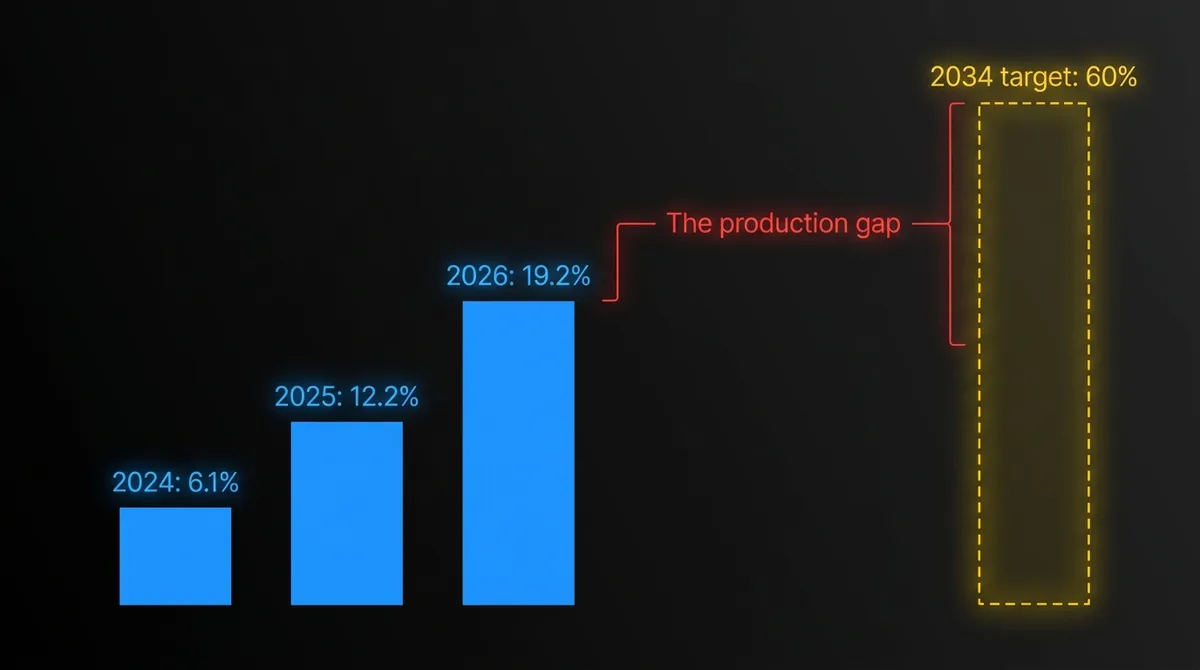
Two things happened within a week of each other in June 2026. Ottawa launched AI for All, Canada’s National Artificial Intelligence Strategy, with a goal of raising business AI adoption from about 12% to 60% by 2034. And Statistics Canada (StatCan) published its latest quarterly reading: 19.2% of Canadian businesses had used AI to produce goods or deliver services over the previous 12 months.
That second number is good news. It’s up from 12.2% a year earlier and 6.1% in 2024, so adoption roughly tripled in two years. It also means four businesses in five still don’t use AI in their actual operations, and the national target is three times today’s level.
Most business leaders in Canada have heard plenty about AI. When BDC (the Business Development Bank of Canada) released its own 2026 study, it put it plainly: the challenge is no longer awareness, it’s execution. We’d go further. The hard part for an SME is getting one useful workflow built, trusted and running.
How many Canadian businesses actually use AI in 2026?
Between 19% and 30%, depending on what you count. StatCan puts production use at 19.2%. BDC puts generative AI use among SMEs at 30%. The federal target is 60% by 2034.
| Source | What it measures | Latest figure | Notes |
|---|---|---|---|
| Statistics Canada, Canadian Survey on Business Conditions (Q2 2026) | Businesses that used AI to produce goods or deliver services in the prior 12 months | 19.2% (up from 12.2% in Q2 2025 and 6.1% in Q2 2024) | Probability survey; narrow definition focused on production use |
| BDC, Digital Transformation & AI Study (SMEs) 2026 | SMEs currently using generative AI | 30% | Online survey of 1,500 owners and decision makers; non-probability sample, not statistically projectable |
| AI for All (federal strategy, June 2026) | National target | 60% by 2034, from a stated baseline of about 12% | Baseline reflects the 2025 StatCan reading |
The two figures don’t contradict each other. Someone using ChatGPT to draft emails counts as a generative AI user in BDC’s study. StatCan asks whether AI was used to produce the business’s goods or services, which is a higher bar. StatCan’s definition is the one that matters here: AI that changes how the business runs.
BDC adds a useful data point on value. SMEs using generative AI reported being 24% more productive than those that don’t. It’s self-reported and not projectable, so treat it as directional. Still, it’s a strong hint that businesses that get past their first project see a return.
Does company size change AI adoption?
Yes, and not only in the obvious way. Bigger companies use AI more, but the sharper difference is that small firms are more likely to rule AI out, and much less likely to get outside help when they try it. StatCan’s Q2 2026 breakdown shows it:
- 27.8% of businesses with 100 or more employees used AI, the highest of any size group.
- 41.4% of businesses with 1 to 4 employees, and 41.0% of those with 5 to 19, said AI wasn’t relevant to them. Among firms with 100+ employees, only 21.3% said the same.
- Among businesses that did use AI, 30.2% of large firms brought in external consultants or vendors. For the smallest firms, it was 10.7%.
- 21.0% of urban businesses used AI, compared with 9.9% of rural ones.
Larger companies see AI as relevant and buy help to implement it. Smaller ones rule it out more often, and when they do try, they mostly go it alone.
What barriers do Canadian businesses report?
Cybersecurity or privacy concerns came first at 13.4%, followed by cost at 10.6%. StatCan added these barrier questions in 2026. The numbers look small because they’re shares of all businesses, including the many with no plans to use AI.
What the survey can’t capture is the more common reason a project never starts. Nobody’s sure which workflow to pick, and nobody has time to build it.
Where do Canadian SMEs get stuck with AI?
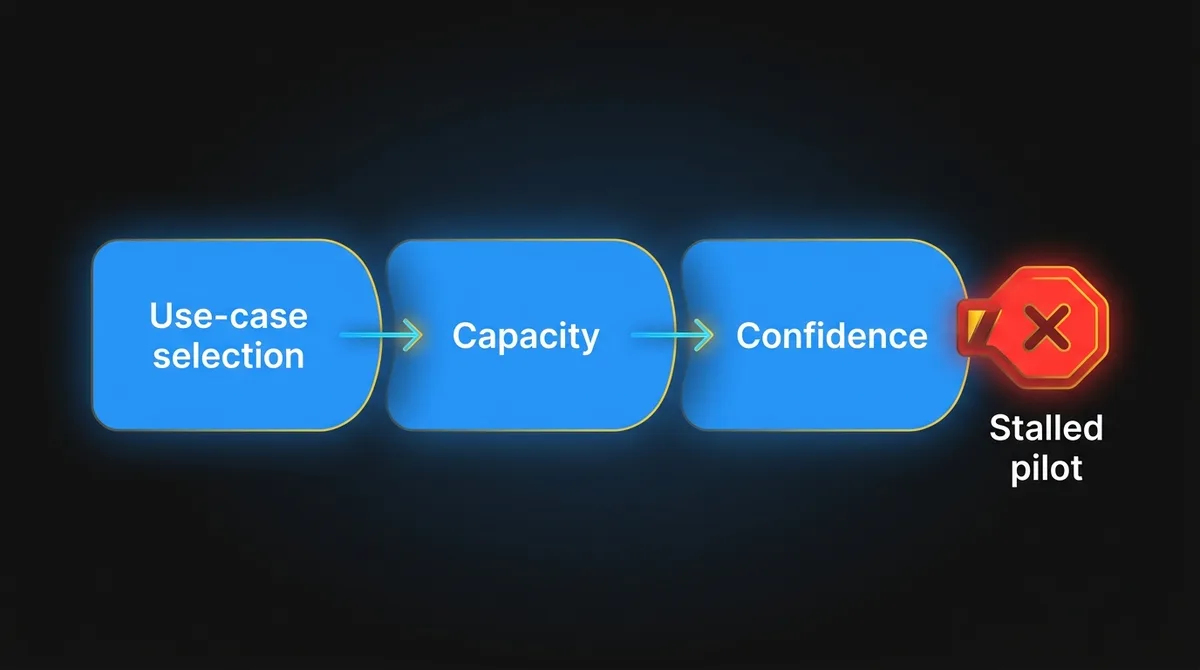
Three blockers come up in our conversations with SME leaders far more than any others: picking the use case, finding the capacity to build it, and trusting it enough to run it. They line up with the data, and they compound.
Why is choosing an AI use case so hard?
Because “use AI” isn’t a project, and the obvious candidates are often wrong. A leadership team that agrees AI matters still has to pick something specific. The flashy idea, a customer-facing chatbot or an AI-generated product, is rarely the best first project. The best one is usually internal, repetitive and measurable: quoting, document review, scheduling, reconciliation, intake triage.
Without a way to compare options, SMEs either pick something too ambitious and stall, or pick nothing and wait.
Do SMEs need an AI engineer on staff?
Not for a first project, and most shouldn’t hire one for it. A 40-person manufacturer or distributor doesn’t have an AI engineer. The IT generalist is busy keeping the lights on. Off-the-shelf AI tools handle generic tasks well, but they don’t connect to your ERP, document store or customer records without real integration work.
StatCan’s numbers on outside help tell the story. The smallest firms using AI mostly do it alone. That’s fine for a general-purpose chatbot. It doesn’t work for a production workflow that touches real systems and real customer data.
How do you build confidence in an AI system?
Through the build itself. This is where the cybersecurity and privacy worries show up. An owner who doesn’t know where the data goes, what the model might say to a customer, or how to tell whether it’s working will reasonably hold back. Clear data handling, a human approving outputs at first, logging, and a metric that shows whether it helps are what earn trust.
How should an SME pick its first AI workflow?
Put two or three candidate workflows on one page, compare them, and pick the one that scores high on value and feasibility with manageable risk. This is the canvas we use in a first working session. Fill it in before you spend anything, and the right first project is usually obvious.
| Field | Question | What a good answer looks like |
|---|---|---|
| Workflow | What process, specifically? | “Building quotes for custom orders,” not “sales” |
| Owner | Who’s accountable for this workflow today? | A named person who’ll spend an hour a week on the project |
| Volume and cost | How often does it happen, and how much time or money does it take? | Weekly or daily; hours per occurrence you can estimate |
| Inputs | What information does it rely on, and where does it live? | Documents, spreadsheets or systems you can export from or connect to |
| Risk | What happens if the AI gets it wrong? | A human reviews before anything reaches a customer, at least at first |
| Data sensitivity | Does it involve personal, financial or regulated data? | Known, documented, and handled within your existing obligations |
| Metric | How will you know it worked? | Time per occurrence, error rate, turnaround or revenue affected, with a baseline |
| First milestone | What’s the smallest version that would be useful? | One team, one document type, one product line |
Score each candidate on three things. Value is volume times cost. Feasibility asks whether the inputs are reachable. Risk asks whether a human can review the outputs. The best first workflow is high on the first two and manageable on the third.
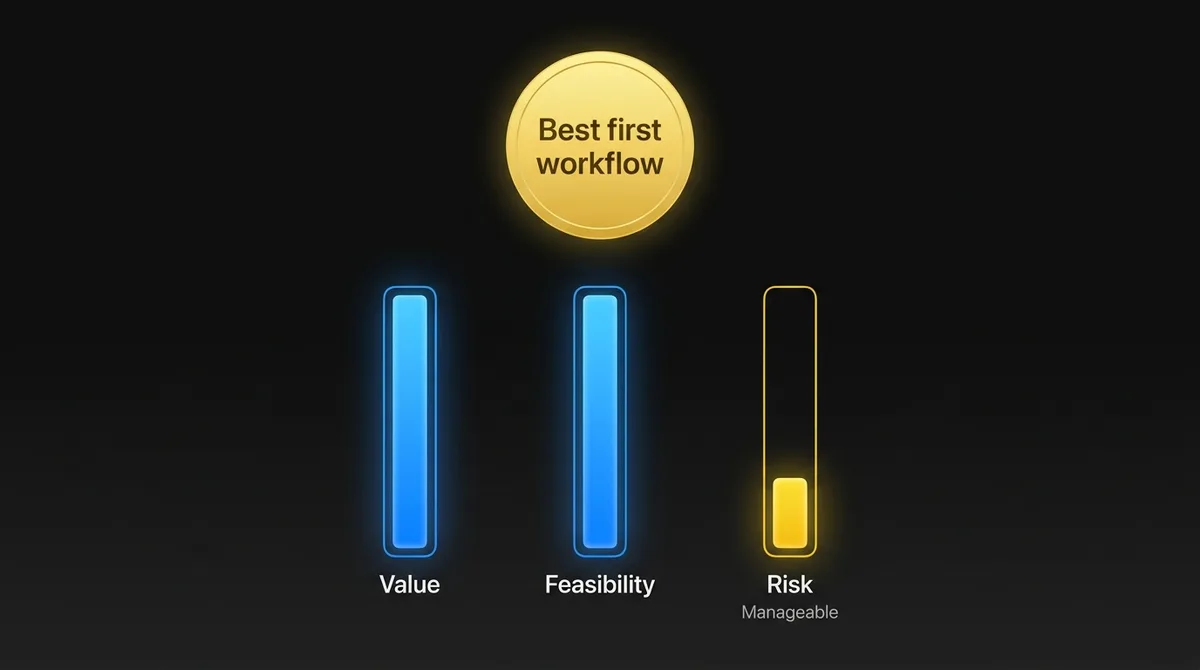
It’s rarely the most strategic idea in the room. That’s fine. The first project exists to prove the pattern and build confidence inside the company. For the financial side, see how to build the business case for AI investment.
What does a first AI production milestone look like?
A tightly scoped system that runs on real work in weeks, with a fixed outcome. For most SME workflows that means:
- Integration with one or two systems the workflow already uses, not a new platform
- A human in the loop: the system drafts, flags or recommends, and a person approves
- Logging of every output and decision, so you can measure accuracy and catch problems
- A baseline measured before launch, so the before-and-after comparison is honest
- Deployment to one team or one product line before expanding
That’s a production system. Small in scope, but handling real work with real data. A demo on sample data proves much less.
Our AI implementation strategy guide covers the same principles for companies that have their own engineering team.
What does this look like at a real business?
Here’s an illustrative example. The figures are assumptions picked to show the method.
A 60-person industrial distributor in the Prairies builds custom quotes for contractors. Each one takes an inside sales rep about 90 minutes: digging through past quotes, checking current supplier pricing, working out freight. The company sends around 25 quotes a week.
Its canvas looks like this:
- Workflow: custom quote preparation
- Owner: sales manager
- Volume and cost: 25 quotes a week at roughly 1.5 hours each, about 37 hours a week
- Inputs: past quotes in the ERP, supplier price lists (spreadsheets), freight tables
- Risk: medium; a wrong price costs margin, so every quote is reviewed before it’s sent
- Data sensitivity: commercial pricing, no personal data
- Metric: preparation time per quote, plus margin variance across reps
- First milestone: the system drafts quotes for one product category, reps review and send
If the system cuts preparation to 30 minutes per quote, the team gets back about 25 hours a week. Whether that becomes faster turnaround, more quotes or more selling time is a business call. Make it before launch, so the metric reflects it.
Which programs help Canadian SMEs adopt AI?
Two are worth knowing. AI for All includes a pillar on speeding up AI adoption across the economy, with support aimed at SMEs. BDC launched LIFT in April 2026, which pairs eligible owners with AI advisors and offers financing for AI adoption. We break down LIFT and how to prepare a project for it in BDC LIFT and AI financing.
Program terms and eligibility change, and they’re set by the government and BDC, not by us. Check the details with BDC or your regional development agency, and ask your accountant or financial advisor how any funding fits your situation.
This section is general information, not financial or tax advice.
Frequently Asked Questions
What percentage of Canadian businesses use AI?
Statistics Canada reported 19.2% in Q2 2026 for businesses using AI to produce goods or deliver services, up from 6.1% in 2024. BDC’s broader measure of generative AI use among SMEs is 30%.
What’s the best first AI project for a small business?
Usually an internal, repetitive workflow with a measurable cost, like quoting, document review or order intake. Customer-facing chatbots are rarely the right place to start because the risk is higher and the value is harder to measure.
How long does a first AI workflow take to reach production?
A tightly scoped first milestone, connected to one or two existing systems with a human approving outputs, usually ships in weeks rather than months. Expanding to more teams or product lines comes after the first numbers are in.
Which workflow should you start with?
Canada’s numbers are moving in the right direction, and fast. The companies that get to 60% first won’t have the most detailed AI strategy. They’ll be the ones that picked one workflow, shipped it, measured it and then picked the next.
What workflow in your business should have changed by now, but hasn’t? Bring it to us. Our senior engineers, working with supervised AI agents, build production AI systems for companies without an AI engineering team, with outcome-based pricing tied to a fixed milestone. We’ll run a free working session to fill in the readiness canvas with you, then send back a proposed first milestone with scope, timeline and price. Book a working session.