Key Takeaway
For most companies, embedding AI expertise delivers faster results than hiring — use a full-time hire only when AI is your core product mechanism or you need to build an internal AI team over multiple years.
You searched “hire AI engineers” because something is already on fire. A competitor shipped an AI feature. A board member asked about your AI roadmap. A customer churned to a product that does something yours doesn’t.
The urgency is real. So is the constraint. Senior AI engineers don’t hire quickly.
This isn’t a pitch for one approach over another. It’s a walk through the actual tradeoffs so you can make the right call for your situation.
The Hiring Reality
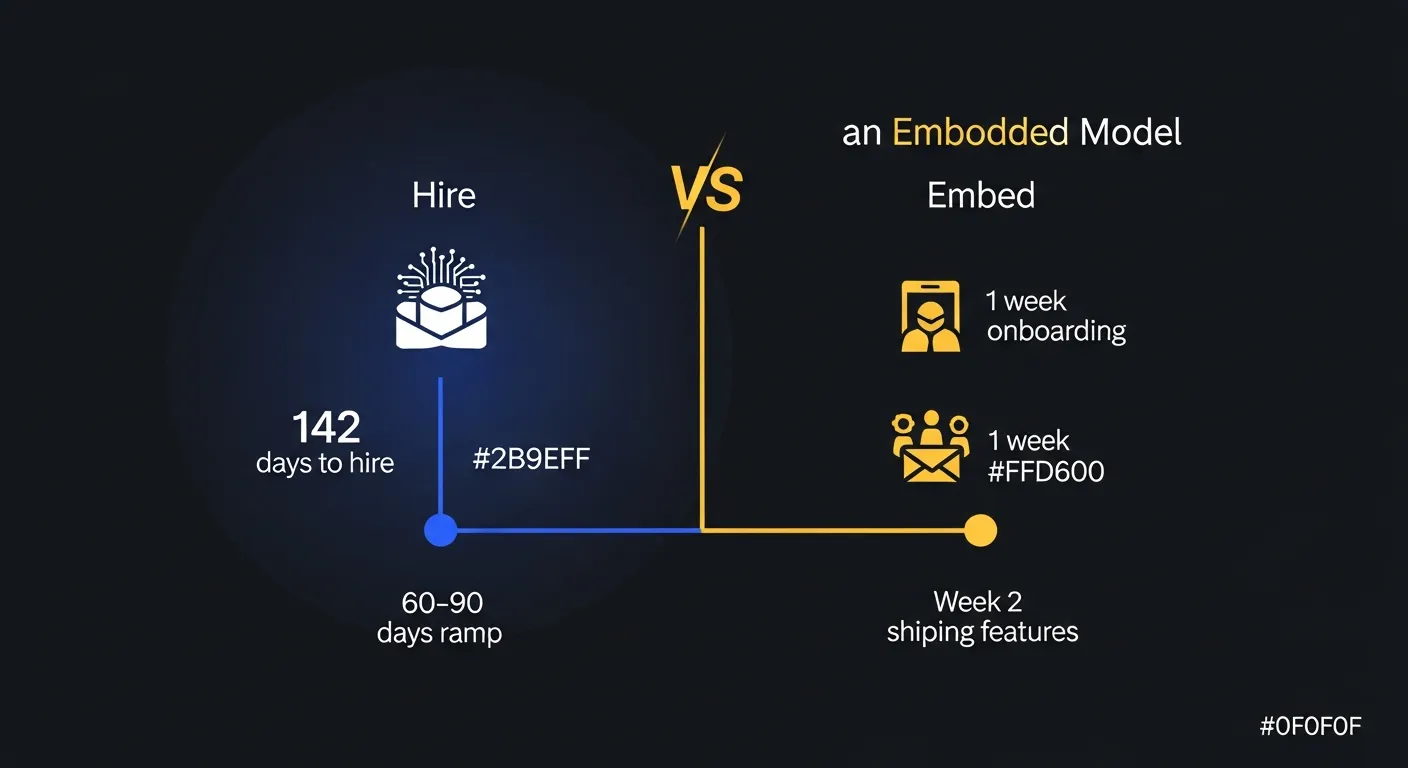
The average time to fill a senior AI engineer role is 142 days. That’s not a worst-case number. That’s the median across North American tech companies.
Break it down: 3-4 weeks to draft the JD and get alignment internally. 6-8 weeks of active sourcing and interviews. 2 weeks for offers and negotiation. Then 60-90 days of ramp before the new hire is shipping AI features at full velocity.
If you start the process today, you’re looking at Q4 before your AI roadmap actually moves.
The salary math compounds the timeline problem. The average US AI engineer salary hit $206K in 2025, up from $155K the year before. Add recruiter fees (typically 20-25% of first-year comp), benefits, equity, and the productivity cost of onboarding, and a single senior AI hire costs $280K-$350K in the first year before you’ve seen a single feature ship.
That’s not an argument against hiring. It’s the cost you should be pricing into the decision.
What You’re Actually Competing For
The talent pool problem is structural. AI job postings grew 78% year-over-year in 2024 while the available candidate pool grew 24%. The delta widens every year as more companies recognize they need this capability.
The best senior AI engineers are rarely looking for new roles. They’re embedded in companies that treat them well, working on interesting problems. When they do move, they move toward the companies with the strongest technical brand, the most interesting domain problems, and the most competitive comp packages.
At $10M-$25M in revenue, you’re competing against companies with deeper pockets and louder names for a small pool of people who have many options.
That’s the external constraint. The internal one is that even if you win the hiring game, you still have the ramp problem. Your new AI engineer doesn’t know your codebase. They don’t know your team dynamics. They don’t know why the architecture looks the way it does. The first 60-90 days are not wasted, but they’re not full velocity either.
When Hiring Is the Right Answer
Hiring makes sense in specific circumstances. It’s worth being clear about what they are.
If AI is the foundational mechanism of your product, not an enhancement layer, you need a full-time AI engineering leader. Someone who owns the model architecture long-term. Someone who builds the data pipeline, the evaluation framework, the fine-tuning loop. Someone who hires engineers under them and builds that capability internally over time. That’s not a role you can fill fractionally. It’s a founding-level technical hire.
If your product requires sustained context in a narrow domain over multiple years — proprietary training data, specialized inference infrastructure, model behavior specific to your vertical — full-time ownership makes more sense than rotating expertise.
The signals that point toward hiring:
- AI is your core product, not a capability you’re adding to your core product
- You need someone to build and lead an AI team, not join your existing engineering team
- You’re at Series B or beyond, with the budget and brand to compete for senior talent
- Your roadmap requires multi-year ownership of a narrow, specialized AI system
For most companies searching “hire AI engineers” right now, those conditions don’t apply yet. They have a roadmap with 3-6 AI initiatives they need to ship in the next 12 months, a product engineering team that understands the domain, and a business problem that won’t wait 6 months for a hire to ramp.
The Embedded Alternative
The fractional AI model is gaining traction because it solves a different problem than hiring does. Not “how do we build a permanent AI team?” but “how do we ship AI capabilities before the hiring timeline catches up?”
Embedded means exactly that. The engineers work in your codebase, not a separate environment they hand off at the end. They’re in your standups. They commit inside your release cycle. They pair with your engineers. They review architecture decisions. Knowledge transfer is continuous, not a document at project end.
The timeline looks different. Week one: environment access, codebase orientation, first commits. Weeks two through twelve: sprint-by-sprint execution on AI tickets. An embedded engineer who has done this across a dozen products ramps in days because they’ve already seen your architectural patterns and your scaling problems in other contexts.
There are real limitations to the model. Deep product context, long-term ML infrastructure ownership, and building an AI team internally — these favor a full-time hire. The embedded model optimizes for velocity on defined initiatives, not for building the long-term institutional knowledge that sustains a large AI org.
A detailed breakdown of what the embedded model looks like in practice is in The Rise of Fractional AI.
The Cost of the Delay
Here’s the number most teams don’t calculate: companies lose an estimated $2.8 million annually from stalled AI initiatives. That figure is from 2024 data, before the competitive environment got sharper.
The cost isn’t the salary you’re not paying while the seat is open. It’s the features you’re not shipping, the customers evaluating competitors who have shipped, and the market position you’re ceding to whoever moves first.
Speed is a competitive moat. Not because shipping imperfect features is good, but because in the time it takes to hire and ramp a senior AI engineer, a competitor with a faster access model can ship, iterate, and own the category-defining version of the feature.
142 days is a long time to wait for your first AI commit.
A Framework for the Decision
The question is not “should we hire or embed?” It’s a sequencing question. Most companies end up doing both at different points, for different reasons.
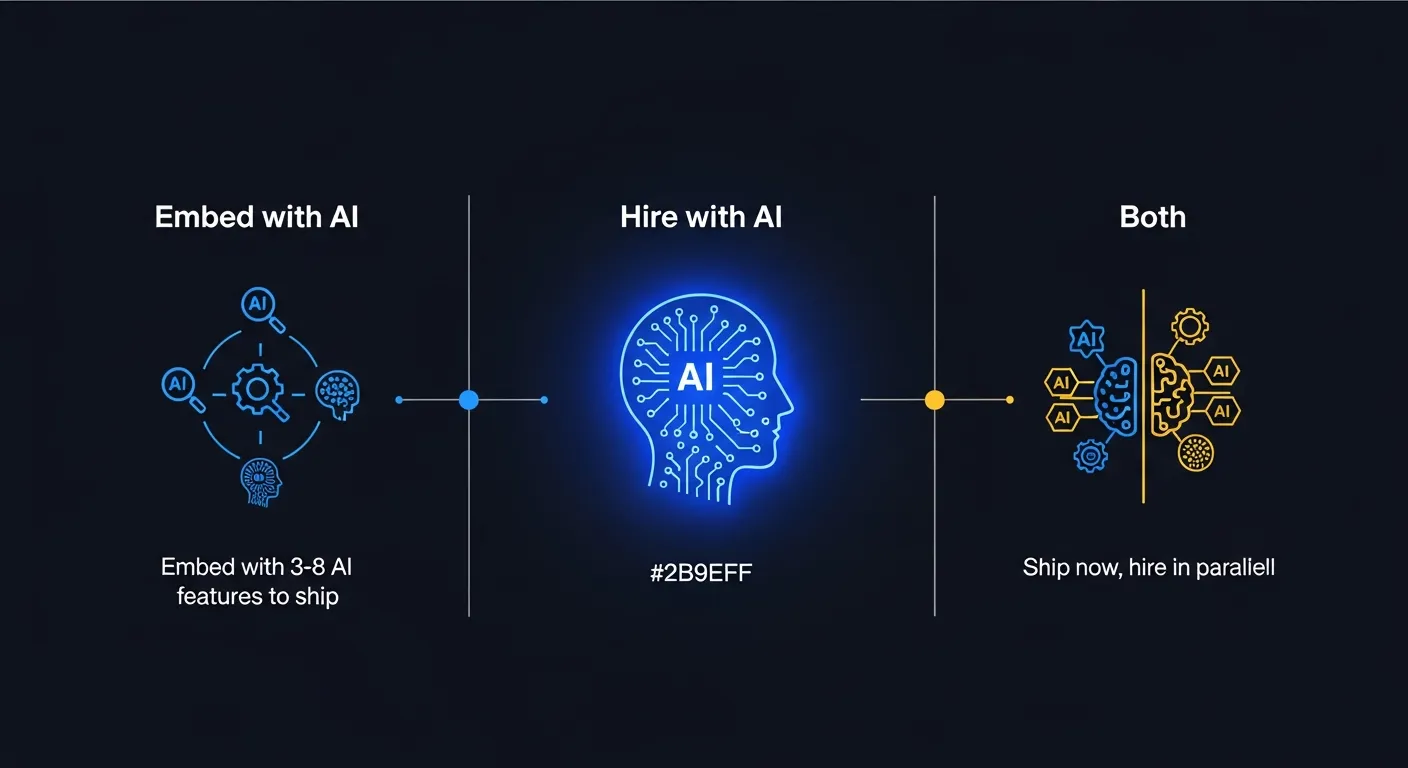
Hire if:
- AI is the core mechanism of your product, not a feature set you’re adding
- You need someone to own and build an AI team over multiple years
- You’re at Series B or beyond with the budget and brand to win in the talent market
- Your roadmap requires sustained, specialized context that an embedded model can’t hold
Embed if:
- You have a roadmap with 3-8 AI capabilities to ship in the next 6-12 months
- Your engineering team has the domain knowledge but not the AI expertise
- The hiring timeline would put you behind competitors who are already moving
- You need velocity now and will evaluate permanent headcount once you’ve validated what AI capability you actually need
Both, in sequence, if:
- You need to ship AI capabilities this quarter while you run a parallel hiring process
- You want to validate what kind of AI engineering you need before committing to a full-time hire
- You’re building toward an internal AI team and want embedded engineers to set the architectural foundation first
The companies that get this wrong tend to fall into one of two traps. They wait for the hire before starting, and competitors pass them. Or they hire without validating what they need, and the expensive senior engineer spends their ramp period solving for the wrong problem.
Frequently Asked Questions
How long does it take to hire a senior AI engineer?
The median time to fill a senior AI engineer role in North America is 142 days. Add 60-90 days of ramp time before they’re shipping at full velocity, and you’re looking at 7-8 months from job posting to first production feature.
What does it cost to hire a senior AI engineer in 2025?
The average US salary hit $206K in 2025. With recruiter fees (20-25% of comp), benefits, and equity, first-year cost runs $280K-$350K before the hire ships a single feature.
What’s the difference between fractional AI and staff augmentation?
Fractional AI engineers work inside your codebase, attend your standups, and commit within your release cycle — not as external contractors handing off work, but as embedded team members who ramp in days rather than months.
What to Do Next
If you’re still figuring out where AI fits in your product architecture — what to build, what to buy, where the data strategy needs to go — AI Advisory is the right starting point. Defining the roadmap before committing to an execution model is usually worth a few weeks.
If you know what you need to build and the question is how to staff it without waiting 6 months, the Fractional AI service is built for that situation. Same codebase, same standups, same release cycle. Different employment relationship.
If you’re running a parallel track — hiring and shipping simultaneously — both approaches above can coexist. The embedded engineers build the AI foundation while you recruit. The hire inherits a working system, a clear architectural direction, and engineers who already understand it. The ramp problem shrinks significantly.
The one thing that doesn’t work is treating the hiring timeline as a neutral variable in the competitive equation. It isn’t. Every week the AI features aren’t shipping, someone else’s are.