Key Takeaway
When choosing an AI development company, look for production experience (not just demos), transparent pricing, and willingness to share technical details. Red flags: vague timelines, no deployed case studies, heavy reliance on buzzwords, and hourly billing without scope guarantees. Ask to see their monitoring dashboards and error handling approach.
You’ve decided your company needs AI. Now you need someone to build it. Google “AI development company” and you’ll get 50 listicles, 200 Clutch profiles, and zero useful guidance on how to actually make this decision.
Here’s what actually matters — and what doesn’t.
Start With What You’re Building, Not Who’s Building It
Before you evaluate a single company, get clear on three things:
- What problem are you solving? Not “we want to use AI” — the specific business process, bottleneck, or capability gap.
- How will you measure success? A number. Accuracy percentage, time saved, cost reduced, revenue generated.
- What’s your timeline and budget? Even rough ranges help you filter immediately.
If you can’t answer these, you’re not ready to hire. Reach out to us and we’ll help you figure out the answers first.
7 Things That Actually Matter When Evaluating AI Companies
1. They’ve Shipped AI to Production — Not Just Built Demos
The gap between an AI demo and a production AI system is enormous.
Ask specifically: “What AI systems are running in production right now that your team built?” If the answer is vague or theoretical, move on.
A demo that works on clean data in a notebook is not evidence of capability. A production system handling real users, real data, and real edge cases is.

2. They Start Small and Validate Before Building Big
Any company that jumps straight to a 6-month, $200K proposal without validating the approach first is either overconfident or optimizing for revenue, not outcomes.
The right pattern: proof of concept first, production build second. A good AI development company will insist on validating feasibility before committing to a full build. That’s not hesitation — it’s engineering discipline.
A 15-day proof of concept should cost $5,000–$15,000 and tell you definitively whether the approach works.
3. They Can Explain the Architecture in Plain English
Ask them to explain their proposed approach. If they can’t explain why they’d use RAG vs. fine-tuning vs. a traditional ML model for your use case — in terms you understand — they either don’t know or don’t care whether you make an informed decision.
Good AI engineers translate technical decisions into business terms: “We’d use retrieval-augmented generation because your data changes weekly, and retraining a model every week would cost 10x more than querying a vector database.”
4. They Talk About Data Before They Talk About Models
Your data is 80% of your AI project. Any company that leads with model selection before understanding your data landscape is solving the problem backwards.
The first questions should be about your data: Where does it live? How clean is it? How much do you have? What format? How often does it change? If they skip this and jump to “we’ll use GPT-4,” that’s a red flag.
5. They Have a Clear Process With Defined Deliverables
“Agile” is not a process description — it’s a buzzword. You should know exactly what happens in week 1, what you’ll see in week 2, and what gets delivered at the end.
Look for: defined phases, specific deliverables at each phase, demo cadence, decision points, and clear criteria for what “done” means. If the process is fuzzy, the project will be too.
6. They’re Transparent About Pricing
If you can’t find pricing information before getting on a call, ask yourself why. The answer is usually that they price based on your budget, not their costs.
Good AI development companies can give you ranges before a call and specific quotes within days of understanding your scope — not weeks.
7. They Build With Your Team’s Future in Mind
The best AI development partners build systems your team can maintain, extend, and understand. Clean code, documentation, standard tools, and knowledge transfer.
Ask: “What happens when this project ends? Can my team maintain this?” If the answer involves an ongoing maintenance contract with no option to bring it in-house, you’re buying dependency, not a product.
Red Flags to Watch For

- “We can build anything with AI.” No one can. The honest answer is always “it depends on your data and use case.”
- No production references. Case studies are nice. Referenceable clients with production systems are better.
- Pushing a specific technology regardless of your problem. If every solution involves their proprietary platform, they’re selling a product, not solving your problem.
- Long discovery phases before any code. Discovery should take days, not months. If they need 8 weeks to understand your problem, they’ll need 8 months to solve it.
- They don’t mention failure modes. Every AI system has limitations. A company that only talks about what AI can do — and never what it can’t — is selling you a fantasy.
Questions to Ask on the First Call
- What AI systems has your team deployed to production in the last 12 months?
- How do you validate feasibility before committing to a full build?
- Walk me through your process from kickoff to production deployment.
- How do you handle it when the AI approach doesn’t work?
- What does your team look like — who specifically would work on my project?
- Can I talk to a recent client whose AI system is in production?
The Validate-First Approach
We build AI products with a simple philosophy: validate before you invest.
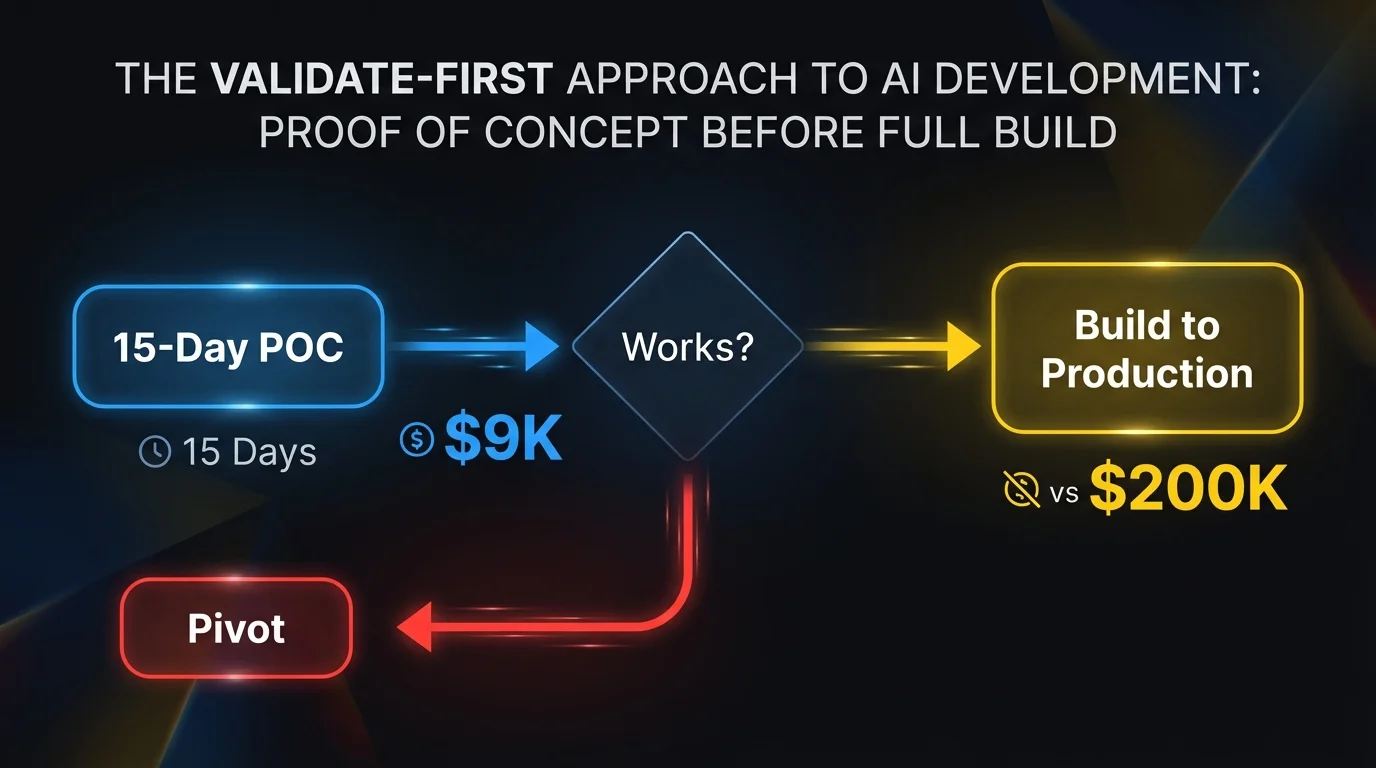
Every engagement starts with a 15-day AI Sprint — a working prototype that proves the approach works with your data, your constraints, and your success criteria. $9,000 CAD, fixed scope, working software delivered.
If it works, we build to production. If it doesn’t, you’ve spent $9K to find out — not $200K.
Ready to Talk?
Skip the sales deck. Get in touch and tell us what you’re building — we’ll tell you honestly whether AI is the right approach and what it would take.