Key Takeaway
Lovable and Bolt.new are great for prototypes, but the rebuild to production costs $20K-100K. For founders who've validated their idea, expert-supervised AI builds ship production-grade products in weeks at lower total cost.
The AI app builder category exploded in 2025. Lovable and Bolt.new emerged as the two tools most founders reach for when they want to build something without writing code. And both genuinely deliver on their core promise: describe a product, watch it get built in real time.
But if you’ve spent time with either tool, you’ve noticed the same pattern. The first 80% is impressive. The last 20% — the part that turns a demo into a product — is where things stall.
This isn’t a hit piece on either tool. Both are useful. Both are impressive engineering achievements. The question is which approach fits your specific situation — and whether there’s a third option most founders don’t consider until they’ve already hit the ceiling of the first two.
This is an honest three-way comparison: Lovable vs. Bolt.new vs. having it built by experts using supervised AI. Tables, numbers, and a decision matrix to help you choose.
What Each Approach Offers
Lovable: The Design-First AI Builder
Lovable positions itself as the AI app builder that produces beautiful, well-designed output. It generates React-based applications with a focus on clean UI, responsive design, and modern visual standards.
Strengths:
- Design quality. Lovable consistently produces better-looking interfaces than Bolt.new. The components are well-styled, spacing is consistent, and the output looks like it was designed by a real designer.
- Supabase integration. Built-in backend support through Supabase gives you authentication, database, and storage out of the box. This is a meaningful advantage over Bolt.new for products that need data persistence.
- Iterative refinement. The conversation-based editing model works well for making visual and structural changes.
Limitations:
- Production-grade security, error handling, and scalability remain gaps.
- Complex business logic (multi-step workflows, conditional rules, edge cases) is unreliable.
- Third-party API integrations beyond Supabase are fragile.
- Code output is tied to React and Supabase. Switching stacks later means rebuilding.
Bolt.new: The Speed-First AI Builder
Bolt.new prioritizes speed and flexibility. It generates full-stack applications quickly and supports multiple frameworks. The in-browser development environment means zero setup — you start building immediately.
Strengths:
- Speed. Bolt.new generates functional prototypes faster than any competitor. From description to working app in minutes.
- Framework flexibility. Supports React, Next.js, Vue, Svelte, and other frameworks. You’re not locked into a single stack.
- In-browser environment. No local setup required. The entire development experience runs in the browser, with deployment built in.
Limitations:
- Output quality is less polished than Lovable, especially for design.
- Database and backend architecture are generated ad-hoc — no built-in backend solution.
- Authentication and authorization require manual configuration and are often insecure by default.
- The same production-grade gaps as all AI builders: testing, error handling, scalability, monitoring.
For a deeper analysis of where Bolt.new stops and what to do about it, see Bolt.new Alternative: When You Need More Than a Prototype.
Expert-Supervised AI Building: The Production-Grade Path
A newer category that uses the same AI technology — but operated by senior engineers instead of non-technical founders. The AI agents generate code. Human experts architect, supervise, review, and ensure production quality.
Strengths:
- Production-grade from day one. Proper authentication, database design, testing, deployment, monitoring — built in, not bolted on.
- Zero founder involvement in the build. You describe the outcome. Experts handle every technical decision.
- Outcome-based pricing. Fixed quote before work begins. No hourly billing.
- Any stack, any complexity. Not limited to what an AI tool can generate from a prompt. Handles integrations, complex business logic, and architectural decisions.
Limitations:
- Higher cost than a $20/month subscription (though lower than an agency).
- Less hands-on control — you trust the team to make technical decisions.
- Newer category with fewer providers to evaluate.
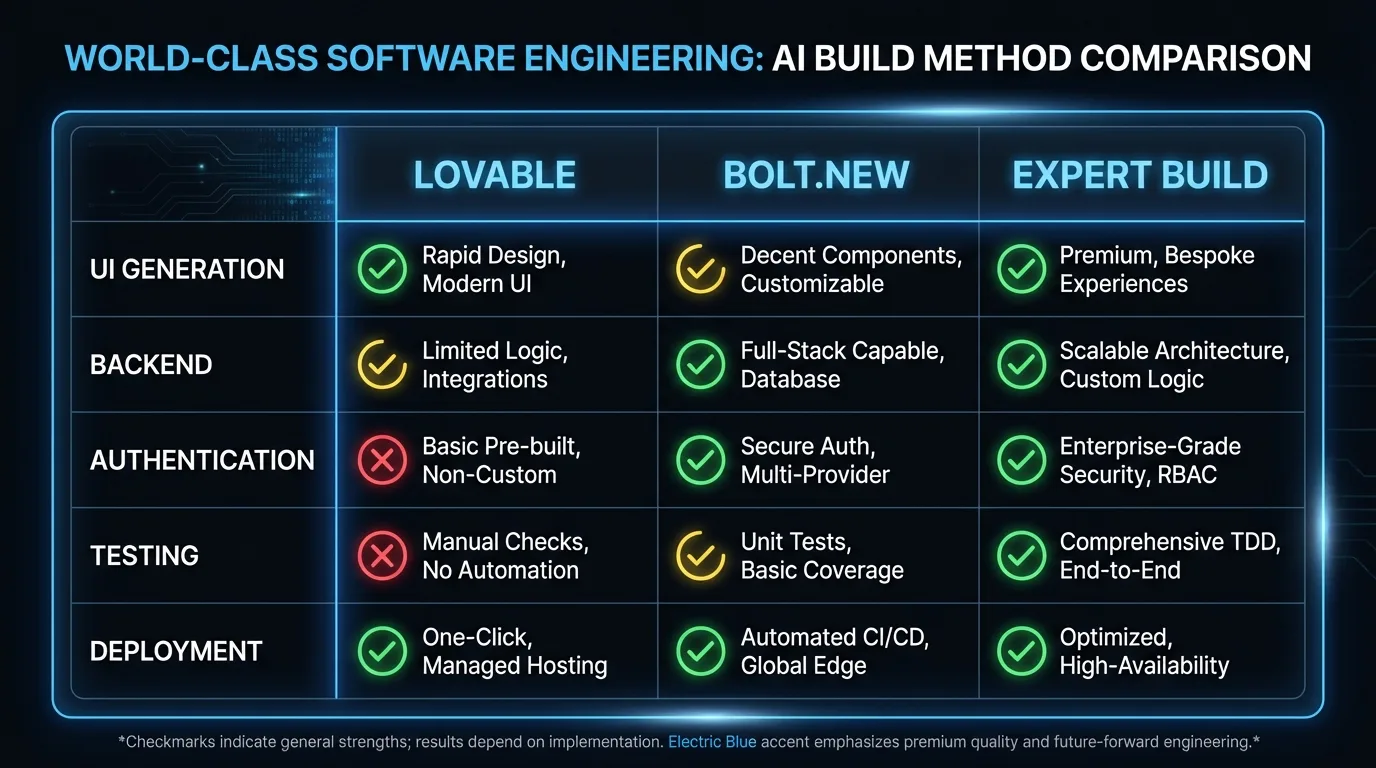
Feature Comparison
| Feature | Lovable | Bolt.new | Expert-Supervised Build |
|---|---|---|---|
| UI generation | Strong — design-focused | Good — functional | Production-quality — designer + engineer standards |
| Backend/database | Supabase (built-in) | Generated (ad-hoc) | Architected for production (PostgreSQL, etc.) |
| Authentication | Basic (via Supabase) | Basic (manual config) | Production-grade (OAuth, RBAC, session management) |
| Third-party integrations | Limited | Limited | Full API integration (Stripe, HubSpot, Twilio, etc.) |
| Error handling | Minimal | Minimal | Comprehensive (logging, graceful failures, monitoring) |
| Testing | None | None | Unit, integration, and E2E tests included |
| Deployment | Lovable hosting | Bolt.new hosting | CI/CD pipeline, staging, production environments |
| Code ownership | Yes (export) | Yes (export) | Yes (full codebase delivered) |
| Scalability | Limited by generated architecture | Limited by generated architecture | Built for scale from the start |
| Mobile responsive | Yes | Partial | Yes — tested across devices |
| Custom domain | Available | Available | Included in delivery |
Cost Comparison
| Cost Factor | Lovable | Bolt.new | Expert-Supervised Build |
|---|---|---|---|
| Monthly subscription | $20-$100/mo | $20-$100/mo | N/A — project-based |
| Project cost (simple app) | $20-$100 + your time | $20-$100 + your time | $5K-$15K (fixed) |
| Project cost (complex app) | $100-$500 + your time + likely rebuild | $100-$500 + your time + likely rebuild | $15K-$50K (fixed) |
| Hidden costs | Rebuilding for production: $20K-$100K | Rebuilding for production: $20K-$100K | None — production-grade included |
| Ongoing maintenance | You maintain it | You maintain it | Handoff or ongoing support available |
| Total cost to production | $20K-$100K+ (prototype + rebuild) | $20K-$100K+ (prototype + rebuild) | $5K-$50K (one build, production-ready) |

The hidden cost line is where most founders get surprised. A Lovable or Bolt.new prototype costs $100 in subscriptions. Getting that prototype to production costs $20K-$100K in engineering — either from a freelancer, agency, or your own painful learning curve. The total cost to a production product is often higher than having it built properly from the start.
Timeline Comparison
| Phase | Lovable | Bolt.new | Expert-Supervised Build |
|---|---|---|---|
| Prototype | 1-3 days | 1-2 days | Not applicable (builds production directly) |
| Production MVP | 2-6 months (after hiring someone to rebuild) | 2-6 months (after hiring someone to rebuild) | 1-4 weeks |
| First real users | 3-8 months | 3-8 months | 2-6 weeks |
| Total to market | 3-8 months | 3-8 months | 2-6 weeks |
Both Lovable and Bolt.new are fast at producing prototypes. But “time to prototype” and “time to market” are different metrics. The rebuild phase — taking a prototype to production — is where months get added.
What Real Projects Look Like
Numbers are useful. But scenarios show the full picture.
Scenario 1: Simple landing page with waitlist
A founder wants a branded landing page with email capture, a thank-you sequence, and basic analytics.
Lovable: Handles this well. 2-3 hours to generate, customize, and deploy. Supabase stores email addresses. Total cost: $20. This is Lovable’s sweet spot.
Bolt.new: Also handles this well. Similar timeline, slightly less polished design. Total cost: $20.
Expert-supervised build: Overkill for this use case. You don’t need production engineering for a waitlist page.
Winner: Lovable or Bolt.new. Save the expert build for the product itself.
Scenario 2: SaaS MVP with auth, billing, and a dashboard
A founder wants a multi-tenant SaaS product with Stripe billing, role-based access, and a data dashboard.
Lovable: Generates the UI and basic Supabase auth. Stripe integration is fragile — webhooks don’t handle edge cases, subscription management is incomplete. Dashboard shows static data. Estimated rebuild cost to production: $30K-$60K.
Bolt.new: Generates the UI and scaffolds the backend. Auth and billing require significant manual work. Dashboard functionality is basic. Estimated rebuild cost to production: $30K-$60K.
Expert-supervised build: Production-grade from day one. Proper Stripe integration with webhooks, dunning, and plan management. Role-based auth. Real-time dashboard. Timeline: 2-4 weeks. Cost: $15K-$35K.
Winner: Expert-supervised build. The total cost (including rebuild) is lower, and the timeline is 5-10x faster.
Scenario 3: Prototype for investor demo
A founder wants something visual to show VCs in 2 weeks. It doesn’t need to process real transactions or handle real users.
Lovable: Perfect use case. Generate the full UI, add demo data, deploy to a shareable URL. Total timeline: 2-5 days.
Bolt.new: Same — fast prototype with shareable URL. Total timeline: 1-3 days.
Expert-supervised build: Works, but you’re paying for production quality you don’t need yet. Better to prototype with AI tools, then build production-grade when you’ve raised.
Winner: Bolt.new (speed) or Lovable (design). Prototype first, build for production after the raise.
Who Each Approach Is Best For
Choose Lovable if:
- You want to validate an idea before investing real money.
- Design quality matters more than technical depth.
- You’re building a simple CRUD app or internal tool that won’t need to scale significantly.
- You’re comfortable managing your own Supabase backend.
- You accept that you’ll likely rebuild for production.
Choose Bolt.new if:
- Speed of prototyping is your top priority.
- You want framework flexibility (not locked into React + Supabase).
- You have some technical skills and can work with generated code.
- You’re using the prototype for investor demos or customer research, not production.
- You accept that production will require a separate engineering effort.
Choose expert-supervised building if:
- You’ve already validated your idea (or are confident enough to skip prototyping).
- You need a product that works in production from day one — real users, real payments, real data.
- Your timeline is weeks, not months.
- You don’t want to manage the build process.
- You’d rather pay for a production product once than pay for a prototype and then a rebuild.
The Production-Grade Question
The fundamental decision comes down to this: do you need a prototype or a product?
If you need a prototype: Lovable and Bolt.new are both excellent choices. Pick Lovable for design quality, Bolt.new for speed and flexibility. Spend the $20-$100/month, validate your idea, and iterate.
If you need a product: Neither Lovable nor Bolt.new will get you there on their own. You’ll need production engineering — from a freelancer, an agency, or a supervised AI build service.
The mistake most founders make is conflating the two. They start with an AI builder, get excited about the output, and try to stretch a prototype into a product. Six months and $50K later, they have a fragile codebase that needs to be rewritten from scratch.
The more efficient path: validate with AI tools (cheap and fast), then build for production with experts (fast and right).
Decision Matrix
| Your Situation | Recommendation |
|---|---|
| ”I have an idea and want to see if it’s viable” | Lovable or Bolt.new — prototype fast, test with users, spend <$100 |
| ”I’ve validated demand and need a product to launch” | Expert-supervised build — skip the prototype-to-production rebuild |
| ”I’m building a simple internal tool for my team” | Lovable — design quality + Supabase backend handles simple use cases |
| ”I need to demo for investors next month” | Bolt.new (for the demo) → expert-supervised build (for the real product) |
| “I tried Bolt/Lovable and the product isn’t production-ready” | Expert-supervised build — production-grade from the start, no rebuilding |
| ”I have $200K+ budget and 6+ months” | Traditional agency — full control, custom everything |
| ”I need a production product in 2-4 weeks” | Expert-supervised build — the only option at this timeline with production quality |
| ”I want to learn and build it myself” | Bolt.new + Cursor — AI tools as learning accelerators |

The Bottom Line
Lovable and Bolt.new are genuine innovations. They’ve made prototyping accessible to anyone with an idea and an internet connection. For validation, demos, and learning — they’re hard to beat.
But a prototype isn’t a product. The gap between “looks right” and “works in production” is still an engineering problem. AI builder tools haven’t closed that gap — they’ve made the first part (creating something visible) trivially easy while the second part (making it production-ready) remains the same challenge it’s always been.
For founders who need to ship a real product, the most efficient path in 2026 is clear: validate fast with AI tools, then build production-grade with supervised AI engineering. Two steps, weeks instead of months, and no painful rebuild in between.
Frequently Asked Questions
Can Lovable or Bolt.new build a production-ready app?
Not on their own. Both tools produce impressive prototypes, but they lack production essentials: proper authentication, error handling, testing, security hardening, and scalable architecture. Getting a Lovable or Bolt.new prototype to production typically costs $20K-100K in additional engineering, often more than building production-grade from the start.
When should I use an AI builder vs. hiring someone to build my MVP?
Use AI builders (Lovable, Bolt.new) for idea validation, investor demos, and internal tools that don’t need to scale. If you need a product that handles real users, real payments, and real data from day one, an expert-supervised build gets you there in weeks instead of months, at lower total cost than prototype-plus-rebuild.
What’s the difference between Lovable and Bolt.new?
Lovable produces better-looking interfaces and has built-in Supabase integration for backend support. Bolt.new is faster and supports multiple frameworks (React, Next.js, Vue, Svelte). Pick Lovable when design quality matters most. Pick Bolt.new when speed and framework flexibility are your priority.
If you’ve validated your idea and need a production product built in weeks, Launchpad is built for exactly that.