Key Takeaway
The fastest productivity gains in most plants over the next two years will come from automating the handoffs around existing equipment, not from new machines. Start with one handoff, a one-sentence automation hypothesis and a KPI the plant already reports, like NCR time-to-disposition.
Plants invest in machines and a manufacturing execution system (MES), then lose hours wherever information moves between the floor, engineering and management by spreadsheet, email and paper. This article is for plant managers, operations leaders and manufacturing IT teams who want productivity gains without a platform program. It shows how to find those handoffs, write an automation hypothesis for one, and tie it to throughput, quality or cycle time.
Ask a plant manager where productivity goes and you’ll usually hear about machines. Unplanned downtime. Changeovers that run long. A bottleneck cell that sets the pace for everything else.
Those are real. They’re also the losses plants already measure, through OEE (overall equipment effectiveness), downtime codes and maintenance logs. The losses nobody measures sit between people. A quality tech writes a nonconformance on paper, and it waits a day to be keyed into the QMS (quality management system). An engineering change is released in the PLM (product lifecycle management) system, and the floor keeps running the old revision because the printed traveler didn’t change. A supervisor rebuilds yesterday’s production numbers from three spreadsheets before the morning meeting.
Each of those is a handoff: information moving from the plant to engineering, from engineering to the floor, or from both up to management. In most mid-sized manufacturers, those handoffs still run on email, spreadsheets, whiteboards and memory.
Our view: the fastest productivity gains in a typical plant over the next two years won’t come from new equipment. They’ll come from automating the handoffs around the equipment you already have. Start with one handoff, a written hypothesis and a KPI the plant already tracks.
How does a manual handoff lose value?
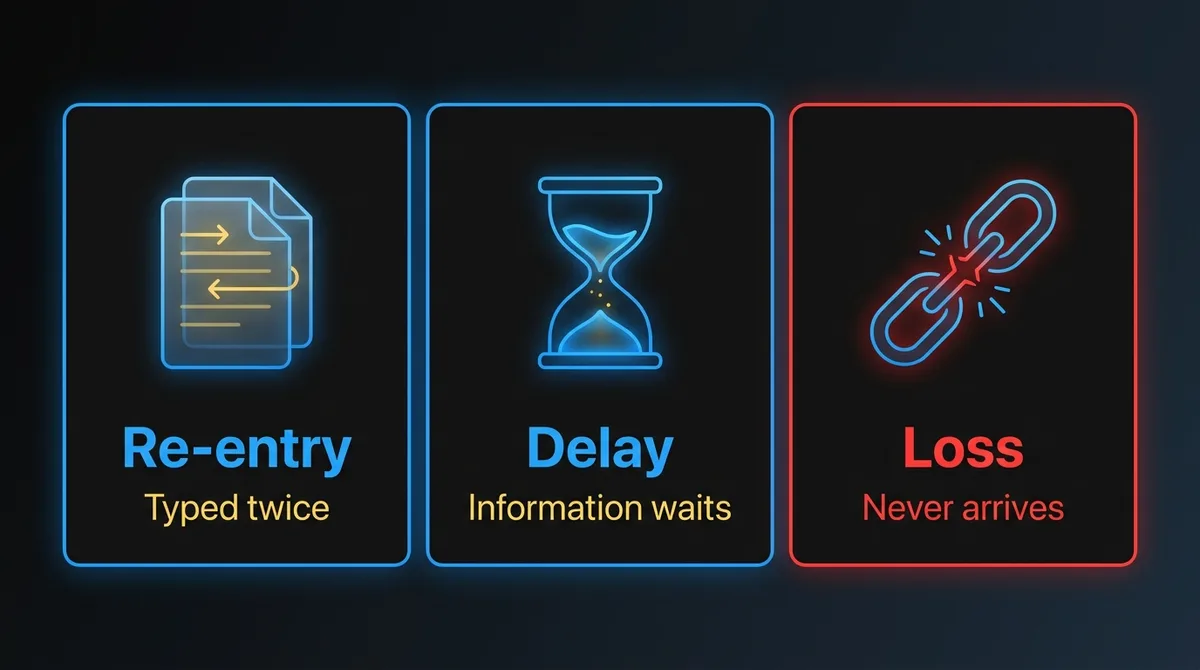
In one of three ways: re-entry, delay or loss. Not every handoff is a problem. The ones worth fixing fail in at least one of these ways, and the ones that fail in all three are usually your best first target.
Re-entry. The same information gets typed more than once. An operator records a defect on a paper tag. A quality tech enters it in the QMS. An engineer copies it into an email to the supplier. Each re-entry costs time and introduces transcription errors, and those errors show up later as bad data in your Pareto charts.
Delay. Information exists but waits. The nonconformance sits in an inbox until the material review board (MRB) meets on Thursday. The engineering change is approved Monday but reaches the floor Wednesday. The machine or the part waits with it.
Loss. Information never arrives. The second-shift lead knew the spindle on machine 7 was running warm and mentioned it at handover. Nobody wrote it down. First shift found out when it failed. Tribal knowledge is the most expensive version of this, because it walks out the door when people retire.
Where are the manual handoffs in a plant?
Mostly in six recurring flows: nonconformances, engineering changes, shift handovers, downtime reporting, quoting and maintenance requests. If you run a discrete or contract manufacturing operation, you’ll recognize most of these.
| Flow | From → To | Typical systems | Common failure |
|---|---|---|---|
| Nonconformance and disposition | Floor → Quality → Engineering → Supplier | Paper tag, QMS, email, ERP | Re-entry and delay. Parts sit on hold waiting for a disposition. |
| Engineering change (ECN/ECO) | Engineering → Planning → Floor | PLM, ERP BOM and routings, printed travelers | Delay and loss. The floor runs an old revision. |
| Shift handover | Shift → Shift | Whiteboard, logbook, group chat | Loss. Context about machines, quality and open issues disappears. |
| Downtime and scrap reporting | Floor → Management | MES or manual sheets, spreadsheets | Re-entry. Reason codes picked at end of shift, from memory. |
| Quote to order (job shops) | Customer RFQ → Estimating → Planning | Email, PDF drawings, spreadsheet estimate, ERP | Re-entry. Estimators re-key dimensions, materials and quantities. |
| Maintenance requests | Operator → Maintenance | Verbal, paper, CMMS | Delay and loss. Work orders created late or not at all. |
Two things stand out when you lay it out this way. First, most of these flows already have a system of record (QMS, PLM, ERP, or CMMS for maintenance) at one end. The failure is in getting information into it, or out of it to the person who needs it. Second, the people involved are almost always skilled and busy. The time goes in the relay between them.
How do you map a handoff before automating it?
Walk one flow with the people who do the work and record how it actually runs, not what the procedure says. For each step, write down five things:
- Who acts. The role, and the shift if it matters.
- What system or medium. QMS, email, a specific spreadsheet, a clipboard.
- What information moves. Part number, lot, defect description, photos, quantities.
- How long it waits before the next step starts.
- Whether it’s re-entered. Is this information already captured somewhere upstream?
The map usually takes half a day on the floor. It almost always reveals more steps than the documented process, and at least one spreadsheet the plant depends on that IT has never seen.
Mark every step that re-enters information, every wait longer than a shift, and every place where information can disappear. That’s your shortlist.
What makes a good automation hypothesis?
One sentence that names the step, the handoff, a KPI with a baseline and a target, a timeline and the system where it’s measured. Write it before anyone builds anything, so operations leadership can approve or reject it.
If we [automate this step] at [this handoff], then [this KPI] moves from [baseline] to [target] within [weeks], measured in [system].
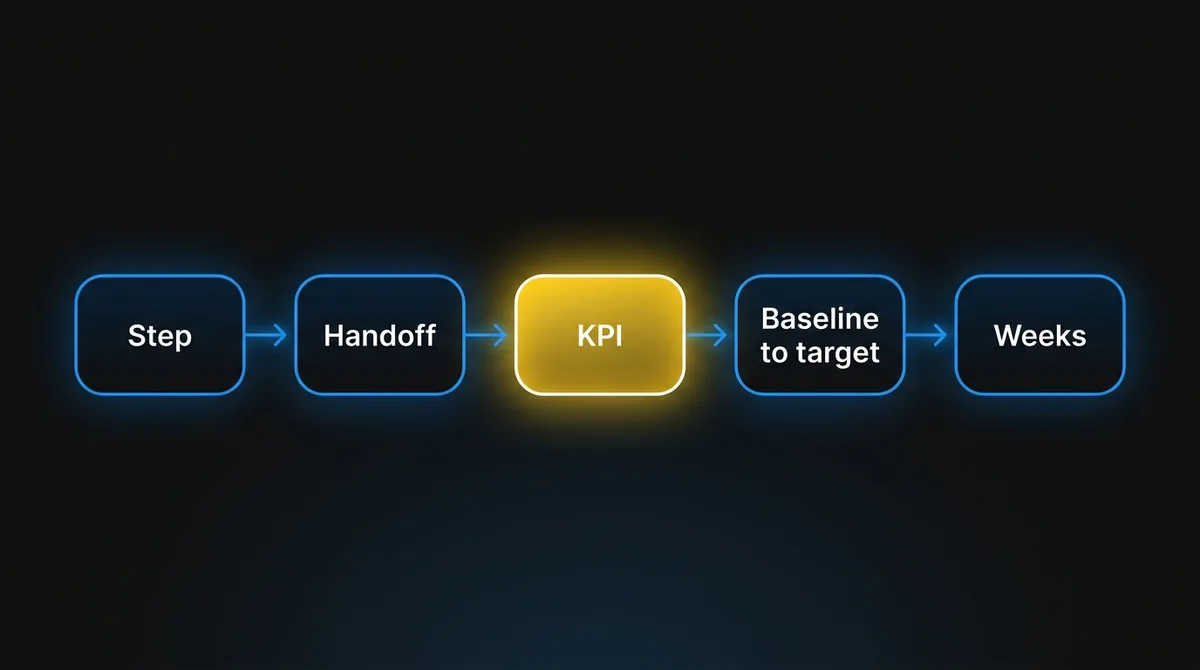
For example: “If we capture nonconformances on a tablet at the cell and draft the QMS record and initial disposition automatically, then median NCR (nonconformance report) time-to-disposition moves from 4.5 days to under 2 within 12 weeks, measured in the QMS.”
A good hypothesis has three properties. The KPI already exists, or you can baseline it in a week from data you have. The step is narrow enough to ship in weeks, not quarters. And it’s falsifiable: if the number doesn’t move, you stop or change course, having spent a fraction of what a platform program would cost.
Which KPI should a handoff project move?
One the plant already reports on, so the result shows up in the meeting where it counts. Plant leaders have enough dashboards. Pick one primary metric and one leading indicator from a family they already watch.
| KPI family | Metric | Handoffs that usually drive it |
|---|---|---|
| Throughput | OEE availability; units per shift; WIP on hold | Maintenance requests, shift handover, NCR holds |
| Quality | First-pass yield; scrap rate; NCR recurrence; customer returns | NCR and disposition, ECN to floor, shift handover |
| Cycle time | NCR time-to-disposition; ECN release-to-floor lag; RFQ-to-quote turnaround | Engineering change, quote to order, nonconformance |
| Decision speed | Time to produce the daily production report; time to root cause | Downtime and scrap reporting |
For an NCR project, the primary metric might be time-to-disposition and the leading indicator might be the share of NCRs created at the cell within 15 minutes of detection. If the leading indicator doesn’t move in the first two weeks, the primary won’t either.
Where does AI help with manufacturing handoffs?
Where the handoff carries unstructured information people currently interpret by hand. A lot of handoff automation is plain integration work: an API between the MES and the ERP, or a form that writes directly to the QMS. Do that wherever it solves the problem. Add AI for the text, documents and judgment calls integration can’t handle.
- Free-text defect descriptions. An LLM can classify an operator’s note (“burr on bore edge, 3 of 20, op 40”) into your defect codes, pull the part and operation, and propose a QMS record for the quality tech to confirm.
- Similar past cases. Retrieval over historical NCRs and their dispositions lets the system suggest “use as is,” “rework” or “scrap” with the three closest precedents attached. Engineering still decides, faster and with better context.
- Documents. RFQ (request for quote) packages, supplier certificates and drawings arrive as PDFs. Extracting materials, tolerances and quantities into a structured estimate removes the estimator’s re-keying step.
- Shift handover summaries. MES events, open work orders and a short voice or text note from the outgoing lead get combined into a structured handover the next shift reads when it starts.
In each case the AI drafts and a qualified person approves. Plants have good reasons to be conservative about automation that touches quality decisions. The human checkpoint is also how you build the labeled history that lets you automate more later. We go deeper on that pattern in agentic AI use cases: a practical guide for product teams.
What does an automated NCR handoff look like in practice?
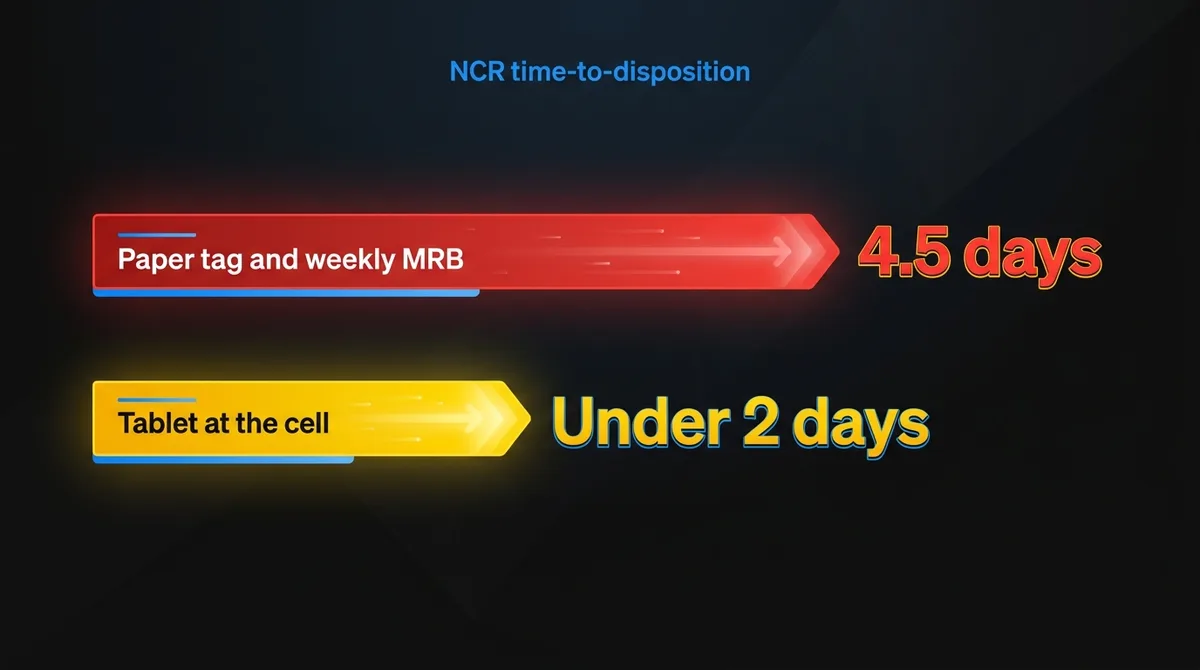
At a 150-person machine shop, it can cut time-to-disposition from 4.5 days to under 2. The numbers here are illustrative. The flow is typical of contract and discrete manufacturers.
The plant. A 150-person contract machine shop running two shifts, an ERP for orders and inventory, and a QMS used mainly by the quality team. Around 60 nonconformances a month.
The handoff today. An operator finds a defect, fills out a paper hold tag and moves the parts to the hold area. The quality tech collects tags at end of shift and enters them in the QMS the next morning. An engineer reviews them in a weekly MRB meeting and emails the disposition. Planning learns about the delay when a job slips.
The baseline. Median time from detection to disposition: 4.5 days. Parts on hold at any time: about $40,000 of work in progress (WIP). Roughly one late shipment a month traced to a hold.
The hypothesis. If operators capture NCRs on a tablet at the cell with photos, and the system drafts the QMS record, the defect classification and a suggested disposition based on similar past cases, then median time-to-disposition drops below 2 days within 12 weeks.
The milestone. Tablet capture and auto-drafted QMS records on one cell in four weeks. Suggested dispositions with past-case retrieval by week eight. Engineering approves dispositions daily in the QMS instead of weekly in a meeting.
What’s hard. The QMS integration, cleaning up historical defect codes so retrieval returns useful precedents, and agreeing with quality on which dispositions can ever be suggested automatically. None of that is model work, and all of it decides whether the project succeeds.
If the hypothesis holds, the plant gets faster dispositions, less WIP on hold and a structured defect history that makes root-cause analysis possible for the first time. For framing that kind of result for a CFO, see how to build the business case for AI investment.
Could a handoff automation project qualify for SR&ED?
Sometimes, if it involves real technical uncertainty. Examples include whether defect classification can reach acceptable accuracy on your data, or how to integrate with a legacy MES that has no documented API. Work that resolves that kind of uncertainty may be eligible for SR&ED (Scientific Research and Experimental Development) tax credits in Canada.
The evidence (experiments, test results, failed approaches) is easiest to capture while the work is happening. Chrono R&D captures it from your engineering tools as you go, and certified SR&ED consultant partners review the documentation. Whether a specific project qualifies is a question for your tax advisor. See SR&ED eligible activities: what qualifies? for the basics.
This section is general information, not tax advice. Your advisor validates eligibility and treatment.
Who should build handoff automation in a plant?
Someone who can work across floor systems and business systems and add AI where it helps, without turning it into a platform program. Most manufacturers have strong process engineers, a small IT team and an ERP partner. That cross-system builder is usually the missing piece.
That’s where we fit. Our senior AI engineers embed with your team, work in your systems and your release cycle, and ship the first automated handoff alongside your process and IT people. The capability stays with your team when the engagement ends. See how we work with manufacturers, and more on the model in AI augmented development: what embedded AI teams look like.
Frequently Asked Questions
What’s the best first handoff to automate in a manufacturing plant?
The one that fails in all three ways: re-entry, delay and loss. Nonconformance and disposition is a common first pick because parts sit on hold, the data is typed several times, and time-to-disposition is easy to baseline in the QMS.
Do we need a new MES or ERP to automate handoffs?
No. Most handoff flows already have a system of record at one end. The work is getting information into it at the source and out of it to the person who needs it, usually through integration plus AI for unstructured text and documents.
How long does a first handoff automation project take?
A narrow milestone can ship in weeks. In the NCR example, tablet capture and auto-drafted QMS records go live on one cell in four weeks, with suggested dispositions by week eight and a 12-week target for the KPI.
Which handoff annoys your plant manager most?
The paper tag, the ECN that never reaches the floor, the morning spreadsheet. Pick one and show it to us. We’ll send back an automation hypothesis: a one-page workflow map, the KPI it should move with a baseline approach, and a scoped first milestone tied to throughput, quality or cycle time. Send us your handoff.