Key Takeaway
The Productivity Mega Deduction changes when you deduct a technology investment, not whether it pays off. Rank your 2027 candidates by time to measurable gain, scope the first one to a single quarter, and hand your tax advisor a cost breakdown before you count on the write-off.
Canada’s proposed Productivity Mega Deduction would let corporations write off most capital investment in the year it’s put to use. This article is for CFOs and operations leaders in manufacturing, transport and services who are planning 2027 technology spending. It explains what the deduction changes, what it doesn’t, and how to rank your candidate projects so the incentive improves a good plan instead of replacing one.
On September 15, 2026, the federal government announced the deduction and released draft legislation. As proposed, corporations could deduct the full cost of a wide range of depreciable property in the year it becomes available for use, permanently. Commentators list software and computer equipment among the assets that benefit.
That’s a real change to the math on technology spending. It’s also the start of a familiar mistake: treating an incentive as a plan. The companies that get the most out of it will rank their projects by how fast each one produces a measurable gain, scope the first one tightly, and only then ask their advisor how it’s treated.
Disclaimer. This is general information, not tax advice. The Productivity Mega Deduction is proposed legislation and may change before it’s enacted. Talk to your tax advisor about how it applies to your business.
What is the Productivity Mega Deduction?
It’s a proposed, permanent measure that lets corporations immediately expense about two-thirds of capital investment, by government figures, for property acquired on or after September 15, 2026. It expands the Productivity Super-Deduction from Budget 2025, which covered about 15%. The table below sticks to points that multiple law-firm and bank summaries agree on.
| Productivity Super-Deduction (Budget 2025) | Productivity Mega Deduction (proposed September 2026) | |
|---|---|---|
| Status | Announced in Budget 2025 | Draft legislative proposals released September 15, 2026. Not yet law. |
| Share of capital investment eligible for immediate expensing | About 15%, per government figures | About two-thirds, per government figures |
| Examples | Patents, data network infrastructure, computers and systems software; manufacturing and processing buildings | Commentators list software, computer equipment, R&D, vehicles, aircraft, rail track, pipelines and more |
| Duration | Temporary, with phase-outs | Proposed as permanent |
| Timing | Varies by asset | Property acquired on or after September 15, 2026, deductible in the year it becomes available for use |
| Notable exclusions | n/a | Buildings (Classes 1 and 3), goodwill and certain other intangibles (Classes 14 and 14.1), certain vehicles, regulated gas distribution pipelines |
A few more points matter for planning. Commentary indicates corporations can claim the full amount with no income limit. Individuals, and partnerships with individual members, can’t use immediate expensing to create or increase a loss. The government estimates the marginal effective tax rate on new business investment would drop from roughly 13% to 6.4%, at a cost of $36 billion over five years.
Some things are still open. Law firms note unresolved mechanical questions, and the draft could change. No source we found addresses how custom software development, integration services or internal engineering time are treated. Those costs make up much of a typical AI or software project. That’s one more reason to bring your advisor a clean cost breakdown, not a single number.
What does the deduction change for technology spending?
It moves the deduction earlier. Instead of writing off a qualifying asset over many years, a profitable corporation deducts it in year one. That lowers cash tax in the year you invest and improves the after-tax return, sometimes enough to push a borderline project over the hurdle rate.
It also weakens one argument at the capital committee. “We can’t justify the spend this year” is harder to make when a big part of the cost comes back as a deduction the same year.
What doesn’t the deduction change?
Whether the project works. The return on a technology investment comes from an operating result: more units per shift, fewer late deliveries, lower cost per order, faster quotes. The deduction does nothing for any of that.
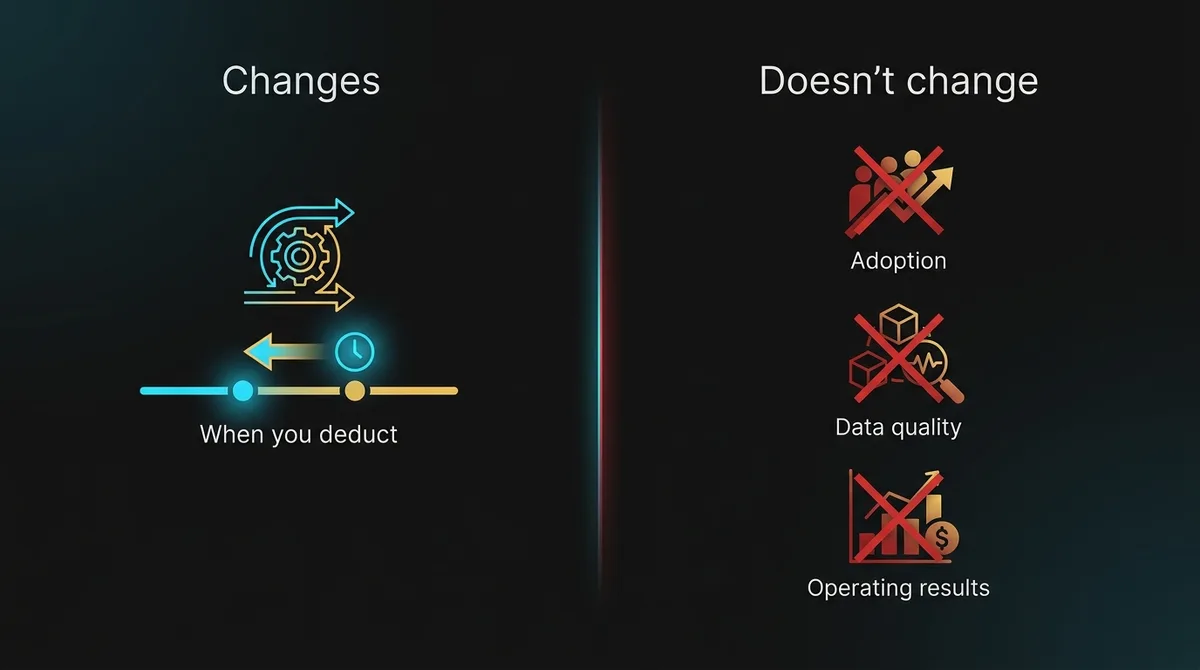
It doesn’t fix adoption. A scheduling system that planners route around returns nothing, deducted early or not.
It doesn’t remove technical dependencies. If the project needs clean routing data from an ERP nobody trusts, the write-off won’t clean it.
It doesn’t help much if you aren’t paying tax. Businesses with losses may see little near-term benefit, as commentators point out.
And it creates a pull toward buying assets because they’re deductible, then hunting for a use. That’s the trap. Our guide to building the business case for AI investment covers the general version: justify a specific implementation, not a category of spend.
How should you rank technology investments for 2027?
By time to measurable gain first, then size of gain, technical dependency risk and owner readiness. Most mid-sized companies already have a list waiting for budget: a scheduling system from operations, an inspection idea from the plant, a module finance has wanted for years, a data platform IT says everything depends on. The list isn’t the problem. The ranking is.
| Factor | Question | Score high when | Score low when |
|---|---|---|---|
| Time to measurable gain | How soon will the operating metric move in a way you can measure? | One quarter or less for a first result | Value only arrives after a multi-year platform build |
| Size of gain | What’s the metric worth at the target level, per year? | Tied to a cost or revenue line with a known baseline | Described as “efficiency” or “visibility” |
| Technical dependency risk | What systems, data or integrations must work first? | Data is reachable, systems are known, IT is engaged | Depends on a system that’s being replaced, or data nobody trusts |
| Owner readiness | Is there one person accountable for the result, and will they make time? | Named operating owner who’ll meet weekly | Sponsored only by IT or finance |
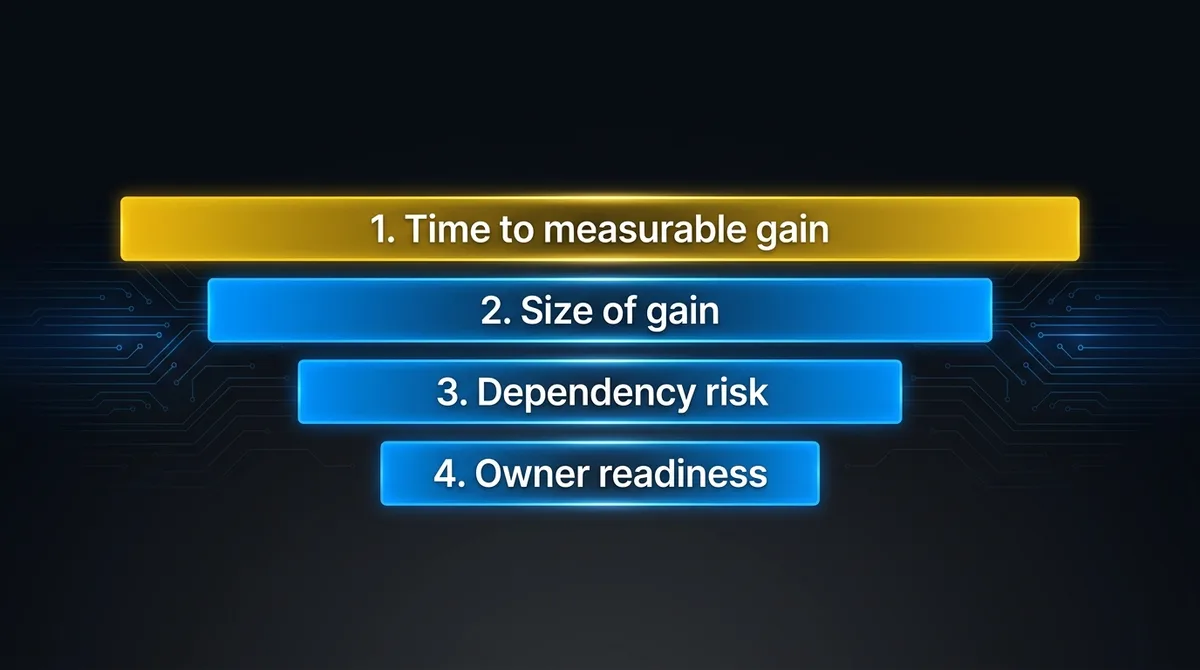
Time to gain goes first on purpose. A project that shows a result in one quarter funds and de-risks the next. A project that needs 18 months of foundation work tends to get re-scoped twice before anyone sees a number.
Platform investments like a data warehouse or an integration layer usually score low on their own. That doesn’t mean you don’t need them. It means you scope them to what the top-ranked project needs and justify them through that project, not as standalone bets.
What goes on an investment-to-outcome canvas?
Ten fields that tie the investment to one operating metric and split the cost so your advisor can work out the tax treatment. Fill it in for the top-ranked candidate before it goes to the capital committee or the advisor.
- Investment. What’s being built or bought, in one sentence.
- Operating metric. The one number it moves.
- Baseline. That number today, measured, with the source.
- Target and date. Where the metric should land, and when.
- Time to first measurable gain. When the first result can be checked.
- Technical dependencies. Systems, data and integrations it relies on, with an owner for each.
- Owner. The person accountable for the result.
- Cost breakdown. Hardware, software licences, external development and integration services, internal staff time, ongoing run costs. Listed separately, not as one total.
- Tax treatment. Left blank for your advisor, who works from field 8.
- First milestone. What ships first, and what result decides whether to keep going.
Fields 8 and 9 are the bridge to the deduction. Most technology projects mix capital assets with services and labour, and those can be treated differently. Your advisor can only answer if you hand them the split. For the measurement side (fields 3 to 5 and 10), see Before You Scale an AI Pilot, Write Down Five Numbers, which goes deeper on baselines, adoption targets and first-milestone scorecards.
What does the ranking look like at a real manufacturer?
Here’s an illustrative example. The company and figures are made up to show the method.
A metal fabricator with three production lines has four technology investments on its 2027 list:
- A. ERP finance module upgrade. Owner: CFO. Metric: days to close the month.
- B. Camera-based quality inspection on Line 2. Owner: plant manager. Metric: scrap and rework rate on Line 2.
- C. Production scheduling optimization. Owner: COO. Metric: on-time delivery.
- D. Central data platform. Owner: IT director. No direct operating metric; pitched as an enabler for C and future work.
Scored against the four factors:
| Candidate | Time to gain | Size of gain | Dependency risk | Owner readiness | Rank |
|---|---|---|---|---|---|
| A. ERP module | 12+ months | Moderate (finance team hours) | High: vendor migration | Ready | 4 |
| B. Line 2 inspection | About 10 to 12 weeks to first result | Scrap on Line 2 runs 3.1% of about $14M annual output (about $430K). A 2.0% target is worth about $150K a year | Low: cameras, edge compute, one integration to send reject signals | Plant manager committed | 1 |
| C. Scheduling | 4 to 6 months | On-time delivery from 86% to a 92% target; affects key accounts | Medium: routing data in the ERP is unreliable | COO committed | 2 |
| D. Data platform | 9 to 12 months | Indirect | Medium | IT only | 3, scoped to C |
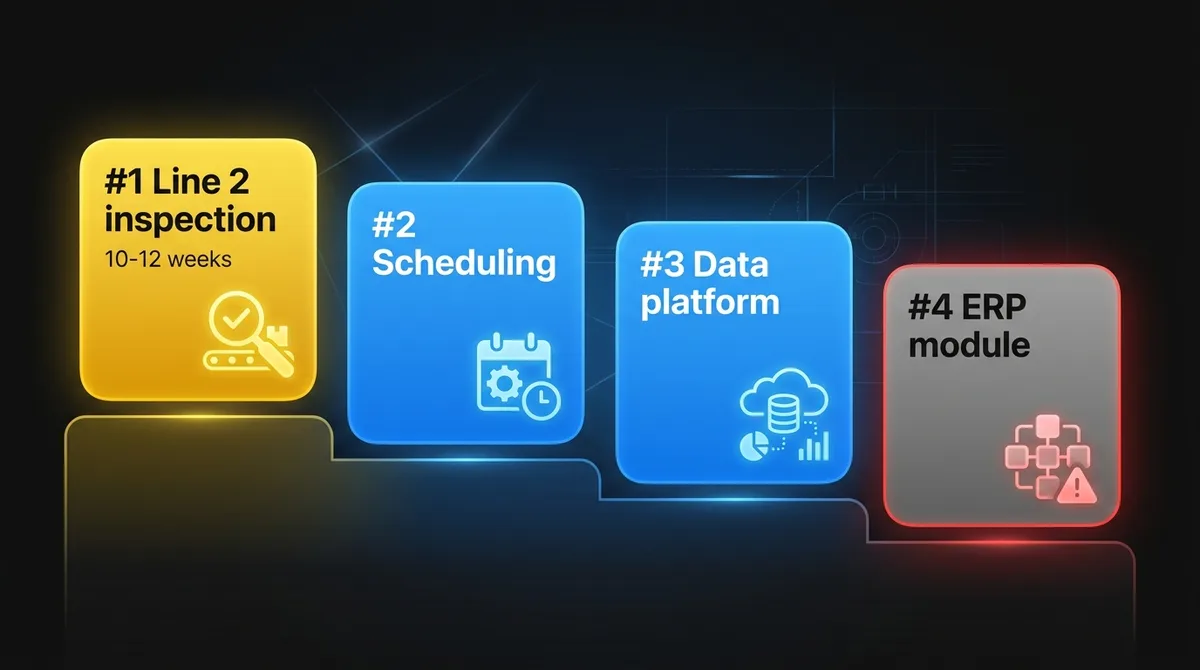
B goes first. Its gain is smaller than C’s on paper, but it shows a measurable result within a quarter and depends on almost nothing else. C goes second, with a short cleanup of routing data as its first milestone. D gets scoped down to what C needs instead of being funded as a standalone platform.
For B, the cost breakdown goes to the advisor as five lines: cameras and lighting, edge compute hardware, inspection software licences, external development and integration work, and internal maintenance and production engineering time. The advisor tells the CFO which lines are depreciable property, which classes they fall in, and when each becomes available for use. The ranking doesn’t depend on that answer. The after-tax payback does.
That’s the order we’d recommend to any company: rank on operating merit, scope, then confirm treatment. If the deduction makes the top project cheaper after tax, good. If it makes the fourth project look attractive only because of the write-off, look harder at the fourth project.
What should you ask your tax advisor?
Ask how each piece of the project’s cost is treated, when each asset counts as available for use, and how your corporate structure and losses affect the benefit. Your advisor’s answers depend on your facts and on what the final legislation says. These are questions, not answers:
- Which parts of this project’s cost are depreciable property, and which are current expenses or something else?
- How are software licences, custom-developed software and integration services treated in our case?
- When will each asset be considered available for use, given our rollout plan?
- We’re a corporation, a partnership or a sole proprietor. How does that change what we can claim?
- We have losses carried forward. When does the benefit actually reach us?
- How does this interact with incentives we already claim, like SR&ED?
- If the draft changes before enactment, what in our plan is most exposed?
How should you sequence technology investments in 2027?
Score and baseline before year-end, confirm treatment and start one project in early 2027, then fund the second on the first one’s result by mid-year. Here’s the rhythm we’d suggest for most companies.
Before year-end. Build the candidate list, score it, and complete the canvas for the top one or two. Measure baselines now, while the current process is still running.
Early 2027. Confirm treatment with your advisor using the cost breakdown. Start the first project with a milestone inside one quarter. Don’t buy hardware for later phases until the first milestone has proven the approach.
Mid 2027. Check the first milestone against the canvas. Fund the second project on that result, with its dependency work (like C’s routing data) already under way.
The underlying work is the same as any AI or software program that pays back: one operating metric, a trusted baseline, a first milestone you can check. We’ve written about that pattern in From Data to Value and in our AI implementation strategy guide.
Frequently Asked Questions
Is the Productivity Mega Deduction law yet?
No. Draft legislative proposals were released on September 15, 2026, and they may change before enactment. As proposed, it applies to property acquired on or after that date.
Does the Productivity Mega Deduction cover software development?
Commentators list software and computer equipment among eligible assets, but no source we found addresses custom software development, integration services or internal engineering time. Give your advisor a cost breakdown that separates those lines so they can tell you what qualifies.
Should we buy technology this year just to use the deduction?
No. Rank projects on operating merit first. If a project only looks attractive because of the write-off, that’s a reason to look harder at it, not to fund it.
Which 2027 investment will move fastest?
Which technology investment in your business creates the fastest measurable productivity gain? If you’ve got a list and want help ranking it, we run a two-week opportunity roadmap. We review your candidates with your operations and finance leads, map the technical dependencies, rank them by time to measurable gain, and complete the investment-to-outcome canvas for the first project, including the cost breakdown your advisor needs. Your advisor validates the tax treatment. When you’re ready to build, our engineers embed with your team and ship it in your systems. Start the conversation.
This is general information, not tax advice. The Productivity Mega Deduction is proposed legislation and may change before enactment. Talk to your tax advisor about how it applies to your business.