Key Takeaway
Don't fund a multi-year AI program on a forecast. Put one or two well-chosen problems into production in 6 to 10 weeks, measure them against a baseline taken before work starts, and let those numbers set the size of the next budget.
Somewhere in your company, a slide deck proposes an AI program. It has a three-year roadmap, a dozen use cases sorted into “quick wins” and “strategic bets,” and a budget line that makes the CFO lean back in their chair.
The CFO’s hesitation is reasonable. They’ve probably already funded one AI initiative that produced a demo and a renewal notice. They’ve heard vendors promise percentage gains that never showed up in the P&L. Before approving a large number, they want evidence from inside their own business.
So give them that evidence first. Pick one or two problems, put a working system into production, measure it against a baseline you took before you started, and let the numbers make the case for the larger budget. This post explains how, for executives and finance leaders weighing an AI investment.
If you’re building the financial model for a larger AI investment, our post on building the business case for AI investment covers cost modeling and ROI (return on investment) framing. This one covers the step before that: getting real proof to put into the model.
Why should proof come before the big AI budget?
Because every number in a large AI plan is a guess until something is running in production. Starting small gives you real data, a clear signal of what works, and an internal win that changes how people talk about AI. There are three practical reasons, and none of them is timidity.
Your estimates are guesses until you’ve shipped something. Before you build anything, you don’t know how clean your data is, how many edge cases the process has, or how your team will react to a system that changes their daily work. A three-year roadmap written before the first production system is a guess stacked on other guesses.
Large programs hide failure. When twelve workstreams run in parallel, it’s hard to tell which ones are working. A single production system with one owner and one metric has nowhere to hide. That clarity is uncomfortable, and it’s exactly what a buyer should want.
Early wins change the internal conversation. Once a finance team sees AP (accounts payable) exceptions clearing in hours instead of days, they stop asking whether AI can help and start asking what to do next. That shift is worth more than any slide.
Ambition is fine. Earn the big budget with a result instead of a forecast. Our post on why AI pilots stall covers what happens when companies skip that step.
How do you choose the first one or two AI problems?
Score your candidates on five criteria: frequency, cost of the current way, data availability, a clear owner, and low blast radius. The first problem sets the tone for everything after it. Too small and nobody cares about the result. Too large and it never finishes.
1. Frequency
The process should happen often. Daily is ideal; weekly can work. A task that happens forty times a day gives you enough volume to measure improvement within weeks. A task that happens twice a quarter won’t produce a meaningful sample before the engagement ends.
Good candidates tend to be repetitive work with judgment in it: reviewing incoming documents, triaging requests, reconciling records across systems, drafting first responses, checking work against a set of rules.
2. Cost of the current way
Someone should be able to say roughly what the process costs today. Hours per week across a team. Error rates and what each error costs to fix. Cycle time and what a delay does downstream, such as late shipments, slower collections, or customers waiting.
You don’t need precision yet. You need enough to know the problem is worth solving. If nobody can estimate the cost, either the process is too invisible to measure or it isn’t painful enough to matter.
3. Data availability
The inputs the system needs should already exist somewhere you can reach. Emails in a shared inbox. PDFs in a document system. Records in an ERP (enterprise resource planning) system. Tickets in a help desk.
Watch for problems where the data mostly lives in someone’s head. That knowledge can be captured, and capturing it is often the most valuable part of the work. Our post on turning institutional knowledge into production systems walks through how. For the first problem, though, you want a head start: some of the inputs and historical outcomes should already sit in a system.
4. A clear owner
One named person on your side owns the process and cares about the result. They run the team that does the work today, they know where the edge cases are, and they’ll use the system once it’s live.
Companies skip this criterion more than any other, and it’s the most common reason first projects drift. A project owned by a committee gets reviewed by a committee. A project owned by the AP manager who’s tired of month-end overtime gets finished.
5. Low blast radius
If the system makes a mistake, the damage should be contained and recoverable. Start with work where a human reviews outputs before they reach a customer, a regulator, or the general ledger. Or start with work where an error is cheap to catch and fix.
Customer-facing decisions, pricing, safety-critical operations, and anything that moves money without review can come later. Once you have a production system, an evaluation set, and a team that trusts it, giving the system more authority becomes a measured decision instead of a leap.
How do you score the candidates?
List ten candidate problems, then score each one from 1 to 5 on all five criteria. Drop anything that scores 1 on owner or blast radius, regardless of the total. Of what’s left, the top two are usually obvious.
Here’s an illustrative example. A 200-person building products distributor might list candidates like these:
| Candidate | Frequency | Cost today | Data | Owner | Blast radius |
|---|---|---|---|---|---|
| PO intake from email and PDF | 5 | 4 | 4 | 5 | 4 |
| Supplier invoice exception handling | 4 | 4 | 4 | 4 | 4 |
| Customer quote generation | 4 | 5 | 3 | 3 | 2 |
| Annual supplier contract review | 1 | 3 | 3 | 3 | 3 |
| Demand forecasting overhaul | 2 | 5 | 2 | 2 | 2 |
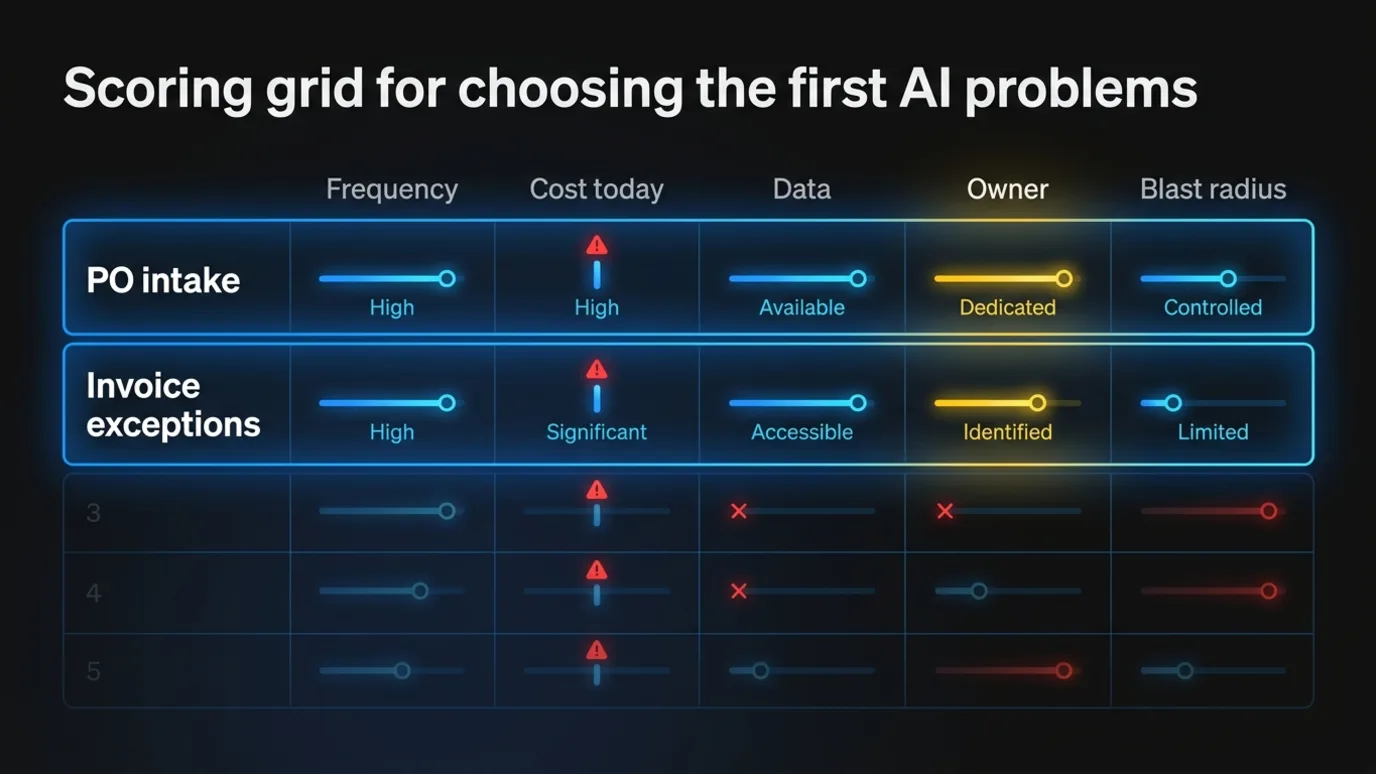
Quoting and forecasting score high on value but low on containment. They belong on the roadmap, not in the first engagement. PO (purchase order) intake and invoice exceptions happen constantly, cost real hours, and have an owner and a human review step. That’s where to start.
What is a fixed-scope production wedge?
It’s a small engagement with a written scope and one deliverable: a working system in production. It’s small enough to approve without a board discussion and real enough to prove something. Once you’ve picked the problem, the shape of the engagement matters as much as the choice of problem.
Fix the scope. Name the problem, the process boundaries, the systems involved, and the definition of done. Write down what’s explicitly out of scope. Fixed scope protects both sides. You know what you’re paying for, and the team building it can’t let the project drift into the next three ideas everyone has once the work starts.
Make the target production. The deliverable is a system that real people use on real work, running in your environment, connected to your actual systems. A recommendation or a slide deck doesn’t count. Neither does a prototype that “proves the concept.” Prototypes are useful inside an engagement. As an end state, they’re where AI budgets go to die, because most of the effort lives in the gap between a demo and a production system. We covered that gap in moving AI from pilot to production.
Sometimes one of the two problems is better suited to a working prototype in the first round. That’s fine if it’s deliberate. One problem goes to production, and the second gets prototyped against real data so the next phase starts with evidence instead of assumptions.
What does AI proof look like to a CFO?
A before-and-after on a number they already understand. Minutes per invoice, cycle time, error rate, days sales outstanding. Anecdotes from happy users help with adoption, but they don’t move budgets.
Why take a baseline before you start?
Without a baseline, every result after launch is arguable. With one, it isn’t. Teams skip this step and regret it. Before anyone writes code, measure the current process for two to four weeks:
- Time per unit. Minutes per invoice, per ticket, per order. Pull it from system timestamps where possible and sample manually where not.
- Volume. How many units per day or week, and how that varies.
- Error rate. How often the work is wrong, and what share of errors get caught before they cause damage.
- Cycle time. Elapsed time from when the work arrives to when it’s done. This often matters more than effort, because delays have their own costs.
- Cash impact, where it applies. Days sales outstanding, early-payment discounts captured or missed, write-offs, chargebacks, expedited shipping fees.
How should you report the results?
Measure the same metrics the same way once the system is live, and report them in units the CFO already uses. Keep the measurement period long enough to include a normal mix of easy and hard cases, usually at least a few weeks.
“Average PO processing time fell from 14 minutes to 4, across about 300 POs a week” turns into hours, and hours turn into capacity. “Invoice exceptions resolved within two business days rose from roughly half to most of them” turns into early-payment discounts and fewer supplier escalations. Those numbers are illustrative. Your baseline determines what’s realistic for you.
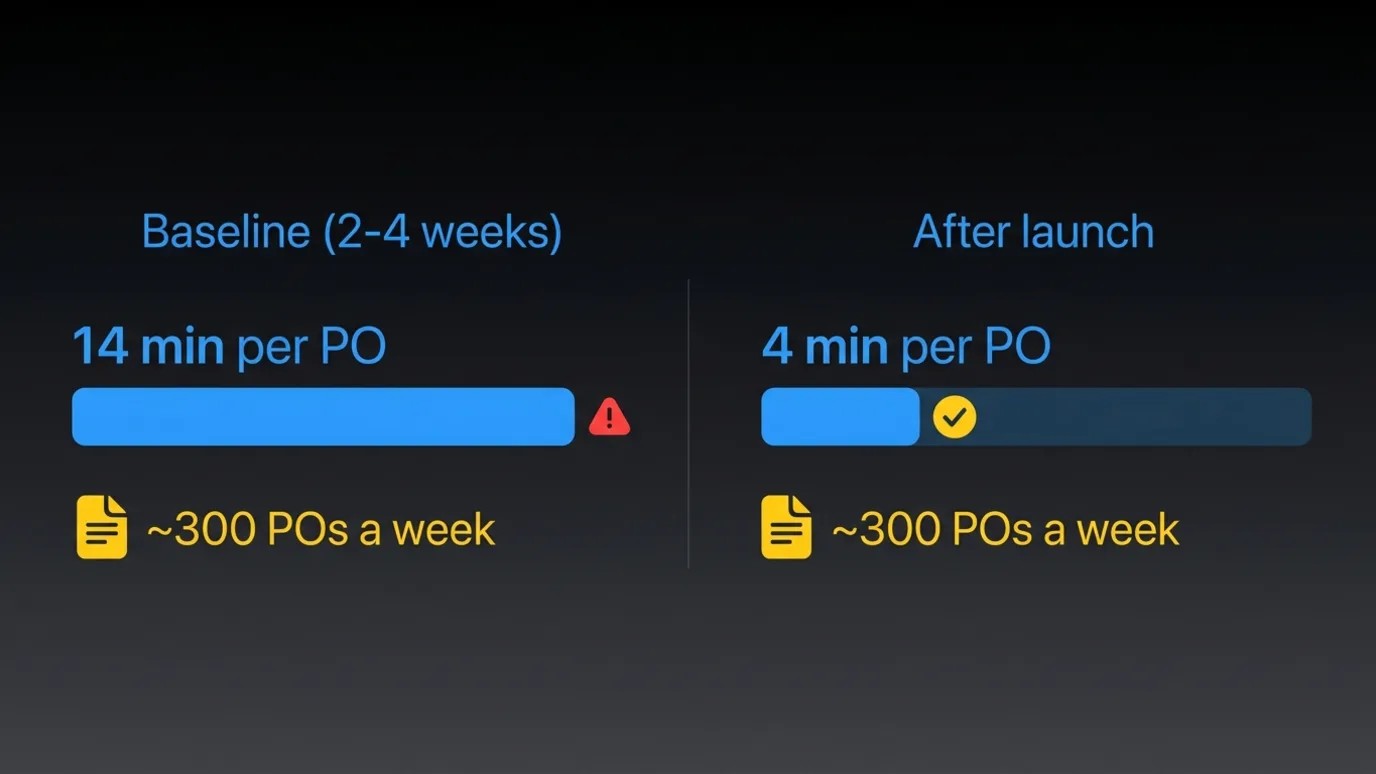
Be honest about what didn’t improve. If the system handles 80% of cases well and routes the rest to a human, say so. A CFO trusts a result with visible limits more than one that claims to have solved everything.
Our post on measuring AI feature success goes deeper on quality metrics and evaluation, which keep the system honest after launch.
How long does a first AI production wedge take?
Usually 6 to 10 weeks. A single, well-contained problem can compress toward six. Two problems, or one with messy integrations, stretch toward ten. Every engagement is different, so treat the schedule below as an illustration of the rhythm, not a fixed plan.
Weeks 1 to 2: embed, baseline, and map. The team sits with the people who do the work today. They watch the process, collect real examples, document the rules that live in people’s heads, and start the baseline measurement. By the end of week two, there’s a written process map, a draft list of edge cases, a starting evaluation set built from real historical examples, and agreement on the success metrics.
Weeks 3 to 5: build against real data. The first working version runs on real inputs from week three, not synthetic ones. The process owner reviews outputs every few days. Thresholds for when a human must review get set based on what the evaluation set shows, and every one of those decisions gets logged. Integration with the actual systems (ERP, inbox, document store) happens in parallel, not at the end.
Weeks 6 to 7: run alongside the current process. The system processes live work while the team keeps doing it the old way, or reviews every output before it’s used. This shadow period surfaces the cases nobody thought of. It also gives the people doing the work time to trust the system, or to show exactly where it hasn’t earned that trust yet.
Weeks 8 to 10: go live and measure. The system takes over the work it handles well, with human review on the rest. Monitoring and alerts are in place. Your operator, the person on your team who’ll run it, makes changes with the build team reviewing. Post-launch metrics get collected against the baseline, and the results go to the CFO in a short written report.
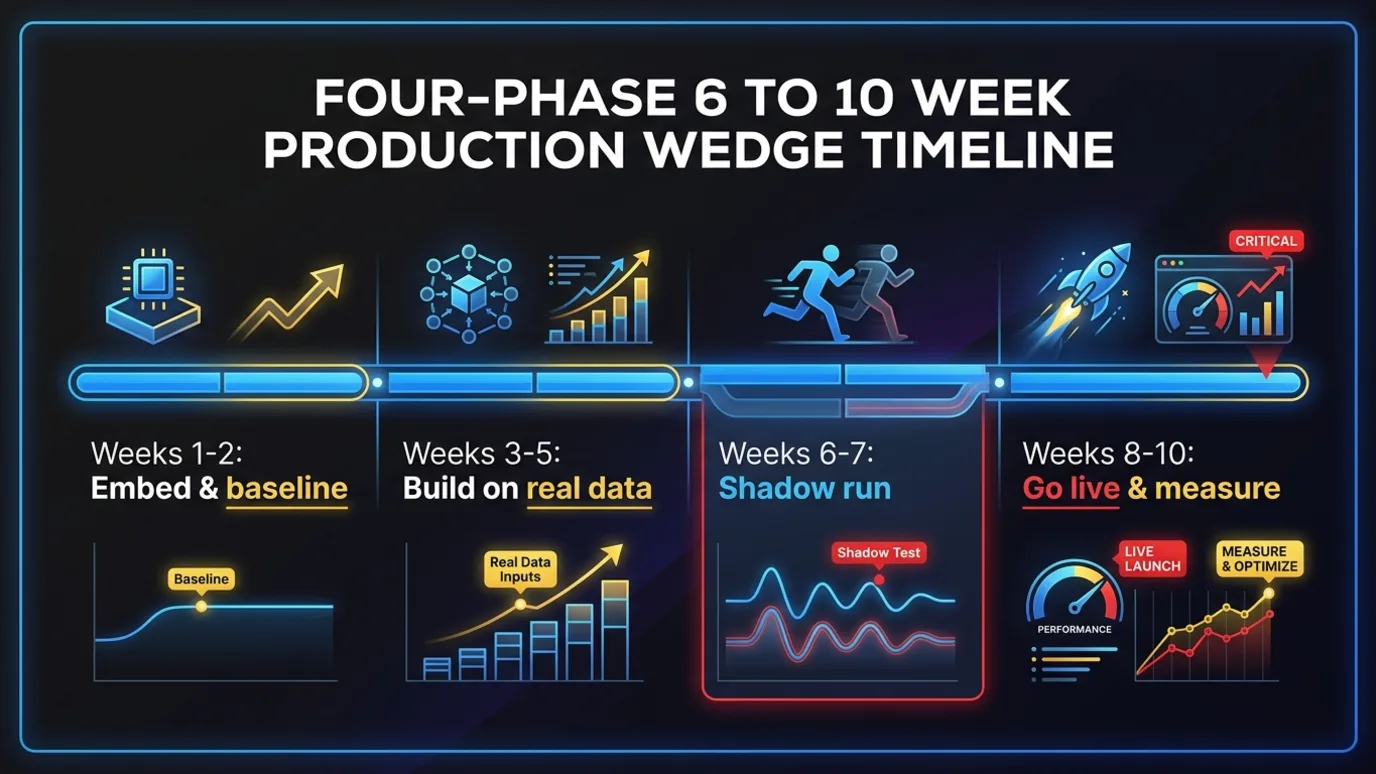
If a partner proposes six months for a first wedge, the scope is probably too big.
How does a first AI win become a roadmap?
The first live system gives you real data about your data, your team, and your integrations, plus reusable parts for the next problem. That’s a far better basis for planning than any pre-build forecast.
After the first system is live, you know how clean your data really is. You know how your team responds to working alongside an AI system, and how long integration with your core systems takes. You have measured results in your own business. That’s the material to build a real roadmap from, and to plug into the business case with numbers you can defend.
The first build also leaves reusable parts behind: document ingestion, a review queue, an evaluation harness, a decision log, access controls, monitoring. The second problem starts with those already in production, so it costs less and ships faster. We wrote about what those parts should look like in what an AI engagement should leave behind.
That compounding is why we structure our own work this way. A fixed-scope wedge proves value on one or two problems. Clients who want to keep going move to an ongoing relationship on ChronoPlatform, where each new workflow builds on the governance, context, and components from the last one. The client owns the systems and code throughout. The relationship lasts because each new problem gets cheaper to solve, and nobody is locked in.
What should you ask before approving a big AI budget?
Ask whether the plan names its first problems, their owners, and how the results will be checked. If someone hands you a multi-year AI plan this quarter, these questions are worth answering before you sign off:
- Which one or two problems would we solve first, and what’s the baseline for each today?
- Who owns each of those problems on our side?
- What does “done” mean for the first phase, and is it a production system or a report?
- How will we measure the result, and who on the finance team will check the numbers?
- What parts of the first build carry over to the second problem?
If the plan can’t answer those, it’s asking you to fund a forecast.
Frequently Asked Questions
How do I prove AI ROI before committing a large budget?
Put one or two contained problems into production and compare them against a baseline measured for two to four weeks before work starts. Report the change in units finance already tracks, like minutes per invoice or cycle time.
What makes a good first AI use case?
A process that runs daily or weekly, has a known cost, already has its data in a system, has one named owner, and lets a human review outputs before they cause damage. PO intake and invoice exception handling are typical examples.
How long should a first AI project take to reach production?
About 6 to 10 weeks for one or two well-scoped problems. If a proposal needs six months for the first phase, the scope is too big.
Working with Chrono Innovation
Our entry engagement is a fixed-scope production wedge. We embed with your team, pick one or two high-value problems together, and put a working system into production with a measured baseline on both sides. If you have a short list of candidates, or a program proposal you’d like a second opinion on, book a call with our team and we’ll work through which problem to start with.