Key Takeaway
AI pilots in mid-market operations rarely fail on the model. They stall in four handoffs where nobody is accountable, so the fix is fewer handoffs and one team that owns the result from strategy through daily use.
Picture a 250-person industrial distributor. Last spring, the leadership team approved an AI pilot to read incoming purchase orders from email and PDF, match them against the product catalogue and draft the order in the ERP (enterprise resource planning system). A small team built it in six weeks. The demo was good. The VP of Operations forwarded the recording to the CEO with one line: “This is going to change customer service.”
It’s now October. The customer service team still keys orders by hand. The pilot runs on a laptop belonging to someone who has since moved to another project. Nobody has turned it off, and nobody uses it.
The scenario is illustrative, but if you run operations at a mid-market company, you’ve probably seen a version of it. The model worked. The idea was sound. The pilot stalled anyway, because the hard part of AI in a working business was never the model.
This post is for the people who run the business: COOs, CEOs, VPs of Operations, and the CTOs who get asked why the thing from the spring isn’t live. If you’re a SaaS product team trying to ship an AI feature to customers, we covered the engineering side of that gap in AI Strategy for Scale-Ups: How to Move From Pilot to Production. This one is about AI inside operations, where the users are your own people.
Why doesn’t a successful demo mean the pilot will reach production?
A demo proves the idea works. Production proves someone is accountable for it. A pilot answers one question: can this work? Production answers a different set. Who gets paged when it breaks at 7 a.m. on a Monday? Who decides when the output is good enough to stop double-checking? Who updates it when the supplier changes its invoice format? Who explains it to the auditor?
A demo needs none of those answers. That’s why demos are cheap and production is expensive. It’s also why “the pilot worked” is such a misleading status update. It usually means the first question got a yes and the others were never asked.
In our experience, pilots rarely die from a single failure. They die in the handoffs, in the spaces between teams where everyone assumes someone else owns the next step. There are four of those spaces, and most stalled pilots are stuck in at least two.
Where do AI pilots actually die?
They die at four seams: the handoff from strategy to build, the lack of an owner in production, adoption nobody planned, and missing production infrastructure and governance. Each one is a gap between groups, and each can stall a pilot on its own.
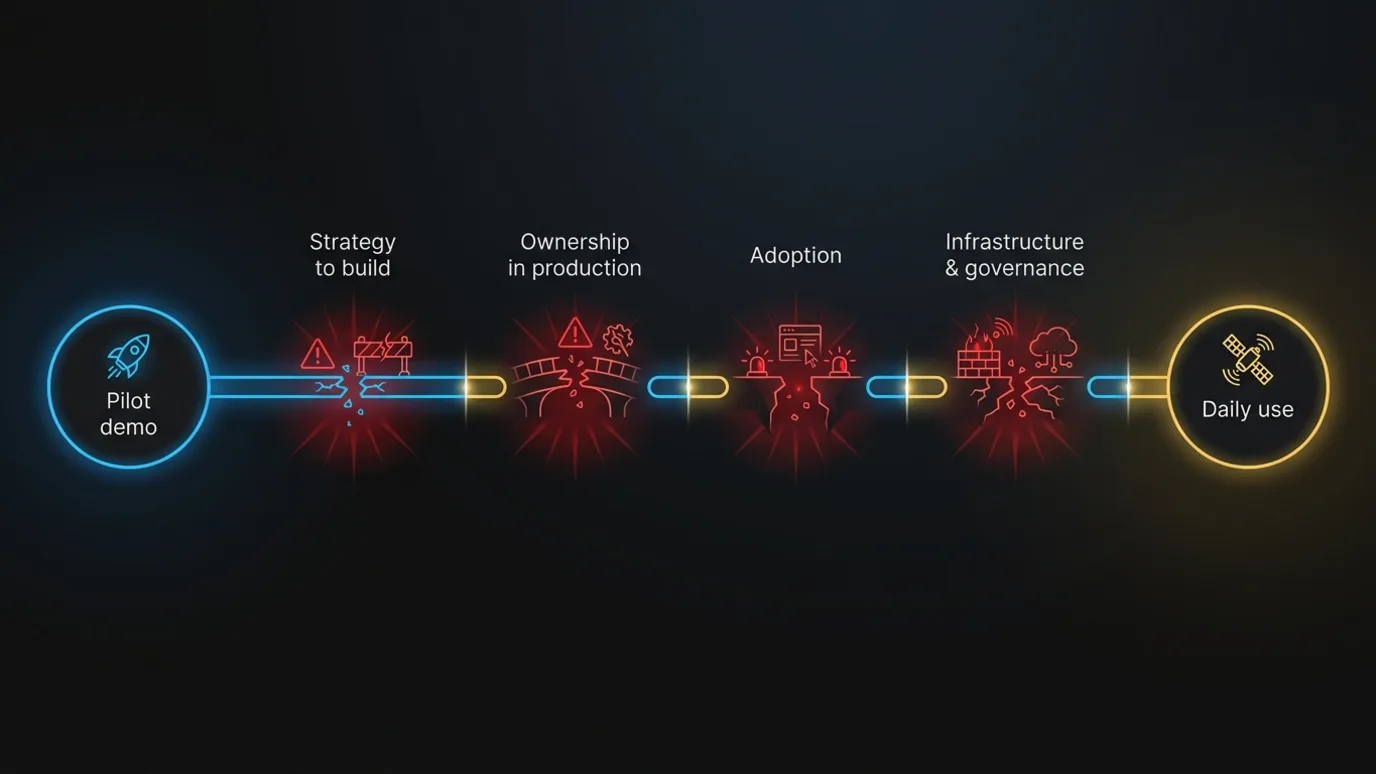
1. The handoff between strategy and build
Many AI initiatives start with a strategy phase. Someone, often an outside advisor, interviews department heads, maps processes and produces a prioritized list of use cases. The list is usually reasonable. Then it gets handed to whoever is going to build.
That handoff loses most of what matters. The strategy document says “automate purchase order intake.” It doesn’t say that a third of orders arrive as scanned faxes, that two large customers use their own part numbers, or that the senior rep who handles rush orders checks inventory in a spreadsheet the ERP doesn’t know about. The people who learned those details during discovery are gone by the time the builders start.
So the build team rediscovers the problem from scratch, or worse, builds against the clean version in the slide deck. The pilot handles the easy 60% of orders well. The other 40% is where the operating knowledge lives, and the pilot was never designed for it.
2. Nobody owns it in production
Ask who owns a stalled pilot and you get a pause. IT says it’s an operations tool. Operations says IT built it. The vendor says their contract ended at go-live. The internal champion who pushed for it has three other priorities this quarter.
Ownership in production means a named person or team is responsible for whether the system keeps working, keeps being correct and keeps being used. It includes boring things: credentials that expire, an API that changes, a model version that gets deprecated, a new product line the matching logic doesn’t cover.
Traditional software has the same needs, but AI systems drift in quieter ways. An ERP integration either posts the order or throws an error. An extraction model that starts misreading a new invoice template keeps producing plausible output. Without an owner watching quality, the first sign of trouble is a customer calling about the wrong shipment. After that, the team stops trusting the tool, and trust is very hard to win back.
3. Adoption was never planned
Operations leaders underestimate this one most. A pilot gets built for a process. Production requires it to fit into how people actually work.
The customer service rep in our distributor example has a rhythm. She knows which customers need a call, which orders she can enter in 40 seconds and which ones she should hold until she checks with the warehouse. A new tool that drafts orders for her review changes that rhythm. If the review screen is slower than typing, she’ll type. If she can’t see why the system matched a part number, she won’t trust it. If her manager still measures her on orders keyed per hour, the tool works against her.
None of that is a model problem. It’s job design, training and measurement, plus the simple fact that people adopt tools that make their day easier and ignore tools that add a step. Pilots that skip this work end up “available” and unused. Adoption needs a plan with the same weight as the build: who uses it first, what changes in their day, how you measure whether it stuck, and who they call when it’s wrong.
We think the best operational AI amplifies the people doing the work instead of trying to route around them. We wrote more about AI that amplifies teams separately.
4. No production infrastructure or governance
The pilot runs on a laptop, a personal cloud account or a shared notebook. It calls a model API with a key someone pasted into the code. It reads customer data that nobody has reviewed from a privacy standpoint. None of this matters during a demo. All of it matters once the system touches real orders.
Getting to production means answering questions the pilot never had to:
- Where does it run? Inside your environment, with access controls your IT team can manage.
- What data does it see, and where does that data go? Especially relevant for Canadian companies thinking about residency and privacy obligations.
- How do you know it’s correct? A test set of real cases, a measure of accuracy, and a check that runs every time something changes.
- What happens when it’s unsure? A clear path to a human, with the reason visible.
- Who can change it, and how is that recorded? Prompt and model changes need the same discipline as code changes.
Mid-market companies often don’t have a platform team to absorb this work. The pilot team assumes IT will handle it. IT sees an unfamiliar system with unclear risk and, reasonably, doesn’t want to own it. The pilot sits in that gap. We covered governance patterns in more depth in AI Governance for Product Teams, and the same principles apply to internal operations tools.
Why does splitting the work across parties cause the stall?
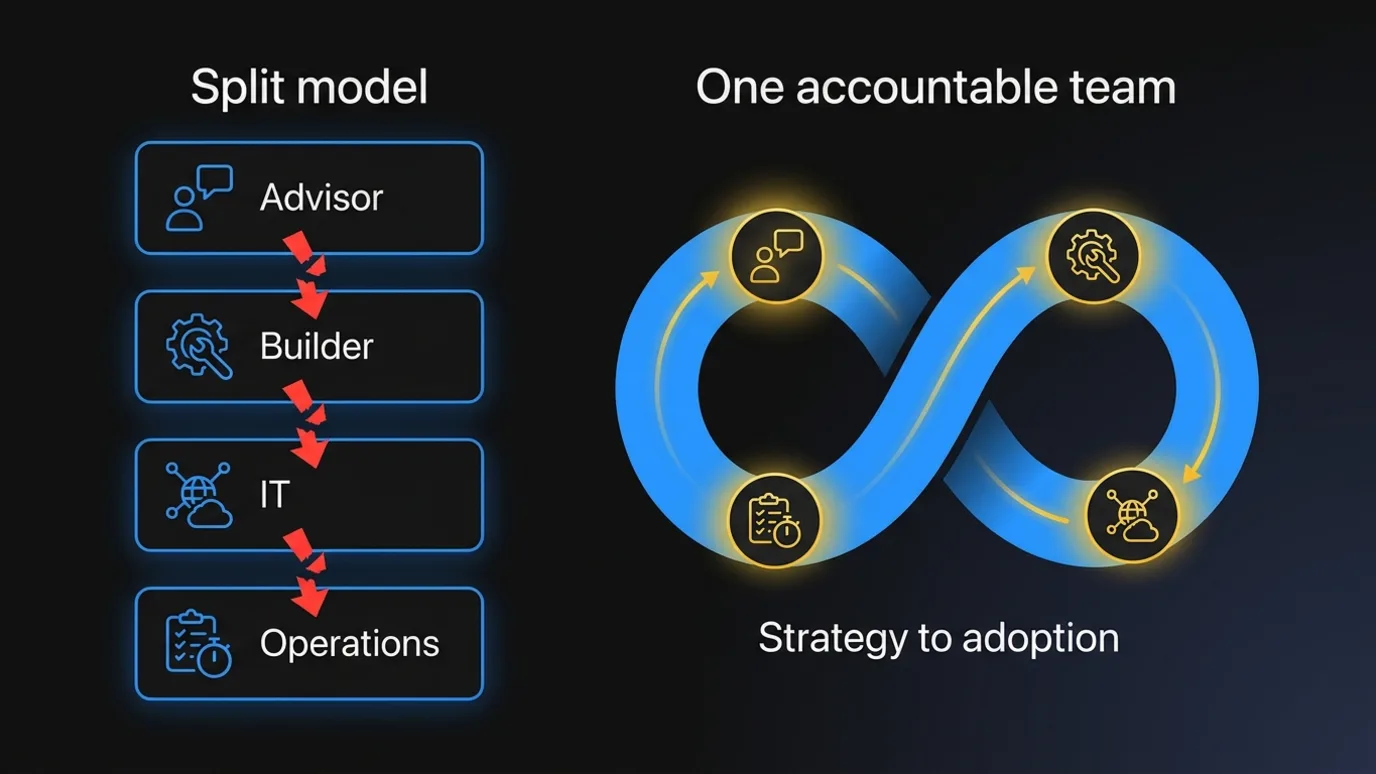
Every one of those four failure points is a seam between different groups: strategy and engineering, engineering and operations, operations and the people on the floor, the pilot team and IT. When different parties own each side, accountability falls through the gap.
Large enterprises can afford to staff every seam. They have transformation offices, platform teams, change management groups and procurement processes that force the questions to get asked. Mid-market companies usually have a COO with too much on their plate, a lean IT team and maybe a few engineers. When the work is split across an advisor, a builder and an internal team that doesn’t really exist, each seam becomes a place where accountability quietly disappears.
So the fix isn’t a better model or a bigger pilot budget. It’s fewer handoffs.
What changes when one team owns it from strategy through operation?
When the same team scopes the problem, builds it, puts it into production and stays accountable for whether people use it, five things change.
Discovery doesn’t get lost. The engineer who sat with the rush-order rep and saw the inventory spreadsheet is the one building the matching logic. The edge cases make it into the design because the person designing heard them first-hand. This matters most in process-heavy businesses where the real rules live in people’s heads, not in the system documentation. (More on turning institutional knowledge into production systems.)
Production is part of the plan from week one. If you know you’ll be on the hook when it breaks, you build monitoring, access controls and a fallback path before the demo, not after. Governance stops being a late-stage blocker and becomes part of the build.
Adoption is designed, not hoped for. The team that owns the outcome cares whether the rep uses the tool on Tuesday, not only whether it passed acceptance testing. So they sit with the users, watch where the tool slows them down and fix it. They help adjust the metrics the team is measured on. They pick a first group of users who want it to work.
Success gets defined as usage and results. “Pilot complete” stops being a milestone. The milestone becomes something like: “Customer service drafts 70% of standard orders through the system, with review time under a minute, and error rates at or below the manual process.” That’s a target an operations leader can hold someone to.
What gets built stays useful. When one team owns the system in production, the workflows, integrations, test cases and operating context it creates become reusable. The second problem you tackle starts from that foundation instead of from zero. And you should own all of it: the code, the system and the knowledge of how it works. We go into what an AI engagement should leave behind in a separate post.
None of this requires one giant team. It requires one accountable team, with senior people who can move between a whiteboard session with the COO and a production incident without a handoff in between.
How can you tell if your AI pilot is headed for the shelf?
Answer the eight questions below honestly. Three or more “no” answers usually means the pilot is stalled, whether anyone has said so out loud or not. This applies to a pilot running right now and to one that “finished” a few months ago.
Can you name the person accountable for it in production? Not the sponsor. The person who gets the call when it’s wrong. If the answer takes more than five seconds, that’s a warning.
Do you know how accurate it is today? Not at demo time. Today, on this week’s real cases. If nobody is measuring, nobody will notice when it degrades.
Is anyone using it who wasn’t on the pilot team? Pilots often get used by the enthusiasts who built them. The test is whether the rest of the department has changed how they work.
Did anyone change a job, a metric or a procedure because of it? If the process documentation, the training and the performance measures are the same as before, the organization hasn’t absorbed the change.
Does it run in your environment, under your controls? If it lives on a vendor’s sandbox, a personal account or a single laptop, it isn’t in production, whatever the status report says.
Was there a production budget, or only a pilot budget? Pilots funded as experiments with no line for running, monitoring and improving the system almost always stall when the experiment ends.
Do you own the code and the system? If the vendor walks away, can you keep running it? Can someone else improve it?
Is there a defined next step? A pilot that succeeds should trigger a decision: expand, harden, or stop. If it’s been “successful” for three months with no decision, it’s on the shelf already.
What should you do with a stalled AI pilot?
Narrow it to one workflow, answer the production questions before writing more code, and put one party in charge of the outcome. A stalled pilot isn’t wasted. It usually proved something real: the data exists, the model can handle the core case, and someone in the business wants it. That’s worth building on.
Start by picking one workflow. The broader the pilot, the more seams it crosses. A single high-value operating problem with a clear owner and a measurable result is far more likely to make it into daily use than a platform meant to solve five things at once. We made the case for proving AI value on one problem first.
Then answer the production questions before you write more code. Who owns it? Where does it run? How is quality measured? What changes for the people using it? If those answers aren’t clear, more build work won’t help.
Finally, look at who’s doing the work. If your current setup splits strategy, build and operation across different parties, ask who is accountable for the outcome rather than for a deliverable. If the honest answer is “nobody,” that’s the thing to fix. Our comparison of vendors, consultants and operating partners walks through how each model handles that accountability.
Canadian companies should also check whether the technical work behind the pilot qualifies for SR&ED (Scientific Research and Experimental Development), the federal R&D tax credit. Experimental development to resolve technical uncertainty often does, and recovered credits can fund the next stage. We explain how SR&ED applies to AI projects.
Frequently Asked Questions
Why do most AI pilots fail to reach production?
Usually not because the model fails. They stall in the handoffs between strategy, build, operations and IT, where nobody owns production support, adoption or governance. A pilot that “worked” often only proved the idea, not that anyone is accountable for running it.
How do you know if an AI pilot has stalled?
Check four things. Can you name its production owner? Does anyone outside the pilot team use it? Do you know its accuracy on this week’s real cases? Does it run in your own environment? Three or more “no” answers usually means it’s stalled.
Should you restart a stalled AI pilot from scratch?
Rarely. A stalled pilot has usually proved the data exists and the model handles the core case. Narrow it to one workflow, settle ownership, hosting and quality measurement, then resume the build.
Talk to us about a pilot that’s stuck
Chrono Innovation works with mid-market operators to take one or two high-value problems from idea to a production system your team uses and owns. One senior team covers strategy, engineering, infrastructure and adoption, and stays accountable for the result. If you have a pilot that stalled, or one you want to start properly, book a call and walk us through it.