Key Takeaway
An AI engagement is only finished when your team could run the system for twelve months without calling the partner who built it. That means code in your repos, accounts in your name, an evaluation set, a decision log, a runbook and a named operator who was in the room from week one.
Most AI engagements end with a meeting. Someone shares a final demo, someone else signs off on the last milestone, and the project gets marked complete in whatever tool tracks these things. Three months later, an invoice-matching model starts misreading a supplier’s new PDF layout and nobody inside the company knows where the prompts live.
That second moment is the real end of the engagement. It tells you what was actually delivered.
If you’re about to hire an AI partner, or you’re halfway through an engagement and wondering what you’ll have when it wraps, use this post as a checklist. It applies to us, to a large consultancy, to a boutique shop and to a single contractor. The questions don’t change.
Why is “delivery complete” the wrong finish line?
A delivery milestone measures whether something was handed over. It says nothing about whether your company can run it, change it or build on it next quarter.
AI systems widen that gap. A traditional application mostly behaves the same way next year as it does today. An AI workflow depends on things that move: model versions, prompt structures, retrieval indexes, the shape of incoming data, and the judgment calls someone made about acceptable error rates. When the people who made those calls leave, the system keeps running. Nobody can tell whether it’s still running well.
So the useful finish line is a different question. Could your team operate this system for twelve months without calling the partner who built it? If the answer is no, the engagement isn’t finished. You’ve rented a capability, and the rent comes due every time something changes.
We covered the earlier version of this problem in why AI pilots stall. A pilot that never reaches production is the obvious failure. A production system only the vendor can operate is the quieter one.
What should remain when the partner leaves?
Five things: code and infrastructure you own, workflows you can reuse, governance artifacts, documented operating context, and people on your team who can run the system. Treat that list as a minimum, not a stretch goal.
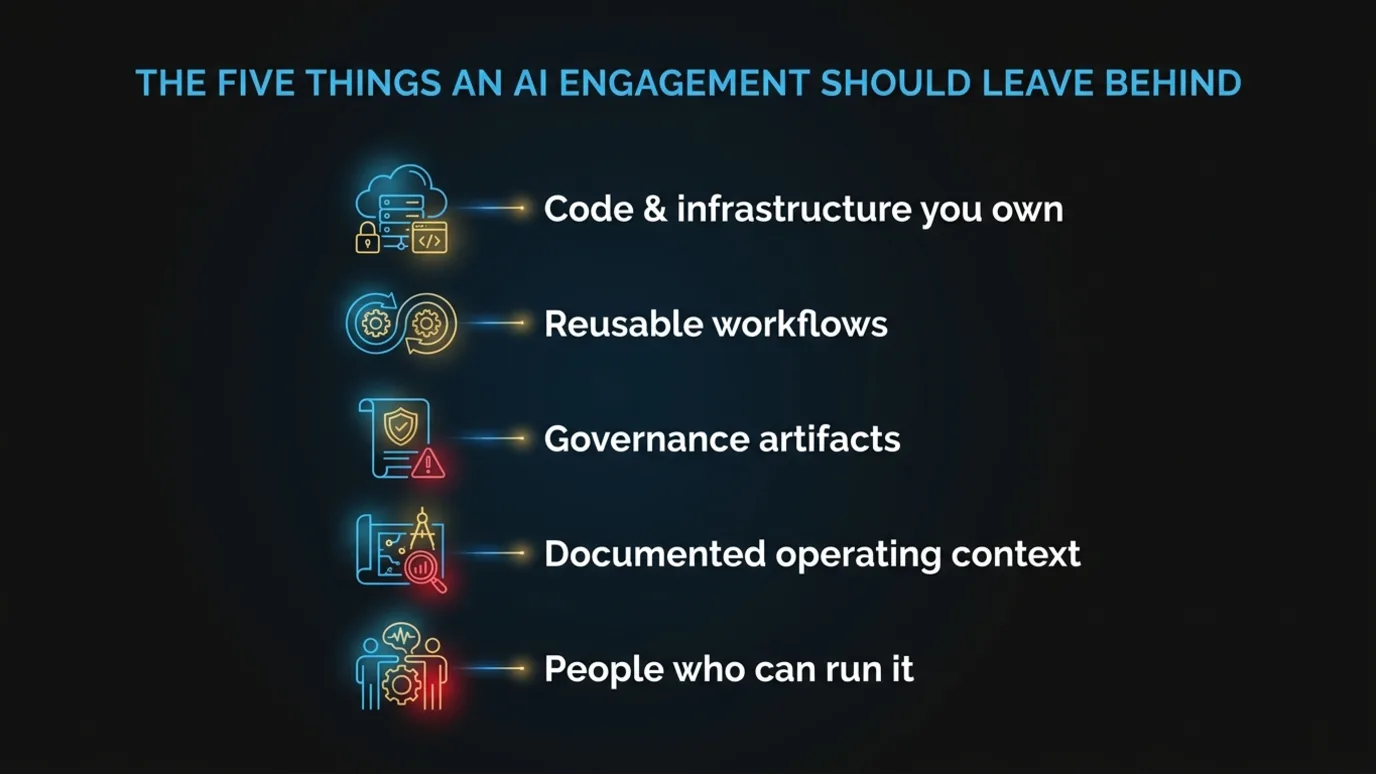
1. Code and infrastructure you own outright
The code lives in your repositories. Not a mirror, not a zip file at the end, not “access on request.” Your GitHub or GitLab organization, with full commit history from day one.
Same for infrastructure. Models, vector stores, queues and scheduled jobs should run in cloud accounts your company owns and pays for. If the partner hosts anything during the build, there should be a written plan and a date for moving it.
This matters more than it sounds. A surprising number of AI projects run on the vendor’s API keys, the vendor’s model provider account, or a vendor-managed orchestration tool. Everything works until the contract ends and the keys get rotated.
Check for:
- Repository ownership. Your org owns the repo. The partner’s engineers are collaborators who get removed at the end.
- Cloud account ownership. Billing, IAM (identity and access management) and root access sit with you.
- Model provider accounts. API keys for OpenAI, Anthropic, Azure or whichever provider you use are issued under your account and your data agreements.
- No hidden runtime dependencies. If the system calls a proprietary service the partner owns, you need to know before you sign, along with what it costs to keep or replace.
2. Workflows you can reuse
Your first AI system usually solves one problem: classifying inbound emails, extracting fields from purchase orders, drafting first-pass replies for a support queue. The second system will need many of the same parts. Document ingestion, a retrieval layer, a human review step, a way to log decisions, an evaluation harness.
A good engagement builds those parts so they can be picked up again. The document parser is a module with an interface. The review queue isn’t hardcoded to one team’s Slack channel. The logic that decides when a human needs to look at something is configurable instead of buried in a prompt.
Test it with one question at the end: “If we wanted to apply this to a second process, which parts would we reuse and which would we rebuild?” A partner who built for reuse answers in specifics. A partner who built a one-off talks in generalities.
3. Governance artifacts
Governance gets treated as paperwork, and that’s a mistake. For an AI system, the governance artifacts are how you know what the system is supposed to do and whether it’s still doing it. Our post on AI governance for product teams goes deeper, but here’s the minimum set:
- A decision log. Why this model and not another. Why this confidence threshold. Why certain cases go to a human. Each entry should say who made the call and when. Six months from now, someone will want to change one of these decisions, and they need to know what it was protecting against.
- Evaluation sets. A labeled set of real examples, with expected outputs, that you can run the system against any time something changes. This is the single most valuable artifact an engagement can leave behind. Without it, every model upgrade is a guess.
- Access controls. Who can change prompts, who can deploy, who can see the data the system touches. Written down, enforced in the tooling and reviewed.
- Monitoring and alerting. Dashboards and alerts that someone on your team actually watches: output quality, error rates, volume, cost per transaction. Our post on AI agent observability covers what to track.
- A data map. What data the system reads, where it goes, what gets stored and for how long. In a regulated industry, or anywhere you handle personal information, this is the first document your privacy officer or auditor will ask for.
4. Documented operating context
Every AI system encodes knowledge about how your business works. The rules for when a credit memo needs approval. The three suppliers whose invoices always arrive with the wrong PO format. Why the night shift logs maintenance tickets differently. Most of this lived in people and spreadsheets before the project started, and the project’s job was to get it out. We wrote about that process in turning institutional knowledge into production systems.
If that context ends up only in prompts and code, you’ve moved the knowledge from one hard-to-read place to another. It should also exist in plain language, as a runbook or operating guide written for the person who owns the process, not for an engineer.
A useful runbook answers:
- What does this system do, in two paragraphs a new manager could follow?
- What does “normal” look like? Volumes, error rates, cost.
- What are the known failure modes, and what should someone do when each one happens?
- Which business rules are encoded, and who on your side owns each one?
- How do you change a rule safely?
5. People on your team who can run it
This is the one most often skipped, and it decides whether everything above gets used.
Somebody inside your company needs to be the operator. They don’t have to write the code. They do need to understand the system well enough to read the dashboards, notice when output quality slips, triage an alert and make a sensible call about when to escalate. Ideally a second person can do the same.
That doesn’t come from a handover meeting in the last week. It comes from working alongside the builders from early on. Your operator should be in the room when thresholds get set and evaluation sets get labeled, and there for the first production incident. By the end, they should have made changes to the system themselves, with the partner reviewing rather than doing.
This is where “amplify, don’t replace” earns its keep. If the system was designed with the people who run the process, those people end up owning it. If it was designed around them, they end up working around it. More on that in AI that amplifies teams.
How should each engagement make the next one cheaper?
The first project should leave a foundation the second one starts from, so project two ships noticeably faster than project one and project three faster again. If it doesn’t, you’re paying for a series of islands instead of a capability that compounds.
Picture a 300-person industrial distributor. In year one, they automate purchase order intake. The project builds a document ingestion pipeline, a field extraction layer, a review queue for low-confidence cases, an evaluation set of a few hundred real POs, and a decision log.
In year two, they want to automate supplier invoice matching. If the first project was a one-off, the second starts from zero. New ingestion, new review queue, new governance, new learning curve.
If the first project was built for reuse, the second starts with half its foundation already in production. The ingestion pipeline handles invoices with modest changes. The review queue gets a new category. The evaluation harness is already there and needs a new labeled set. The governance patterns are known. And the operator who runs PO intake can help design the invoice workflow, because they already understand how these systems behave.
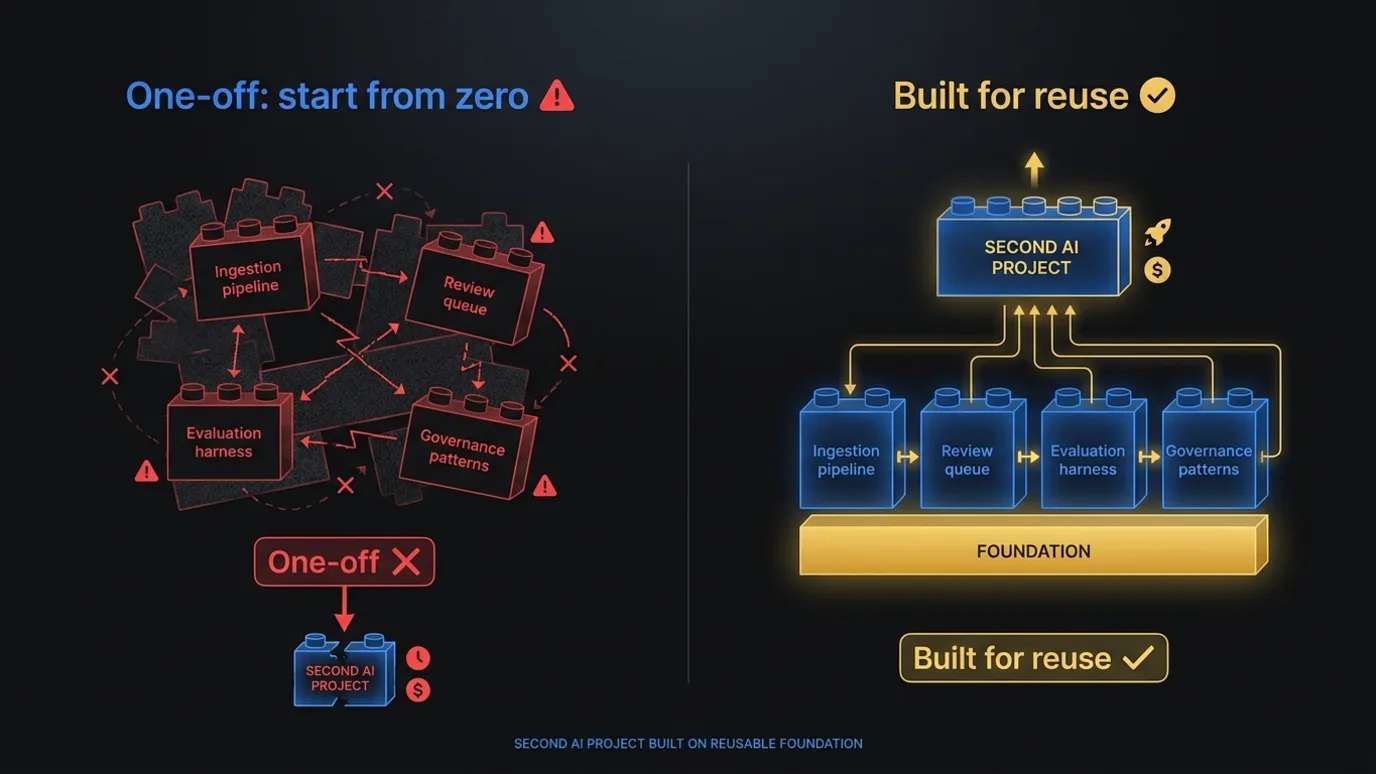
If your partner’s estimate for project three looks like their estimate for project one, ask why.
That’s the reason we built ChronoPlatform. Every engagement we run leaves reusable workflows, governance patterns and operating context behind, and ChronoPlatform is where those pieces accumulate so the next problem starts further along. The code and systems still belong to the client, in the client’s accounts. The platform keeps the reusable parts organized and governed so nobody has to rediscover them.
You don’t need our platform to get this effect. You do need someone to design for it on purpose, because it won’t happen by accident. Left alone, every AI project becomes its own island.
What should you ask any AI partner before you sign?
Ask about intellectual property, hosting and accounts, exit terms, documentation and who runs the system afterward. Do it in the first sales conversation, not after the statement of work is drafted. How a partner answers tells you how they think about the end of the relationship.
Intellectual property
- Who owns the code written during the engagement? Does the contract say so plainly?
- Are you licensing any components to us rather than assigning them? Which ones, and on what terms?
- If you use internal tools or accelerators to build faster, what happens to their output? Do we own what they produce for us?
Hosting and accounts
- Where will the system run during the build, and where will it run in production?
- Whose cloud account, whose model provider account, whose API keys?
- If anything runs on your infrastructure, what’s the migration plan and who pays for it?
Exit
- If we end the relationship after phase one, what do we walk away with, and when?
- What would it take for our team, or another partner, to pick this up without you?
- Is there anything in the system we couldn’t operate if you disappeared tomorrow?
Documentation and governance
- What documentation do you produce as standard? Can we see an example from a past engagement, with client details removed?
- Do you build evaluation sets as part of the work? Who labels them, and do we keep them?
- Where do you record design decisions, and who has access to that record?
Who runs it after
- Who on our side do you expect to operate the system, and how are they involved during the build?
- How do you measure whether our team is ready to take over?
- What ongoing support do you offer, and is it optional?
That last answer is a good tell. Ongoing support is fine and often useful. We offer it ourselves. The problem is support you can’t decline because the system won’t run without it. In a healthy relationship you keep working with the partner because each engagement builds on the last, and walking away stays a real option.
What if you’re already mid-engagement?
It’s usually fixable, and much cheaper to fix now than after the team rolls off. Start with the evaluation set and account ownership, then name your operator.
Ask for the evaluation set, even a small one, and have it run against the current system so you have a baseline. Then ask for repository and account access to move under your ownership if it isn’t there already. Those two steps alone take you from dependent to capable.
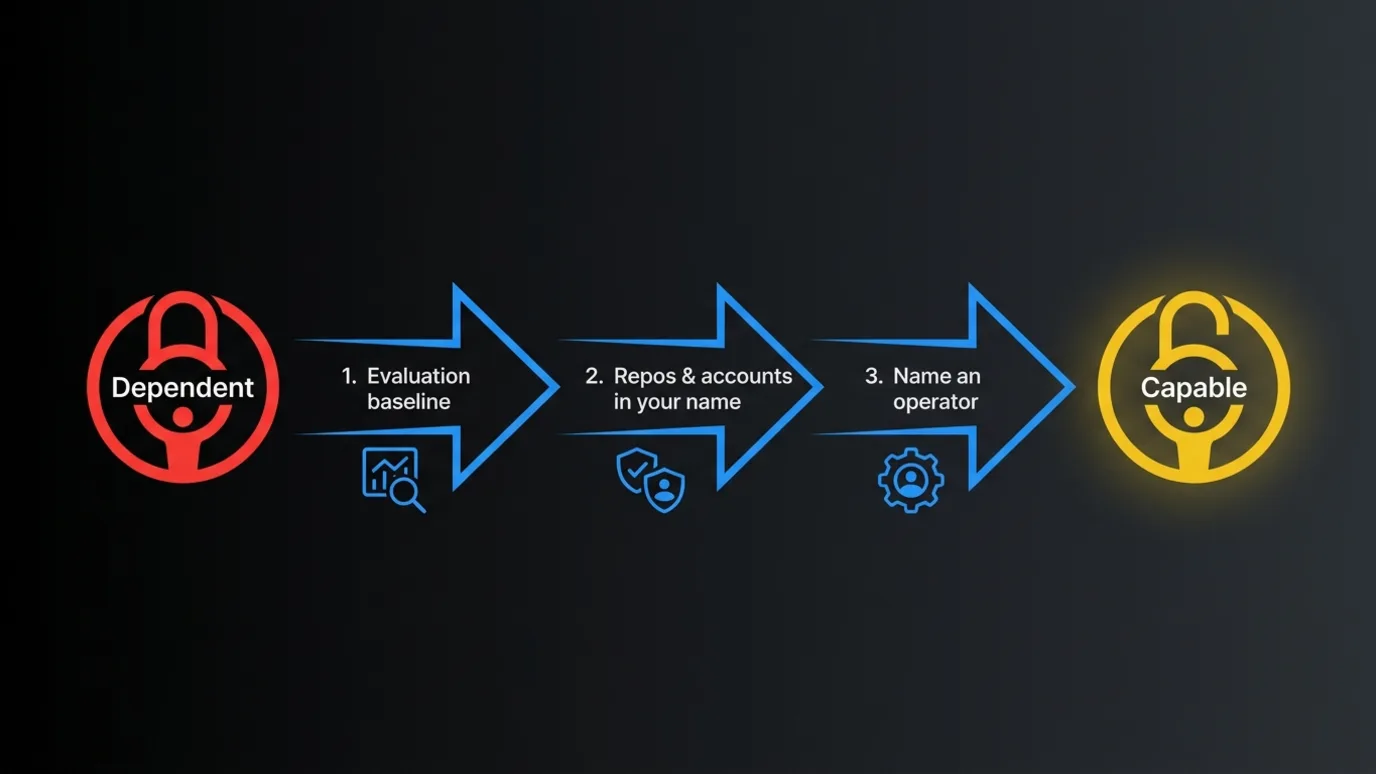
Next, name your operator and get them into the working sessions for the rest of the engagement. Have them write the first draft of the runbook, with the partner correcting it. Whatever they get wrong in that draft shows you exactly where knowledge transfer hasn’t happened yet.
If you’re evaluating partners more broadly, our comparison of vendors, consultants and operating partners lays out how each model handles ownership and what that means for you once the engagement ends.
Frequently Asked Questions
What is the most important thing an AI partner should hand over?
The evaluation set. It’s a labeled collection of real examples with expected outputs, and it’s the only way to know whether a model upgrade, prompt change or new data format broke something. Without it, every change is a guess.
Should AI systems run in the partner’s cloud account during a project?
Only temporarily, with a written migration plan and a date. Production systems, model provider API keys and billing should sit in accounts your company owns, or the system can stop working the day the contract ends.
How do you know your team is ready to take over an AI system?
Your operator can read the dashboards, triage an alert, explain the business rules in the runbook and has already made changes to the system with the partner only reviewing. If they’ve never touched it before the last week, they aren’t ready.
Working with Chrono Innovation
We run AI engagements assuming you’ll own everything we build: the code in your repos, the systems in your cloud, the evaluation sets, the decision log, and people on your team who can run it. If you’re weighing a problem, or want to pressure-test a proposal you already have from someone else, book a call with our team. We’ll tell you what we expect to leave behind, and you can hold us to it.