Key Takeaway
Canadian tech companies leave $200K-$500K per year in SR&ED credits unclaimed because they can't document R&D work after the fact. Engineers don't write contemporaneous records, and retroactive documentation is expensive and incomplete. The fix is automated evidence collection from tools your team already uses: Git, Jira, Slack.
There’s a gap between what your company could claim and what it actually does claim.
For most tech companies, that gap is between $200K and $500K per year.
Some companies don’t file SR&ED claims at all, so the gap is 100%. Other companies file but conservatively. Either way, the math is stark: this is money your company is entitled to that you’re not collecting.
The Typical Math
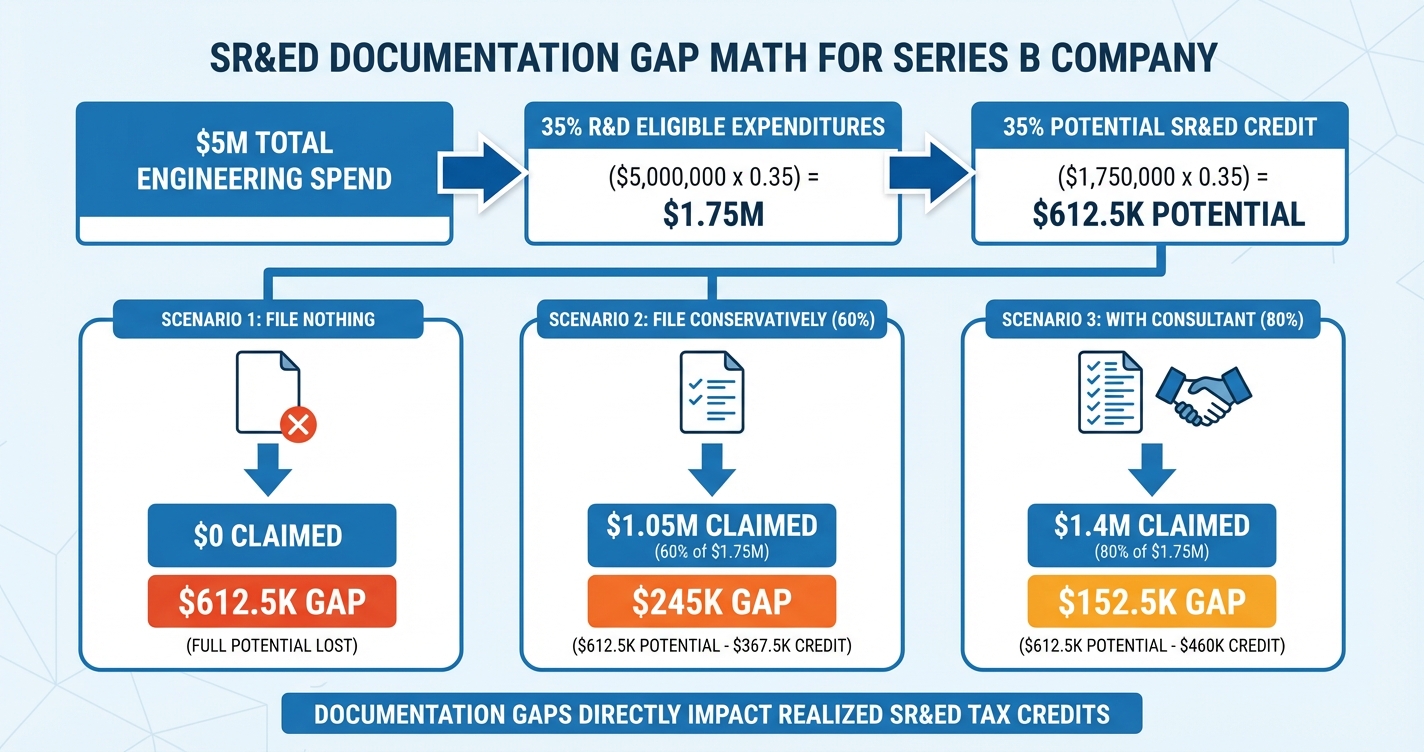
Take a Series B SaaS company with 25 engineers at $200K loaded cost each:
- Total engineering spend: $5M per year
- Estimated R&D work: 35% of engineering = $1.75M
- Potential credit (35% refundable): $612,500
But what actually happens:
- If you file nothing: Gap of $612,500
- If you file conservatively: Claim 60% of eligible = Gap of $245,000
- If you hire a consultant: Pay $30K, claim 80% = Net of $460,000, but gap of $152,500
Across Multiple Years

If your company has never claimed SR&ED in 5 years:
- Year 1-5 gaps: $300K → $450K annually
- Total 5-year gap: $1.825 million
You can claim back 5 years. This is recoverable money.
Why the Gap Exists
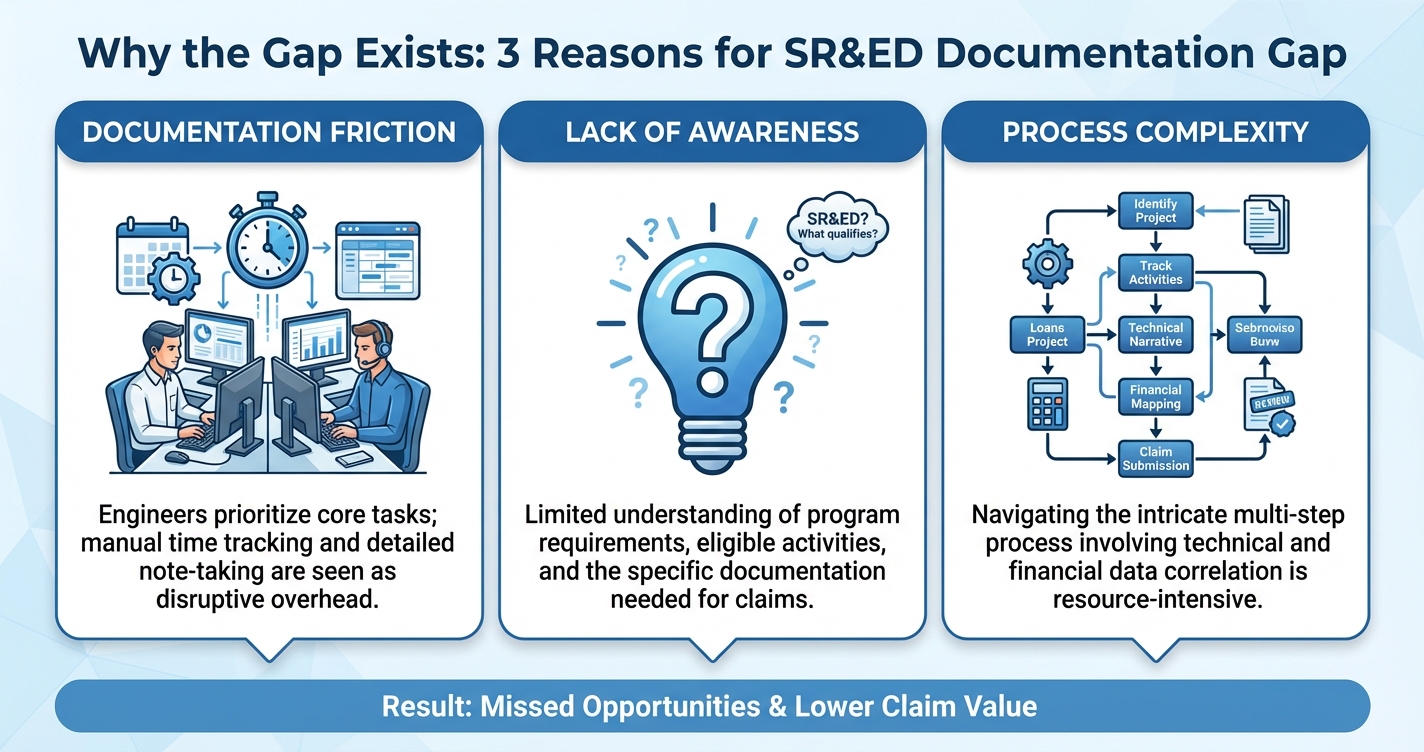
- Documentation friction — Engineers don’t naturally track SR&ED time
- Lack of awareness — Many companies don’t know the program exists
- Process complexity — Filing involves multiple steps and coordination
The Automation Trend
Companies are moving from consultant-driven documentation to software-driven automation. This closes the gap—companies using automation tools claim 85-95% of eligible work instead of 50-60%.
What To Do
If you’ve never claimed, get a rough estimate and consider filing amended returns for past 5 years. If you claim conservatively, review what eligible work you’re leaving out. If you claim fully, continue documenting rigorously.
The gap isn’t permanent. Close it, and you recover substantial money.
Frequently Asked Questions
Why do tech companies under-claim SR&ED?
Engineers don’t write contemporaneous R&D records, and most companies try to reconstruct documentation retroactively at year-end. CRA treats retroactive documentation skeptically, so companies file conservatively or skip qualifying projects entirely. The result is $200K-$500K per year left unclaimed.
Can I claim SR&ED for past years I missed?
Yes. You can file amended returns for up to the past 18 months from each fiscal year-end. If you’ve never claimed, you may be able to recover credits for multiple prior years.
How does automated SR&ED documentation work?
Platforms like Chrono connect to your development tools (Git, Jira, Slack) and automatically categorize engineering work as it happens. This creates contemporaneous evidence that CRA values highly, without requiring engineers to change their workflow or fill out timesheets.