Key Takeaway
Any Canadian company doing R&D can qualify for SR&ED, regardless of size or industry. The CRA requires three things: technological uncertainty (you don't know if something will work), systematic investigation (you follow a structured approach), and technological advancement (you're pushing beyond known methods). Software companies solving novel technical problems almost always qualify.
If you work at a Canadian technology company, there’s a high probability your company qualifies for SR&ED tax credits. Not “maybe.” Probably.
The CRA doesn’t require you to be a certain size, or to have a certain amount of funding, or to be in a specific industry. They just require that you do R&D work in Canada and document it properly. Most tech companies meet these criteria.
The Three Basic Requirements
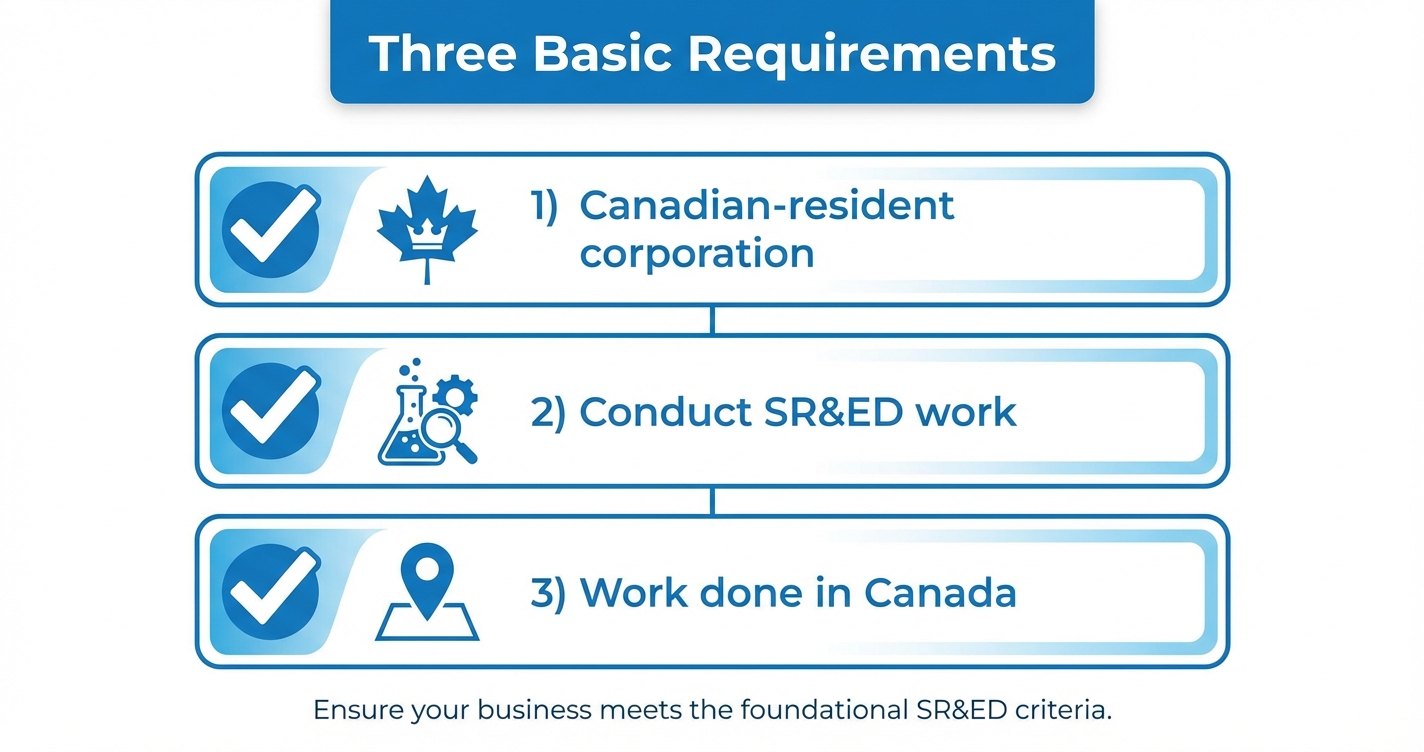
To claim SR&ED, three things must be true:
- You’re a Canadian-resident corporation. Incorporated federally or provincially in Canada, or operating a Canadian branch.
- You conduct SR&ED work. Your company does development work where you face technological uncertainty and investigate systematically to achieve advancement.
- You do this work in Canada. The research must happen in Canada.
By Company Size
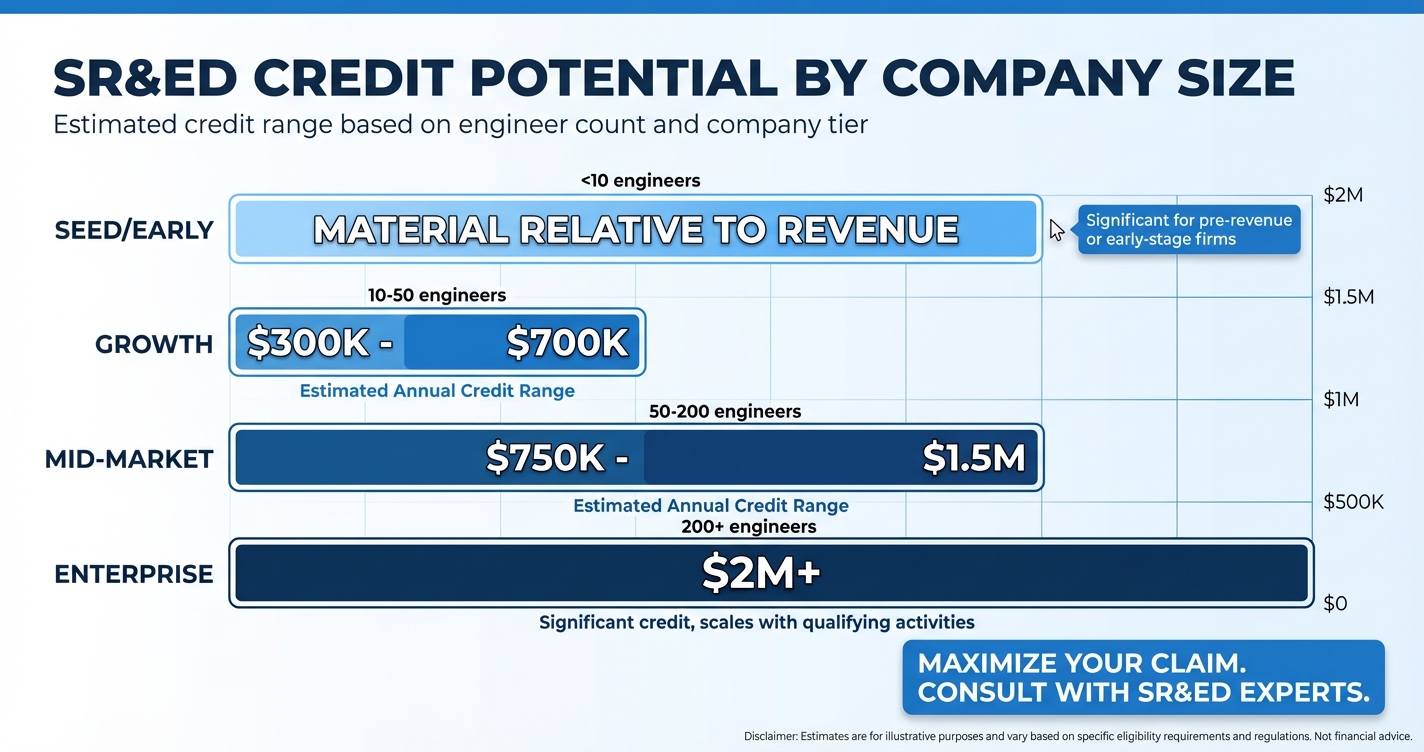
Seed/Early Stage (Less than 10 engineers): Almost certainly yes, if you’re doing real R&D work. The credit can be substantial relative to your revenue.
Growth Stage (10-50 engineers): Definitely yes. Annual engineering spend of $2M–$5M puts credits at $300K–$700K.
Mid-Market (50-200 engineers): Yes. Engineering spend of $5M+ means credits could be $750K–$1.5M annually.
Enterprise (200+ engineers): Yes. Credits could be $2M+.
By Business Model
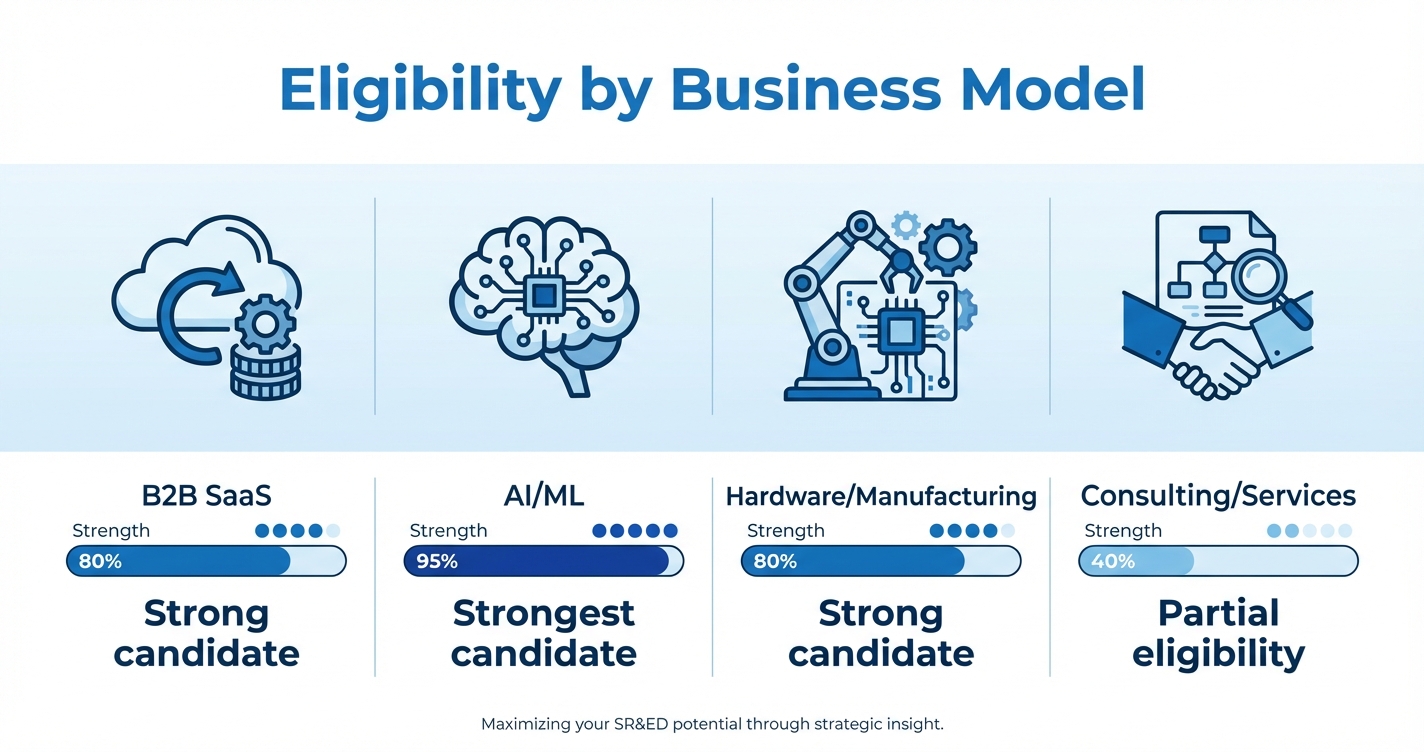
B2B SaaS: Strong candidates. You’re developing technology, facing technical challenges continuously.
AI/ML: Strongest candidates. Almost pure R&D work.
Hardware/Manufacturing: Strong candidates, especially with recent capital expenditure changes.
Consulting/Services: Partially eligible if you develop proprietary IP.
Key Point
The real question isn’t “do we qualify?” It’s “why haven’t we claimed yet?”
If you think you qualify, your next step is understanding whether the credit is material to your business. Do the math: Annual engineering spend × 30-40% × 15-35% = potential annual credit. If that number is $50K+, it’s worth your attention.
Frequently Asked Questions
Can startups with no revenue qualify for SR&ED?
Yes. Revenue isn’t a requirement for SR&ED eligibility. Pre-revenue startups doing R&D work in Canada can qualify, and CCPCs receive refundable credits, meaning you get cash back even if you owe no taxes. That makes SR&ED particularly valuable for early-stage companies.
Does my company need to be incorporated in Canada?
Your company needs to have a taxable presence in Canada and perform the R&D work in Canada. Foreign-controlled corporations doing R&D in Canada can claim the 15% non-refundable credit. CCPCs get the enhanced 35% refundable rate on the first $3M of qualifying expenditures.
What percentage of engineering time typically qualifies for SR&ED?
It varies by company, but most software companies find that 30-40% of their engineering time involves work that meets the SR&ED criteria. The qualifying portion is the time spent on technically uncertain work, not routine feature development or maintenance.