Key Takeaway
Buy from a vendor when a mature product already solves your problem, hire a consultant when you need a decision, and bring in an operating partner when the problem is core to how you make money and nobody inside can build and run the system. Ask every candidate who's accountable in production and who owns the code; those two answers tell you which model you're really buying.
A mid-market company that gets serious about AI usually ends up choosing between three kinds of help. It can buy software from a vendor. It can hire a consultant to tell it what to do. Or it can bring in a partner that builds and runs the system alongside its team.
From the outside, these blur together. Vendors now offer “implementation services.” Consultancies have “build practices.” Everyone says they’re outcome-focused. The proposals look similar enough that the decision often comes down to price and who gave the better presentation.
The three models differ in ways that matter a lot over two years: who’s accountable when something breaks, who owns what gets built, and what’s still standing after the engagement ends. This post compares them on those terms, says when each one is the right call, and ends with a checklist for your next evaluation.
What’s the difference between a vendor, a consultant and an operating partner?
A vendor sells you a product, a consultant sells you advice and deliverables, and an operating partner sells you a working system in production. The difference shows up in where each one’s accountability stops.
A vendor sells you a product. You get a configured instance of their software, some onboarding and a subscription. The vendor is accountable for the product working as documented. They aren’t accountable for whether it solves your specific operating problem.
A consultant sells you expertise and time. Usually that means an assessment, a strategy, a roadmap, a business case and sometimes a project to build a first version. The consultant is accountable for the quality of the advice and the deliverables in the statement of work. When the engagement ends, responsibility for execution moves to you.
An operating partner sells you an outcome in production. They work with your team to scope a problem, build the system, deploy it in your environment, get people using it and stay accountable for whether it keeps working. The system and code belong to you. The relationship continues, usually as a subscription or ongoing engagement, because running and improving the system is part of the job.
Each model is a legitimate business. The real question is which one matches the problem you have and the team you have.
How do the three models compare on what matters?
They split on four things: accountability, ownership, what’s left when the contract ends, and how cost behaves over about 24 months. Price in month three tells you very little.
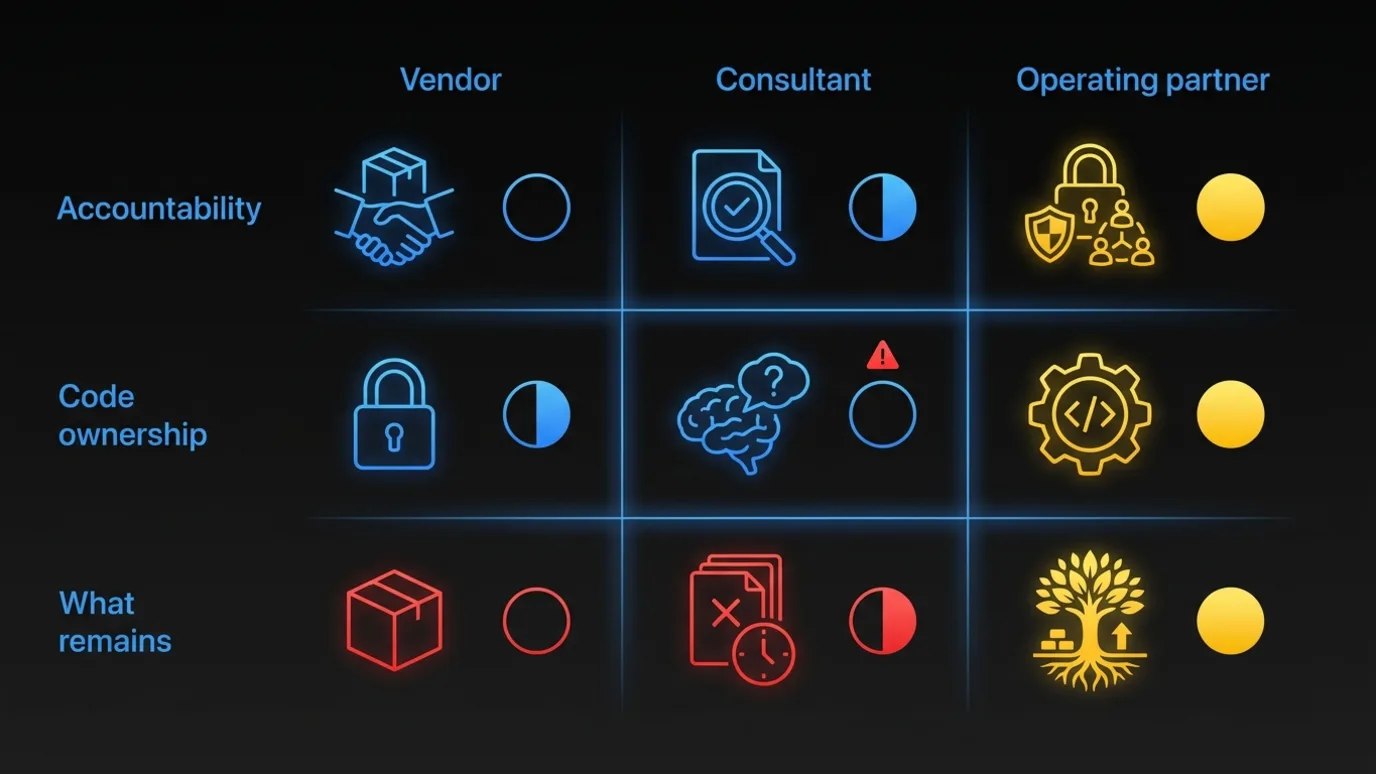
Who’s accountable when something breaks?
With a vendor, accountability ends at the product boundary. If the software does what the documentation says and your process doesn’t fit, that’s a configuration or adoption issue on your side. Good vendors help, but their incentive is the licence renewal, not the change in your operation.
With a consultant, accountability ends at the deliverable. A well-run engagement produces a sound recommendation and maybe a working prototype. Whether that prototype reaches daily use depends on who picks it up next. If you’ve read why AI pilots stall before anyone uses them, you’ll recognize that handoff as the place most initiatives die.
With an operating partner, accountability extends into production. The partner is on the hook for the system working in your environment, with your data, for your people. That changes how they build. Monitoring, access controls, fallbacks and training get planned from day one, because the partner is the one who’ll deal with the consequences if they’re missing.
Who owns the code and the system?
Buyers ask this least and regret it most.
With a vendor, you own your data (check the contract) and your configuration. You don’t own the software. If prices rise, the product changes direction or the vendor gets acquired, your options are limited to what their export tools allow.
With a consultant, ownership depends on the contract. Strategy documents are yours. Code from a build phase is often yours too, though it may depend on the firm’s proprietary accelerators or frameworks that you license rather than own. Read the intellectual property (IP) clause carefully.
With an operating partner done properly, you own the systems and code outright. The partner may bring a platform of reusable components, but what gets built for you runs in your environment and stays with you if the relationship ends. If a partner can’t say that plainly, treat it as a red flag.
What’s left after the engagement ends?
Picture the day after the contract ends, 18 months from now.
With a vendor, what remains is the subscription. Your team knows how to use the product. The operating knowledge about why your process works the way it does is mostly still in people’s heads, because the product never needed to capture it.
With a consultant, what remains is documentation and, if you’re lucky, a prototype. The people who understood the details have rolled off to the next client. Your team inherits a plan and the job of carrying it out.
With an operating partner, what should remain is a set of production systems your team uses daily, plus the workflows, integrations, test cases and governance that came with them. Ideally, the institutional knowledge the partner captured while building (the rules that used to live in one person’s spreadsheet) now lives in a system you own. We wrote about what an AI engagement should leave behind in more detail.
What does each model cost over 24 months?
We won’t put dollar figures on this because they vary too much by scope. The shape of the cost curve is more useful than any number.
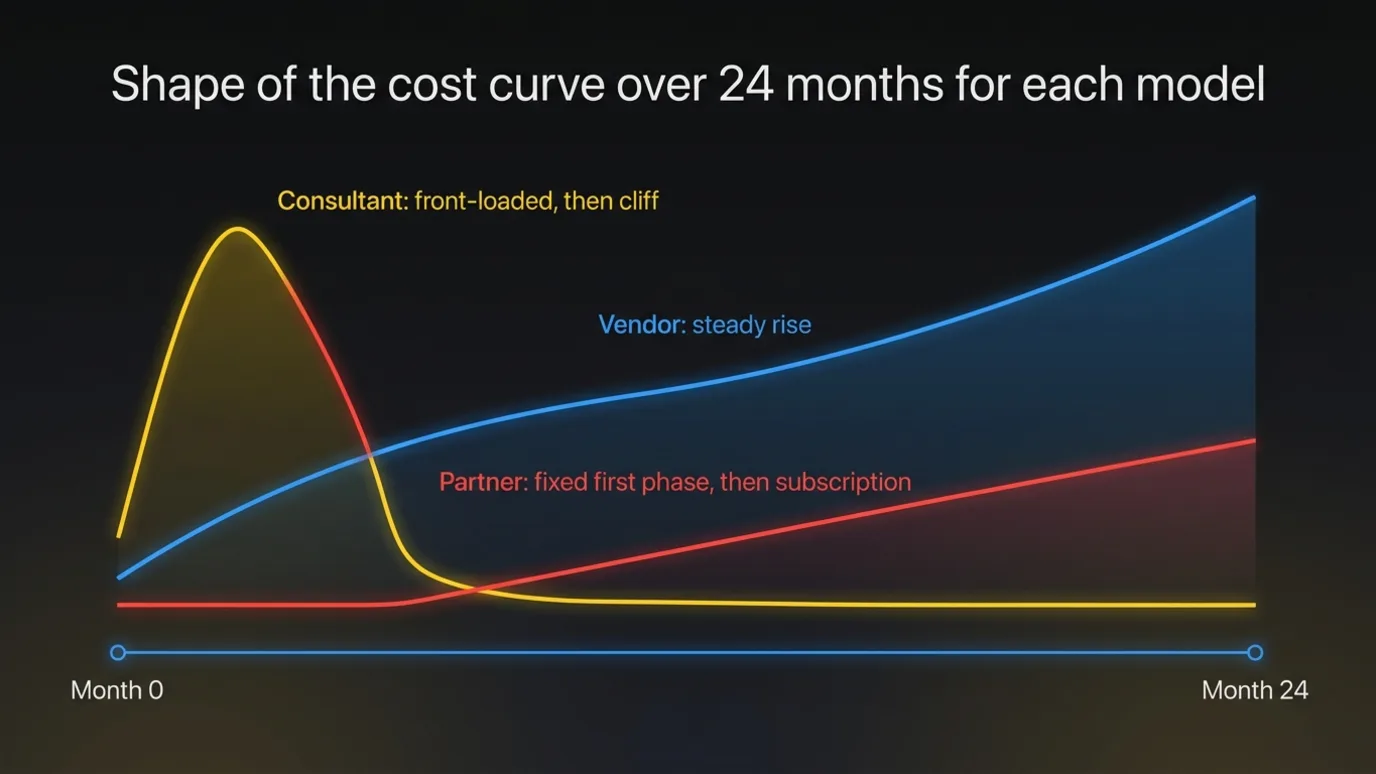
Vendor: low entry cost, predictable recurring cost. Licences tend to grow as you add users, volume or modules. Hidden costs show up as internal time spent configuring, integrating and working around gaps. Over 24 months the total is usually predictable but rises steadily, and you’re buying capability, not building an asset.
Consultant: high cost packed into a short window, then a cliff. The engagement fee is front-loaded. After that, the cost of execution shifts to your internal team, or to a second engagement with someone else to build what the strategy recommended. The risk is paying twice: once for the plan and once for a different team to rediscover the details and build it.
Operating partner: a defined first phase, then ongoing cost tied to systems in production. A good entry point is a fixed-scope piece of work that solves or prototypes one or two specific problems, so you can judge results before committing further. After that, cost usually moves to a subscription or retainer covering the platform, operation and the next problems. The bet is that each new problem costs less to solve than the last, because workflows, integrations and context from earlier work get reused.
The honest comparison isn’t which model is cheapest in month three. It’s which one leaves you with the most working capability per dollar in month 24.
Why can’t mid-market companies just hand off to an internal team?
Because at most mid-market companies, that team doesn’t exist. Enterprise playbooks assume consultants design, a systems integrator builds and an internal AI team or centre of excellence takes over. Take away the last step and the handoff lands on nobody.
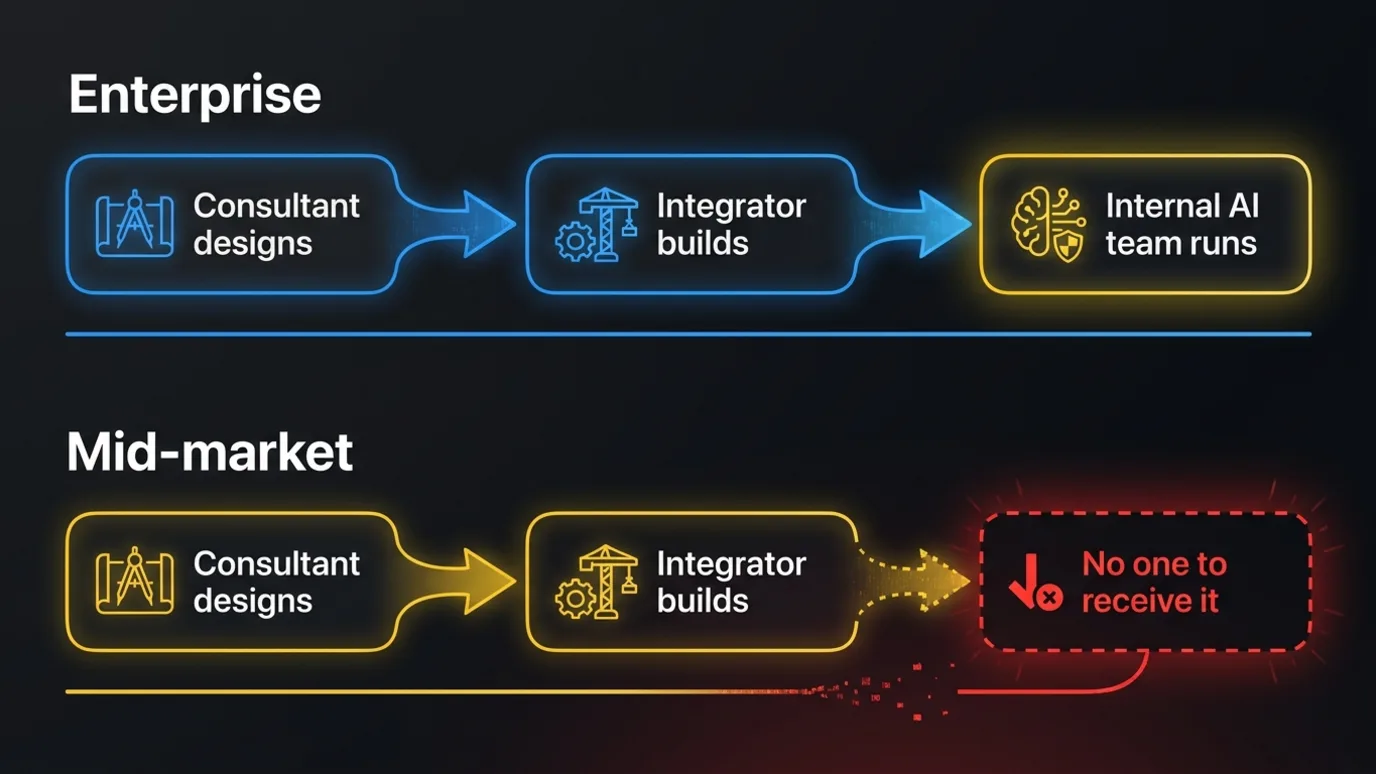
Look at who’s actually there. You might have a CTO, a small IT group that keeps the ERP (enterprise resource planning system) and the network running, a few developers and a data analyst who’s very good with Power BI. None of them have spare capacity. None of them signed up to own a production AI system with model drift, prompt changes and accuracy monitoring.
Hiring that team is possible but slow. Senior people with production AI experience are scarce, and a company of 150 or 400 people rarely needs a full-time team of them on day one. You need the capability before you can justify the headcount.
That’s the main reason consultant-led AI projects stall more often in mid-market companies than in large ones. The advice may be excellent. There’s simply no one positioned to receive it.
The operating partner model exists to fill that gap. The partner’s team acts as the AI capability you don’t have yet, embedded with the operators who know the business, until you decide whether to build that capability in-house. If you do hire, the partner should help you do it and hand over systems that are documented and owned by you.
This hits harder in traditional, process-heavy industries like distribution, manufacturing, construction and logistics. These companies often have the most to gain, since so much of their operation still runs on spreadsheets, email and expert judgment. They also have the least internal software capacity to absorb a handoff. We cover AI in traditional industries separately.
When is each model the right call?
Pick a vendor for solved, common problems, a consultant when you need a decision, and an operating partner for high-value problems specific to how you run. Being fair here matters. The wrong model for your situation will cost more than any of them priced correctly.
Choose a vendor when the problem is common across companies and a mature product already solves it well. Accounts payable automation, meeting transcription, sales call analysis and support ticket routing all have good products. If your process is close to standard and you’d rather adapt to the tool than build around your specifics, buy the product. Building custom software for a solved problem is a waste.
Choose a consultant when you need a decision more than a system. Say you’re evaluating whether AI matters to a pending acquisition, you need an independent assessment for the board, or you want a market scan before committing budget. Consultants are also the right call when you already have a capable internal team ready to execute and want senior outside perspective to shape the plan.
Choose an operating partner when the problem is specific to how your business runs, the value justifies a custom system, and you don’t have an internal team that can build and run it. That’s typical for operating problems at the core of how you make money: quoting, scheduling, order intake, compliance documentation, field service dispatch. It’s also the right call when you want each project to build on the last instead of starting over.
Plenty of companies end up using all three. A vendor for the commodity tools, a consultant for the occasional strategic question, and a partner for the problems that define their operation. The mistake is using one model for every job.
What should you ask before you choose?
Ask about accountability and ownership first. A candidate’s answers to those two sets of questions will tell you more about the model you’re actually buying than the proposal will.
On accountability
- Who’s accountable for this working in production six months after go-live? Name the person or role.
- What happens when accuracy drops or a process changes? Who notices, and who fixes it?
- How is success defined: delivery of a document or system, or measurable use and results in our operation?
On ownership
- Who owns the code, models, prompts, data pipelines and configurations you build for us?
- Does anything you build depend on components we license rather than own? What happens to them if we end the relationship?
- Where does the system run, and who controls access?
On what remains
- What will exist in our company 18 months from now that doesn’t today?
- How will the operating knowledge you capture from our team be stored, and who can use it?
- If we bring this in-house later, what does the handover look like?
On people and adoption
- Who from your team will be in the room with our operators, and how senior are they?
- What’s your plan to get our people using this day to day, beyond training sessions?
- How do you handle the people whose jobs change because of this?
On cost and structure
- What’s fixed scope, and what’s open-ended?
- What does the first phase deliver, and how will we judge whether to continue?
- How does cost change over 24 months, and what gets cheaper as we do more?
On governance and fit
- How do you handle data residency, privacy and audit requirements for a Canadian company? Our post on AI governance for Canadian companies covers what to look for.
- Can you work in French as well as English, if our teams need it?
- Is any of this work eligible for SR&ED (Scientific Research and Experimental Development) tax credits, and will you help document it? Our post on SR&ED for AI projects explains how that works.
If a candidate struggles with the accountability and ownership questions, you’ve learned what you need to know. Those two separate a real partner from a vendor with a services team or a consultancy with a build practice.
Why start with one problem?
Whichever model you choose, a focused first phase with a clear definition of done tells you more about a partner than any reference call. It also gives your team a working system to react to, which surfaces the real requirements faster than any workshop.
We made the full case for proving AI value on one problem, and the business case for AI investment covers how to frame the numbers for your leadership team.
Frequently Asked Questions
What is an AI operating partner?
An operating partner builds an AI system with your team, deploys it in your environment and stays accountable for it working in production. You own the code and systems. The relationship usually continues as a subscription because running and improving the system is part of the work.
Is it cheaper to hire an AI consultant or an operating partner?
A consultant often looks cheaper up front, but execution cost shifts to your team once the engagement ends, and many companies pay a second firm to build what the strategy recommended. Compare working capability per dollar at month 24, not the first invoice.
When should a mid-market company just buy AI software?
When the problem is common and a mature product already solves it, like accounts payable automation or meeting transcription. If your process is close to standard, adapting to the tool beats building custom software.
Talk to us
Chrono Innovation works as an operating partner for small and mid-market companies in Canada and the US. A senior team covers strategy, engineering, infrastructure, adoption and SR&ED, working with your operators in English or French. We start with a fixed-scope engagement on one or two problems, and you own everything we build. If you’re weighing your options, book a call and we’ll tell you honestly which model fits your situation, even if it isn’t ours.