Key Takeaway
AI's biggest payoff right now isn't in SaaS. It's in manufacturers, distributors, contractors, carriers and brokers whose expensive work lives in quotes, orders, drawings and claims, and the right first project is one high-volume workflow with an expert bottleneck and a number you already track.
Most AI marketing is written for software companies. The case studies are support chatbots at SaaS firms, coding assistants for engineering teams and personalized onboarding flows. If you run a 300-person distributor or a regional engineering firm, almost none of it describes your business.
That gap is an opportunity. The companies with the most to gain from AI right now are often the ones software vendors have spent the least time on: businesses where the real work happens in quotes, purchase orders, schedules, drawings, inspection reports and claims files. The work is repetitive enough to be expensive and variable enough that off-the-shelf software never quite fit.
Why are traditional industries underserved by AI vendors?
Software vendors build for markets they can sell to over and over. A horizontal tool for sales teams sells to every company with a sales team. A tool that handles the specific way a mid-sized steel fabricator turns customer drawings into quotes has a much smaller market, so it rarely gets built well.
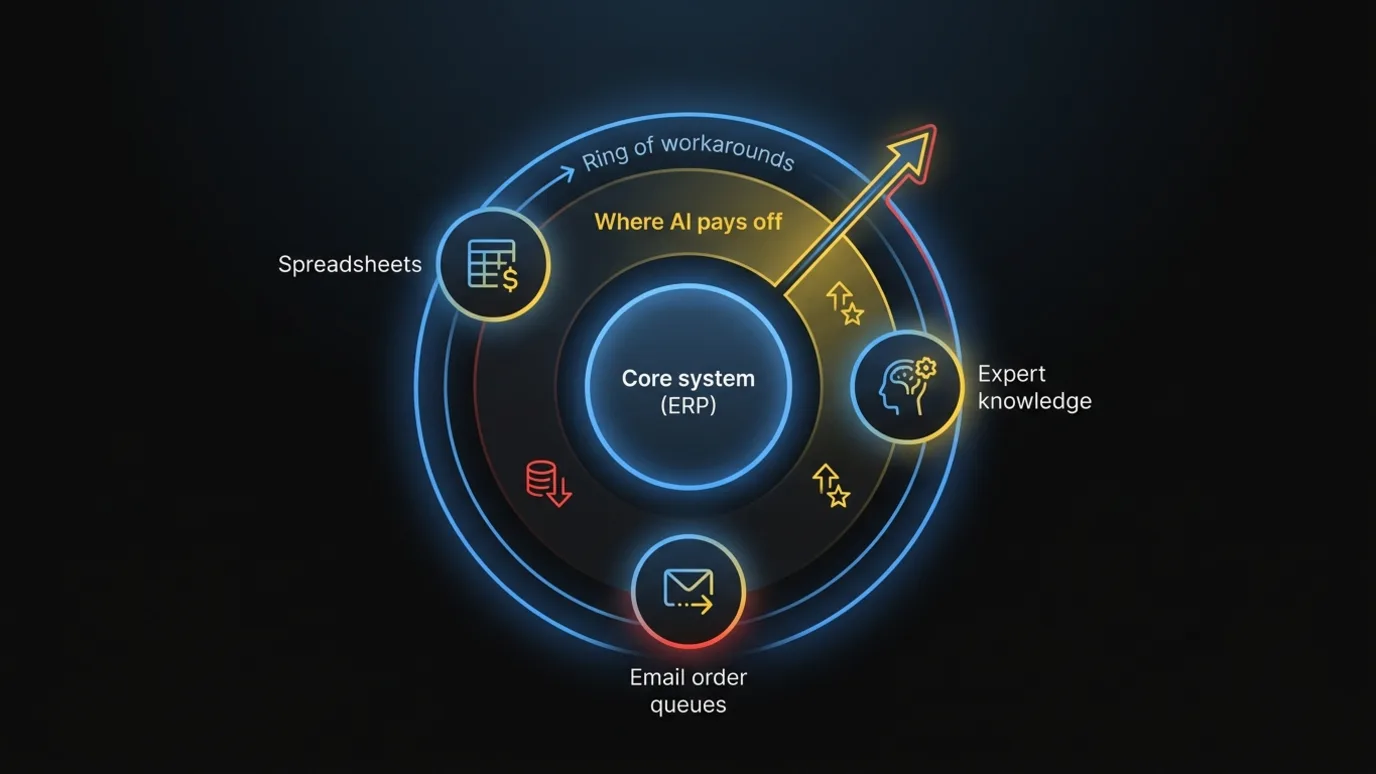
What these companies end up with is a core system (an ERP, or enterprise resource planning system, an accounting package, a field service tool) and a ring of workarounds around it. Spreadsheets that calculate what the ERP can’t. Email inboxes that act as order queues. A senior estimator who knows which suppliers quote high and which customers always change the spec after approval.
That ring of workarounds is where the cost sits. It’s also where the value is, because those workarounds encode years of judgment about how the business actually runs.
What makes this territory a good fit for AI?
The inputs are unstructured. Drawings, PDFs, emails, scanned forms, phone notes. Until recently, software couldn’t read these reliably. Current models can, with the right engineering around them.
The decisions follow patterns people can explain. An estimator can tell you why one job gets a 15% contingency and another gets 5%. That reasoning can be captured, tested and encoded.
The volume is high and the margins are thin. Saving 20 minutes on each of thousands of transactions a year matters more in a thin-margin distribution business than in a high-margin software company.
The people doing the work are scarce. Experienced estimators, schedulers, adjusters and project coordinators are hard to hire and slow to train. Making each of them more effective is often worth more than any headcount reduction.
Where does AI pay off in manufacturing?
In manufacturing, the two biggest wins are usually quoting and quality paperwork. Both involve people reading documents and retyping parts of them, and both slow the business down in ways customers notice.
Quoting and estimating
A custom or make-to-order manufacturer receives RFQs (requests for quotation) as drawings, specs and emails. An estimator reads them, identifies materials and operations, checks past jobs for similar parts, applies costing rules and builds a quote. Turnaround time often decides who wins the work.
AI can read the drawing and spec, pull the relevant attributes, find comparable historical jobs and assemble a draft quote with the estimator’s costing logic applied. The estimator reviews, adjusts and sends. The goal is faster turnaround with consistent margins. A fully automated quote isn’t.
Quality and compliance documentation
Inspection reports, non-conformance records, certificates of conformance and customer-specific quality packages take real time to assemble, especially in regulated sectors. AI can draft these from inspection data and production records, flag missing fields and check them against customer requirements before they ship.
Where does AI pay off for distributors and wholesalers?
For distributors, order intake is the standout. The clean orders already flow through. It’s the exceptions that eat the team’s day, and AI handles routine exceptions well.
Order intake and exceptions
Distributors receive orders through every channel imaginable: EDI (electronic data interchange), portals, email attachments, phone calls transcribed by inside sales. The problems are unknown part numbers, quantities that don’t match pack sizes, pricing that doesn’t match the contract and ship-to addresses that don’t exist in the system.
This is one of the strongest AI use cases in any traditional business. A system that reads incoming orders in any format, maps them to SKUs using the customer’s history, flags genuine exceptions and resolves the routine ones lets inside sales spend time on customers instead of data entry.
Purchase-order and invoice matching
On the buy side, matching supplier invoices to purchase orders and receipts is tedious and error-prone. Partial shipments, substitutions, freight charges and price changes all create mismatches. AI can do the first-pass match, explain each discrepancy and route only the real problems to accounts payable.
Where does AI pay off in construction and the trades?
In construction, AI earns its keep on estimating and on the paperwork that piles up around every active job. Both draw on the same senior people who should be running projects.
Estimating and takeoffs
General contractors and specialty trades spend a lot of senior time on bids they won’t win. Reading tender documents, pulling quantities from drawings and applying unit costs is slow, and the people who do it well are the same people needed on active jobs.
AI can extract scope from tender packages, summarize addenda, pull quantities for common elements and pre-populate the estimate with historical unit costs. An estimator can then review more bids, or spend more time on the ones that matter.
Submittals and project documentation
Submittals, RFIs (requests for information), change orders, daily reports and closeout packages grow with every project. A system that checks submittals against specifications, drafts RFI responses from project documents and keeps closeout documentation organized as the job progresses takes a large share of admin off project managers.
Where does AI pay off in logistics and transportation?
In logistics, the payoff comes from dispatch and from the document trail every load leaves behind. One is a judgment problem, the other is a reconciliation problem, and AI helps with both.
Scheduling and dispatch
Dispatchers juggle driver hours, equipment availability, customer windows, traffic and the call that comes in at 4:45 p.m. Much of that judgment lives in one or two experienced people. AI can propose schedules that respect the hard constraints, explain trade-offs and help a dispatcher re-plan when something breaks. The dispatcher still decides. They decide faster, with better information.
Freight documentation and billing
Bills of lading, proof of delivery, accessorial charges, customs paperwork and carrier invoices create a steady stream of reconciliation work. AI can extract data from these documents, match them against loads and rates, and catch billing errors before they turn into disputes or lost revenue.
Where does AI pay off in professional services?
For professional services firms, AI gives senior people back the hours they spend assembling documents instead of exercising judgment. The review stays human. The prep work shrinks.
Engineering firms
Engineering firms produce large volumes of technical documentation: proposals, specifications, design reports, inspection reports. A lot of it reuses prior work. AI that can search a firm’s own project history, draft sections from comparable past projects and check documents against code requirements gives senior engineers back hours they now spend on assembly.
Accounting firms
Accounting firms deal with client documents arriving in every format, at the same time of year, under deadline. Document collection and classification, first-pass reconciliation, variance explanations and working-paper preparation are all good candidates. The partner and manager review stays. The hours spent preparing material for that review drop.
Where does AI pay off in insurance brokerage?
Commercial brokers spend much of their week re-keying the same client data into different carrier formats. Submissions, claims intake and policy checking are all detail work where AI is fast and errors are expensive.
Submissions and claims intake
Brokers collect client information, fill carrier-specific applications and assemble submission packages. AI can build submissions from client files, highlight missing information and tailor the package to each carrier’s requirements.
On the claims side, intake means gathering the facts of a loss from emails, photos, forms and calls, then structuring them for the carrier. A system that turns that raw material into a complete, consistent first notice of loss shortens the cycle and cuts the back-and-forth.
Renewals and policy checking
Comparing renewal terms against expiring policies, and checking issued policies against what was bound, is detail work where mistakes cost money. AI can do the comparison and surface the differences that need a broker’s attention.
Why should you lead with the outcome instead of “AI”?
Because outcome-first projects have a target, an owner and a way to tell if they worked. Every example above was framed as an operating problem first: quote turnaround, order exceptions, bid volume, claims cycle time. That’s deliberate.
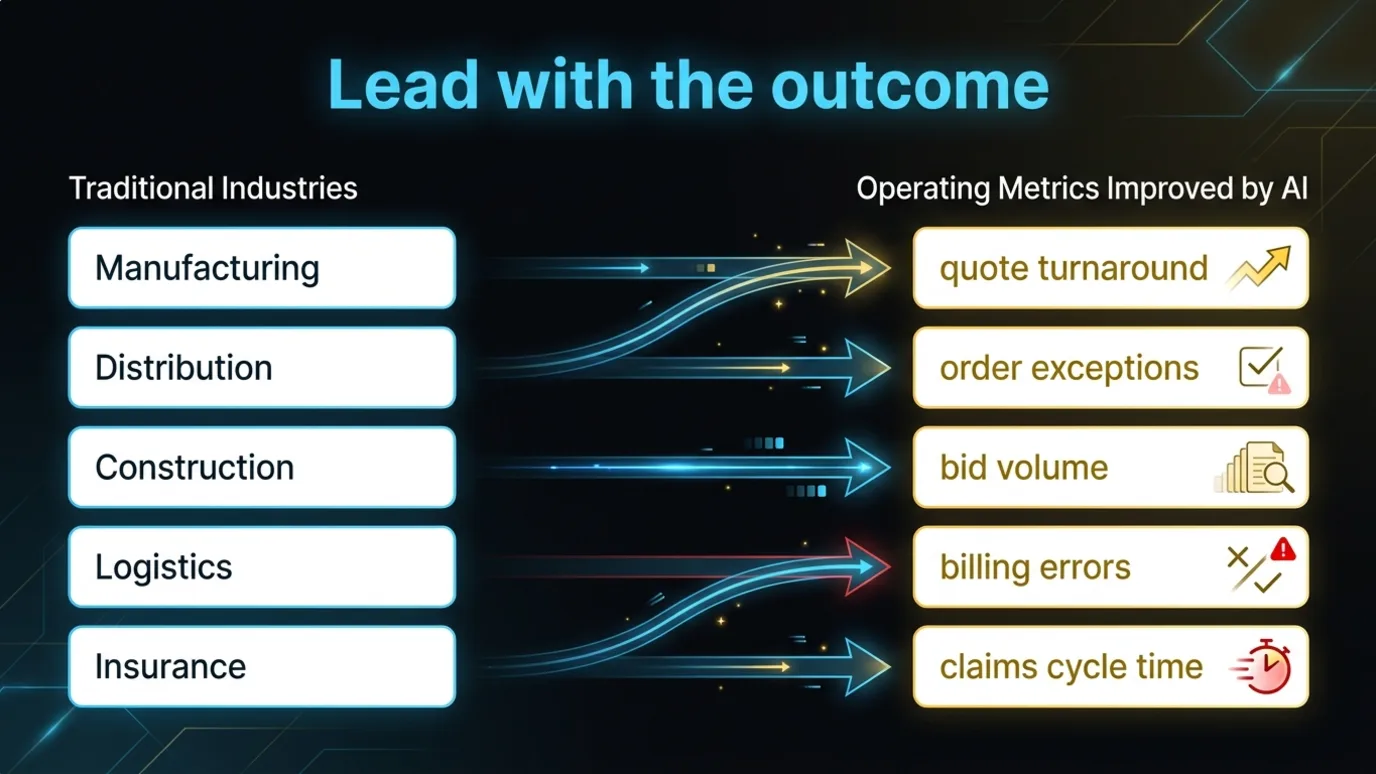
Projects that start with “we need an AI strategy” tend to produce a slide deck and a pilot that stalls. We’ve written about why AI pilots stall, and a missing operating metric is near the top of the list. Projects that start with “our quote turnaround is five days and we’re losing work to competitors who answer in two” know exactly what success looks like.
Leading with the outcome also changes the conversation inside the company. A plant manager or controller doesn’t need to care about models. They need to know the change will make their team’s week easier and the numbers better. When they help define the problem, they help make the solution work.
It also keeps you honest about technology choices. Sometimes the right answer to an operating problem is a better report, a cleaned-up process or a configuration change in the ERP. A partner who starts from the outcome will tell you that. One who starts from AI usually won’t.
How do you tell if a workflow is a good first AI candidate?
Look for high volume, document-heavy inputs, an expert bottleneck and a metric you already track. Not every process is worth automating, and not every good candidate should come first. These are the signals we look for when helping a company pick where to start.
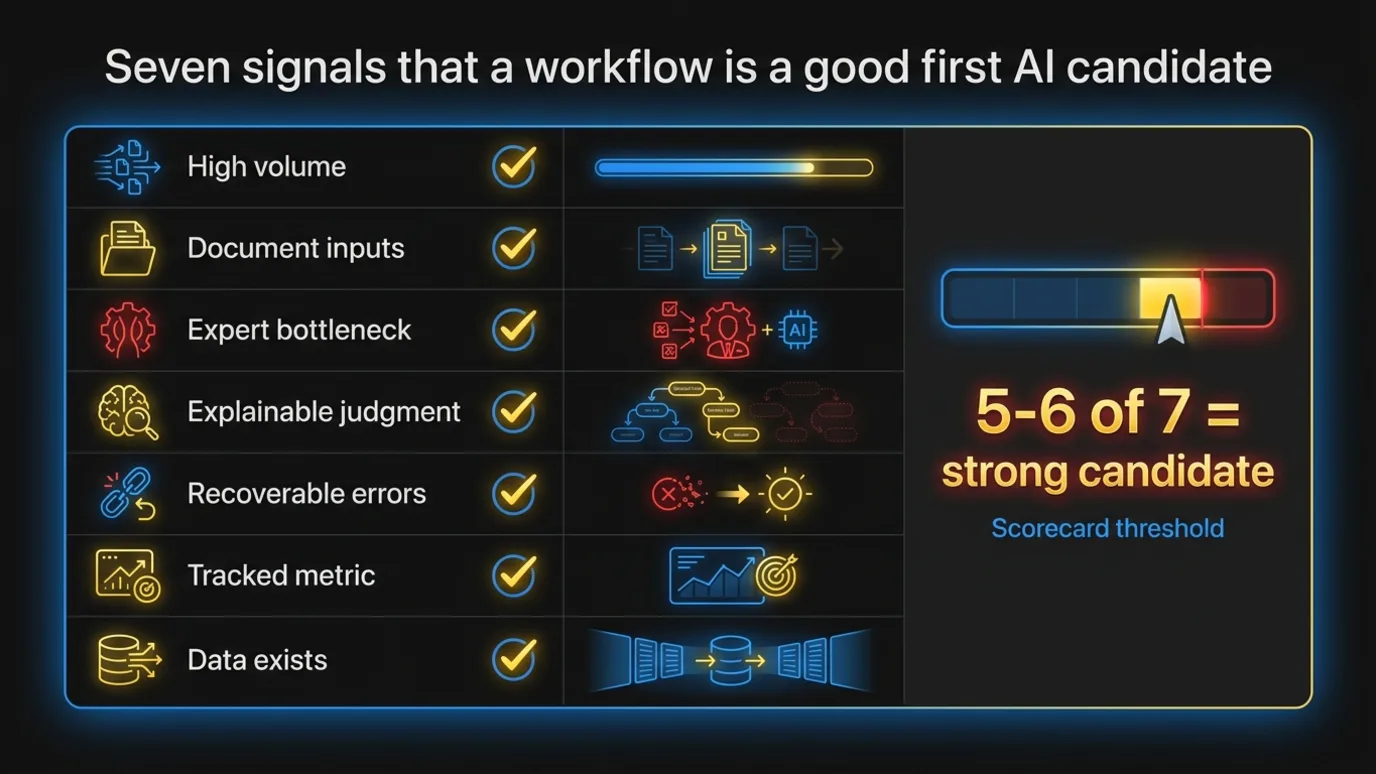
It’s high volume and repetitive in structure. The same kind of work arrives many times a week, even if each instance looks a little different.
The inputs are documents or messages people read. Drawings, emails, PDFs, forms. If a person reads something and types parts of it into another system, that’s a strong signal.
There’s an expert bottleneck. One or two people know how to do it well, the queue backs up when they’re away, and training someone new takes a year.
The judgment can be explained. If you ask the expert why they made a decision and they can tell you, the logic can usually be captured. If the answer is “I just know,” it’s a harder first project.
Errors are visible and recoverable. A human reviews the output before it reaches a customer or a regulator, at least at first. Workflows where a mistake can’t be undone are poor starting points.
There’s a number you already track. Turnaround time, error rate, backlog, write-offs, bids per estimator. If you can’t measure the problem today, you won’t be able to show the improvement.
The data exists, even if it’s messy. Historical quotes, past orders, closed claims. The data rarely needs to be clean. It needs to exist and be reachable.
A workflow that hits five or six of these is usually worth a closer look. One that hits two probably isn’t the place to start.
What’s the real asset AI has to capture?
It’s the knowledge that isn’t written down. The estimator’s rules of thumb. The dispatcher’s sense of which customers will accept a late window. The adjuster’s instinct for which claims need a site visit.
Good AI work in these environments starts by capturing that knowledge, with the people who hold it, and encoding it into systems the company owns. We cover that process in turning institutional knowledge into production systems. Done well, it makes your experienced people more effective and makes the business less dependent on any one of them. It doesn’t replace them. Our view on that is in AI that amplifies teams.
How should a traditional business start with AI?
Narrow and deep. Pick one workflow that hits most of the signals above. Define the operating metric. Build a production system that handles it, with the people who do the work today involved from the first week. Measure. Then decide what’s next.
The first project should leave something behind beyond the result: a reusable integration with your ERP, a governed way to handle your documents, captured decision rules your team can inspect and change. That’s what makes the second project faster and cheaper than the first. The post on what an AI engagement should leave behind goes into that, and proving AI value on one problem covers how to scope the first one.
For Canadian companies, some of the technical investigation in this kind of work can also qualify for SR&ED (Scientific Research and Experimental Development) tax credits. Here’s how to tell if your AI work may qualify for SR&ED.
Frequently Asked Questions
Which traditional industries get the most out of AI?
Manufacturing, distribution, construction, logistics, professional services and insurance brokerage. They share the same pattern: high-volume work built on unstructured documents like drawings, orders, tender packages and claims, handled by a few experienced people who are hard to replace.
What’s a good first AI project for a manufacturer or distributor?
Quote preparation for make-to-order manufacturers and order-exception handling for distributors. Both are high volume, both start from documents people read and retype, and both have a metric you can measure today, like quote turnaround or orders touched by hand.
Does AI replace estimators, dispatchers or adjusters?
No. It drafts, matches and flags so the expert reviews instead of assembling. The estimator still sends the quote and the dispatcher still decides, but each of them handles more work with better information.
If you run a business where the expensive work lives in quotes, orders, schedules, drawings or claims, book a call with Chrono Innovation. Bring the workflow that costs you the most time. We’ll tell you plainly whether it’s a good first candidate and what a fixed-scope first engagement on it would look like.