Key Takeaway
Advisors and investors don't need their own dev team to deliver AI results. They need an execution partner that ships to production, leaves the client owning the code, and agrees in writing not to take over the relationship.
A fractional COO spends six weeks inside a 150-person logistics company. She maps the quoting process, finds that two senior estimators carry most of the pricing logic in their heads and a 40-tab spreadsheet, and recommends an AI-assisted quoting system. The CEO agrees. Then he asks the obvious question: “Who builds it?”
She doesn’t have an answer she likes. Her network includes a few freelance developers and a large systems integrator that won’t return calls for a project this size. The client has two IT generalists who keep the ERP (enterprise resource planning) system running. The recommendation is right. It also isn’t going anywhere.
If you advise or invest in mid-market companies, you’ve probably had some version of this conversation. This post is for consultants, accounting firms, fractional executives and private equity (PE) or venture capital (VC) operating partners who need to turn AI recommendations into working systems.
Why can’t advisors deliver the AI systems they recommend?
Most advisory practices don’t have production engineering, and that’s a sensible choice. The diagnosis is where advisors are strong. The build is the gap, and AI recommendations are the first kind that clients usually can’t implement on their own.
Management consultants, accounting and advisory firms, fractional executives and operating partners share real strengths. You have the client’s trust. You understand the business well enough to find the problem worth solving. You can get the CEO and CFO to agree on priorities. Most technology vendors can’t do any of that.
Building a dev team is another matter. It means hiring engineers you can’t keep busy between projects, carrying delivery risk that doesn’t fit a partnership model, and competing for AI talent against companies that pay more. Few advisory firms want that business. The ones that try often end up running a small, stretched agency on the side.
For a long time the gap didn’t matter much. The client’s own people could implement recommendations about pricing, org design or process. AI changes that. When the recommendation is “automate the quoting workflow” or “build a system that reads supplier contracts and flags exceptions,” the client’s team usually can’t execute it. Someone has to build it, run it and keep it working.
That’s where the value of the recommendation leaks out. The client hires whoever is available, the project drifts, and six months later the advisor’s name is attached to an AI initiative that didn’t deliver. Or the client never starts, and the recommendation sits in a deck.
What breaks when an advisor hands off to a vendor?
Five things break, and they break the same way almost every time: context, scope, ownership, the client relationship and the path to production. Each one is avoidable with the right execution partner and a clear agreement up front.
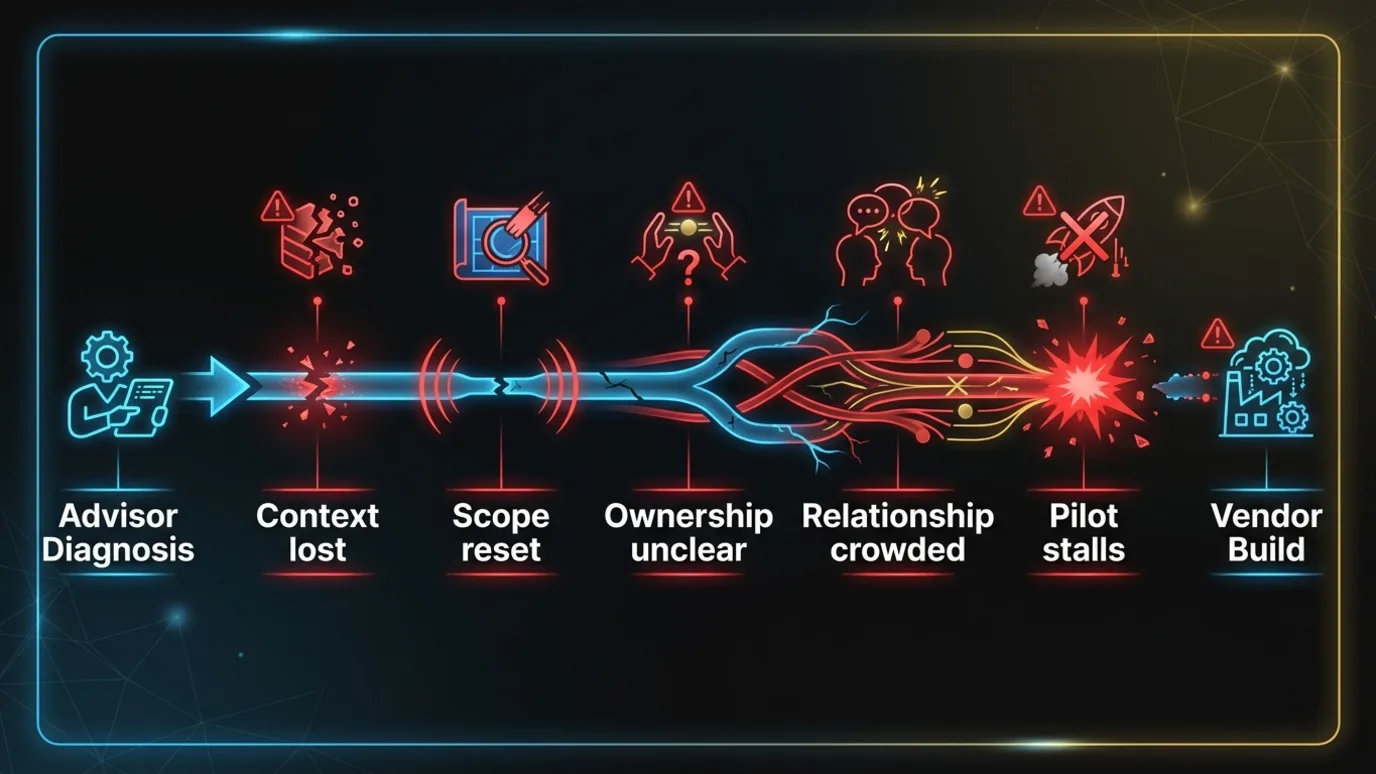
Context gets lost. You spent weeks learning how the business actually works: which exceptions matter, which numbers the CFO doesn’t trust, which operator knows the real process. A new vendor starts from zero and often re-runs discovery, at the cost of the client’s money and patience.
Scope gets reset. The vendor proposes what they know how to build, which may not be what you diagnosed. A focused operating problem turns into a generic chatbot or a platform evaluation.
Ownership gets murky. The client ends up with a system they don’t control, built on the vendor’s proprietary tooling, with code they can’t see. When the vendor relationship ends, so does the system.
The relationship gets crowded. Some vendors see an advisor’s client as their next account. They pitch adjacent work and position themselves as the strategic voice. You brought them in, and now you’re competing with them.
Pilots stall. A prototype gets built and demoed. Getting it into production, with real data, monitoring, access controls and people actually using it, is a different project that nobody scoped. We wrote about this pattern in why AI pilots stall.
How can advisors partner with an AI execution team?
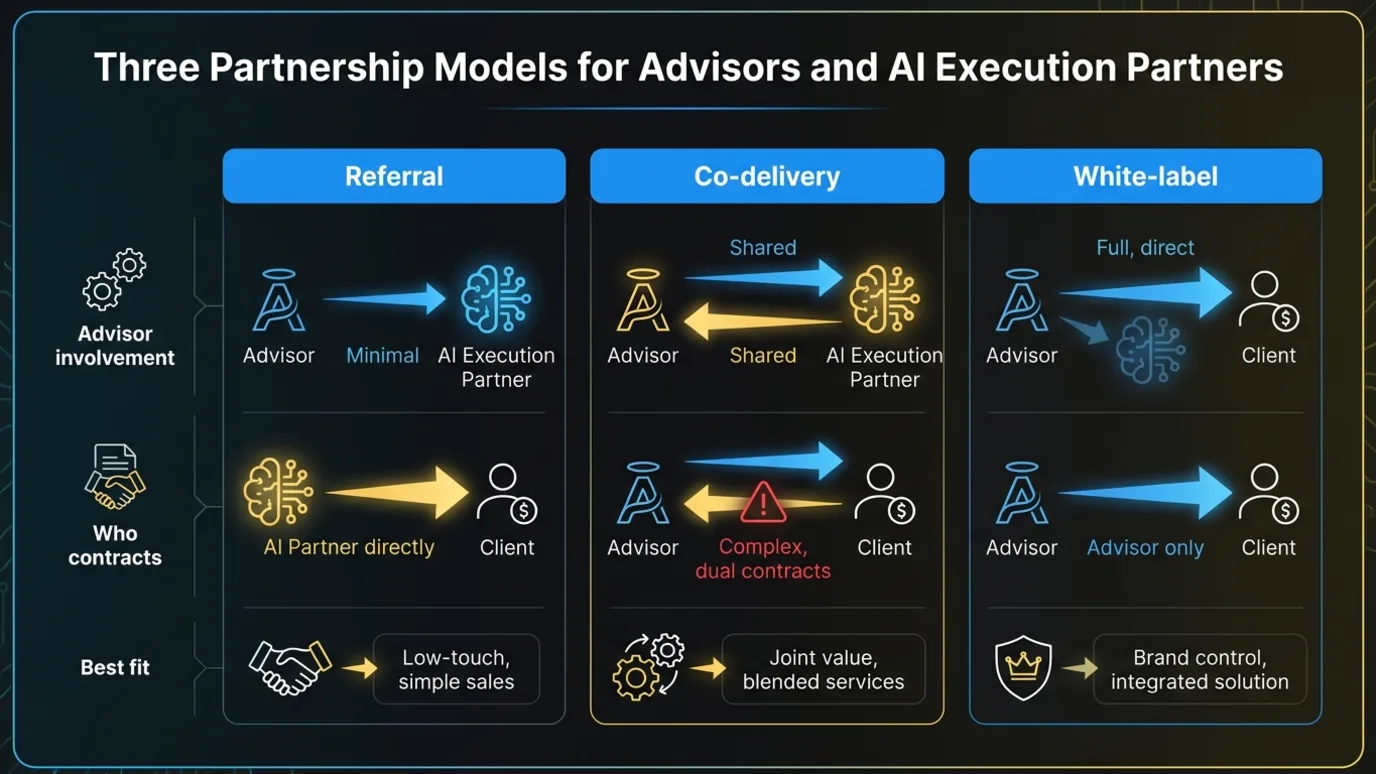
There are three workable structures: referral, co-delivery and white-label. The right one depends on how involved you want to be in delivery and how you want to show up to the client. Whichever you pick, write down three things before the first client conversation: who owns the client relationship, who’s accountable for what, and what the client owns at the end.
Referral
You make the introduction and stay in the relationship as the strategic advisor. The execution partner contracts directly with the client.
This works when you don’t want delivery accountability, or when your engagement is ending and you want to leave the client with a credible path forward. It’s the lightest option. A good partner keeps you informed, includes you in key reviews if the client wants that, and doesn’t try to replace you as the trusted advisor. Revenue share or referral fees are possible, structured however suits your firm and your professional obligations.
Co-delivery
You and the execution partner work the engagement together. You lead the business side: problem definition, operating changes, change management, executive alignment. The partner leads engineering, infrastructure and production deployment. The client sees one coordinated team, usually with two contracts or one prime and one sub.
This is the most common model for consultants and fractional executives who want to stay hands-on. It keeps the context you built, because you’re in the room when the system gets designed. It also produces better systems. The person who understands why the estimators override the pricing spreadsheet should be in the conversation where that logic gets encoded.
White-label
The execution partner delivers under your brand. The client contracts with you, and the partner works as part of your team.
This suits advisory firms that want an AI implementation service line without building the capability in-house. It needs the most trust and the clearest agreement: who owns the code, who supports the system after launch, what happens if the partnership ends, how client confidentiality is handled. Done well, it lets a 20-person advisory firm offer production AI delivery next to its existing services.
How should PE and VC operating partners approach AI execution?
Operating partners face the same gap in a different shape. You’re not advising one company. You’re trying to create value across a portfolio, on a hold period, with a small team. That makes repeatable work and deal timing the two things to get right.
Can one AI project carry across a portfolio?
Yes, if the problems repeat, and they usually do. Quoting and estimating. Accounts payable exceptions. Customer service triage. Field service scheduling. Contract review. Month-end reconciliation that depends on one controller and a set of macros.
When an execution partner solves one of these at one portfolio company, much of the work carries over: the workflow patterns, the evaluation approach, the governance setup, the integration with common ERPs and CRMs (customer relationship management systems). The second company starts from a working reference. The third starts further ahead. That’s a portfolio-level asset, and it’s hard to build if every company hires a different vendor.
One condition matters. Each company owns its own system and code. Reusable patterns can travel. One company’s data and proprietary logic can’t.
When in the deal cycle does AI execution fit best?
Three moments stand out: the post-close 100-day plan, add-on integration and the run-up to a raise or exit. Each has a clear owner, a bounded problem and a reason to show results quickly.
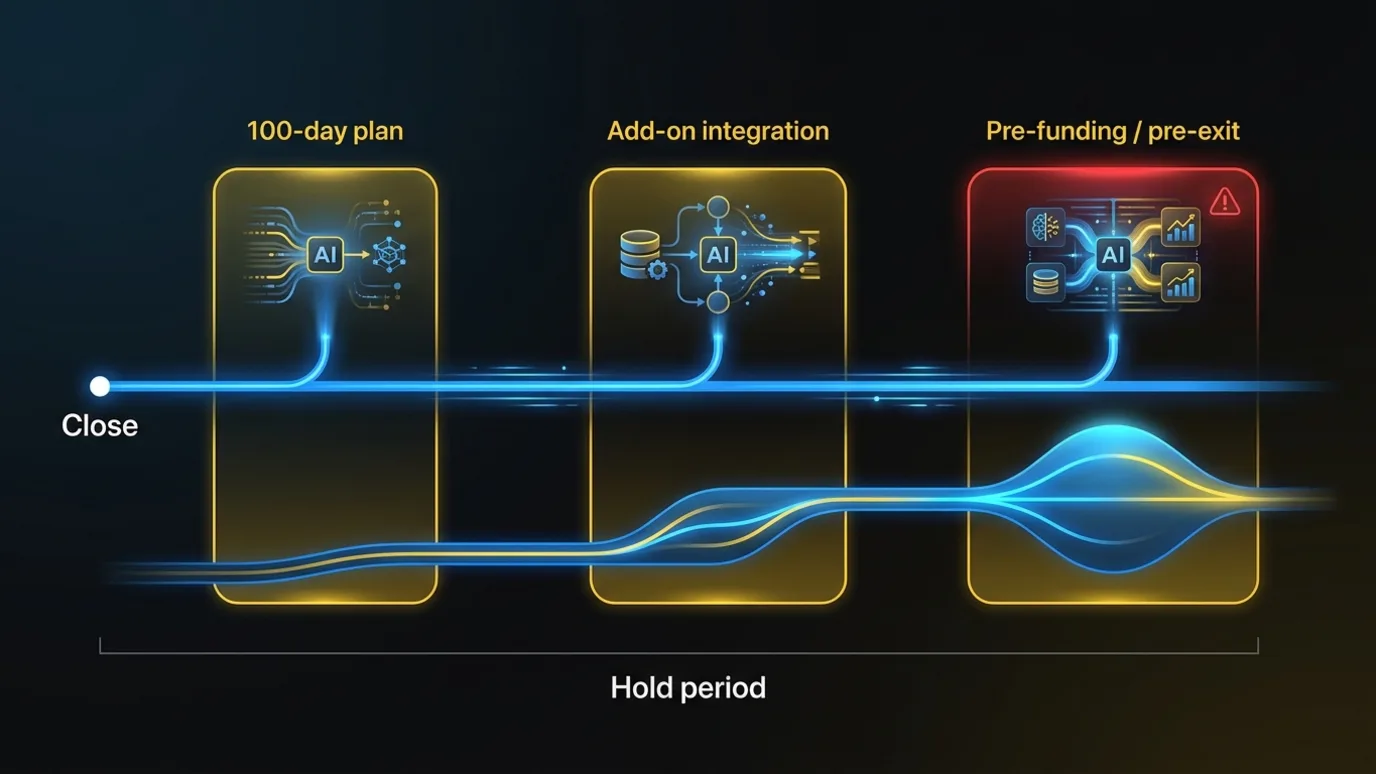
Post-close 100-day plans. Management expects change in the first 100 days after an acquisition, and that’s when the value creation plan gets set. A fixed-scope AI project on one high-value operating problem fits that window. It produces a visible result early in the hold period and gives the board evidence of operating improvement instead of a technology roadmap.
Add-on integration. Buy-and-build strategies create integration problems AI can help with: reconciling product catalogues, mapping customer records across systems, standardizing pricing logic that lives in different spreadsheets at each acquired company. These are well-bounded, high-value problems with a clear owner.
Pre-funding or pre-exit. For growth-stage portfolio companies, a production AI system that measurably improves margins or throughput beats an AI strategy deck. Buyers and later-stage investors increasingly ask what’s actually running.
What does a portfolio board want to see?
A board doesn’t need a vision for AI. It needs to know which operating metric moved, what it cost, who owns the system, and whether it’ll keep working after the vendor leaves. Set up the engagement so those four questions have clear answers from day one. We go deeper on scoping a first project around them in prove AI value on one problem.
What does a good AI execution partner look like?
A good partner ships to production, leaves the client owning everything, uses senior people and stays out of your client relationship. If you’re putting your reputation behind someone else’s delivery, be demanding. These are the criteria we’d use in your seat.
The client owns the code and the system. Ownership, not a licence to use it. That covers code, prompts, configuration, evaluation sets and documentation, in the client’s repositories and cloud accounts. If the partnership ends, the system keeps running and another team can pick it up. Ask to see the contract language.
It doesn’t poach your relationship. The partner should agree in writing on how client relationships are handled. That includes no pitching of unrelated work without your involvement, and no positioning as the client’s strategic advisor when that’s your role. Ask how they’ve handled this with other partners.
It ships to production. Ask how many of their projects are running in production with real users today, and what a typical path from kickoff to production looks like. A partner whose portfolio is mostly prototypes will hand you the stall problem described above.
Senior people do the work. Mid-market clients often get junior teams. You need senior engineers who can sit with operators, understand the business logic and make sound architecture decisions without three layers of review.
It works with the client’s people. Good AI systems in mid-market companies make the existing team more effective. A partner who pitches headcount reduction as the headline benefit will create resistance you’ll have to manage. See AI that amplifies teams for how that plays out on the ground.
Governance is handled up front. For Canadian clients, privacy assessments, data residency decisions and Québec’s French-language requirements belong in the design, not in a cleanup task later. We covered the specifics in AI in Canada: governance, bilingual delivery and data residency.
Each engagement leaves something reusable. The client should come out with more than one working system. Look for reusable workflows, documented operational context, governance artifacts and an integration layer that makes the next project faster. That’s what turns a one-off project into a program. More on this in what an AI engagement should leave behind.
There’s a clear entry point. The best test of a partner is a fixed-scope project: one or two specific problems, a defined deliverable, a clear decision point at the end. If they can’t scope it that tightly, they probably can’t deliver it that tightly either.
Can AI projects for Canadian clients qualify for R&D tax credits?
Often, yes. Building a production AI system frequently involves real technological uncertainty, and some of that work can qualify for SR&ED (Scientific Research and Experimental Development) tax credits. Whether a given project qualifies depends on the work, and it needs documentation captured as the work happens.
Typical sources of uncertainty include getting a model to handle messy, domain-specific data reliably, or integrating with legacy systems in ways that haven’t been done before. When the work qualifies, the credits can offset a meaningful share of development cost. That changes the economics of the first project and the business case you take to the CEO or the investment committee.
Contractor work has its own rules. This breakdown of SR&ED for outsourced development explains how claims work when an outside team does the build. We also cover where AI projects and SR&ED overlap in this guide.
An execution partner that understands SR&ED and documents qualifying work from day one gives you a better financial case for the client. For accounting and advisory firms that already handle a client’s tax position, it’s also a natural bridge between your existing services and the AI work.
Where should an advisor start?
Start with one client or portfolio company where you’ve already done the diagnosis. You know the problem, you know who owns it and you know what a good outcome is worth. That’s the best possible starting point for a first project, and it’s where your context does the most work.
Then pick the partnership model. Referral if you want to stay advisory, co-delivery if you want to stay in the work, white-label if you want to build a service line. Put the relationship terms in writing before the client meeting.
Frequently Asked Questions
Do consultants need their own developers to offer AI implementation?
No. Most advisory firms partner with an execution team through a referral, co-delivery or white-label model. The advisor keeps the diagnosis and the client relationship, and the partner handles engineering, infrastructure and production deployment.
Who should own the code when an outside partner builds an AI system?
The client. Code, prompts, configuration, evaluation sets and documentation should live in the client’s own repositories and cloud accounts, so the system keeps running if the partnership ends.
When should a PE firm start an AI project at a new portfolio company?
The post-close 100-day plan is the strongest window. A fixed-scope project on one high-value operating problem shows the board a measurable result early in the hold period.
Partnering with Chrono Innovation
Chrono Innovation works with advisors, accounting firms, fractional executives and investors who need production AI execution behind their recommendations. We’re a Canadian team covering strategy, engineering, infrastructure, adoption and SR&ED economics, with senior people on every engagement and delivery in English and French. Clients own their systems and code, and we work under whichever partnership model suits you. If you have a client or portfolio company with a problem that needs building, talk to us about partnering.